
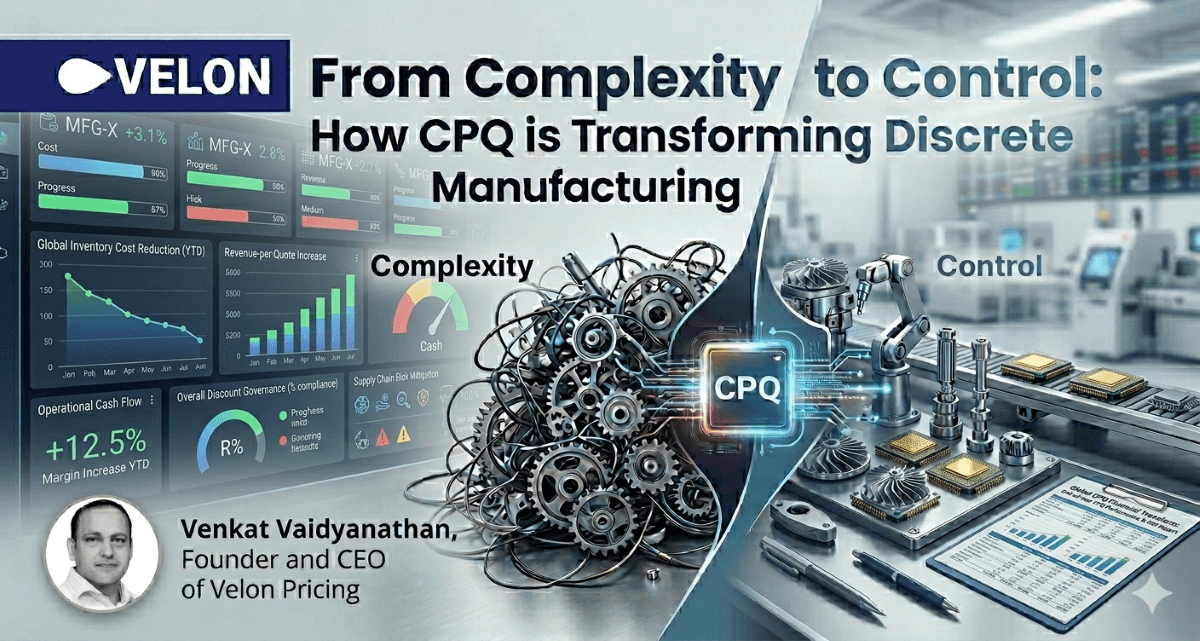
From Complexity to Control: How CPQ is Transforming Discrete Manufacturing
There is a moment that every sales leader in discrete manufacturing knows intimately. A promising deal is on the table. The client is engaged. The requirement is clear. And then the quoting process begins, and everything slows to a crawl.
A sales representative spends three days building the quote. She pulls figures from a pricing spreadsheet last updated six months ago, cross-references a product catalogue she is not entirely sure is current, and emails the engineering team twice for validation. By the time the quote lands in the client’s inbox, a competitor has often already responded. The business is now on the back foot. The deal may still be won, but typically at a lower margin, with less confidence in the numbers and more internal effort required to deliver it.
That story is not unusual. In discrete manufacturing, it is practically the default.
In this article, I’ll discuss why investing in a well-designed CPQ platform, where configuration, cost and pricing are evaluated together in a unified system like Velon®, could be one of the most profitable strategic decisions your discrete manufacturing business makes this year.
How Discrete Manufacturers Can Retain Control with CPQ – The Key Takeaways
Discrete manufacturers are losing margin, deals and time because quoting and pricing processes have not kept pace with the increasing complexity of products and their associated configurations. Configure, Price, Quote (CPQ) technology solves this by embedding configuration, pricing and commercial logic directly into the sales process.
When implemented well, with configuration, cost and pricing evaluated together in a unified CPQ system, the results are measurable and significant:
- ✅ Quote cycle times drop from days to minutes
- ✅ Margin improvements of five to ten percent are consistently achieved
- ✅ Sales, operations and finance teams finally work from the same commercial truth
- ✅ Businesses move from reactive, inconsistent quoting to controlled execution at scale
Read on to discover the full benefits of CPQ to your business. 7 minute read.
But first, let’s consider why your company really needs it and why you may continue leaving money on the table without it.
The Commercial Reality That Nobody Talks About Loudly Enough
Discrete manufacturing businesses operate in one of the most commercially demanding environments imaginable. Think about what is actually at play every single day:
- Thousands of possible product configurations
- Engineered-to-order and configure-to-order models
- Customer-specific pricing agreements negotiated over years
- Multi-region sales teams, distributor networks, and partner channels
On paper, pricing and quoting in this environment should follow structured, repeatable processes. In practice, they almost never do. Most organisations are still relying on;
- Excel-based pricing
- Manual quote construction
- Rep-driven discount decisions, and:
- A collection of disconnected systems that were never designed to talk to one another.
The result is predictable:
- Slow quotes
- Inconsistent pricing
- Margin leakage that nobody can quite quantify, and;
- A commercial operation that is reactive by nature rather than strategic by design.
This is not a minor inefficiency. It is a systemic problem. And the longer it goes unaddressed, the more it compounds.
Why Incremental Fixes to Manual Quoting Stop Working
Most organisations do not leap straight from spreadsheets to transformation. They try something in the middle first. Better templates. More approval layers. A revised price list issued quarterly. Tighter controls on who can discount and by how much.
And for a while, those measures help at the margins. But they share a common flaw: they are not built for scale or growing complexity.
As product combinations multiply and customer expectations evolve, something quietly breaks down. Sales teams start spending more time navigating internal processes than they do selling. Pricing decisions become inconsistent across regions and channels. Exceptions become the everyday norm rather than the edge case. Governance turns reactive.
At that point, pricing is no longer a strategic capability. It has become a situational improvisation. And that is precisely where Configure, Price, Quote (CPQ) technology enters the conversation.
What CPQ Does Well
A well-implemented CPQ system is not simply a faster way to build quotes. It fundamentally changes how a business controls commercial execution. Here is what it solves:
- Structuring product complexity. A properly configured CPQ engine guides sales teams through product configuration using validated logic. It eliminates technically impossible combinations, reduces manual errors, and removes the need for engineering sign-off on routine or repeatable configurations.
- Evaluating pricing as part of the configuration and quoting process. Rather than being handled after the quote is built, pricing is evaluated in real time within the CPQ workflow. Customer-specific rules, volume tiers, and margin guardrails become part of the system, not an afterthought managed via email.
- Compressing quote cycle times. What once took days can take minutes. That speed matters enormously in competitive sales environments where the first credible quote often wins.
- Enforcing commercial governance. Controlled discount thresholds, approval workflows for exceptions, and consistent execution across every team and channel replace the patchwork of informal rules that tend to develop organically in growing organisations.
In short, CPQ transforms quoting from a manual, variable task into a controlled and scalable commercial process. The real challenge, however, is not just managing configuration, but handling the interdependencies between configuration, cost and pricing in real time.
How CPQ Supports Operations Teams Too
Here is something finance and operations leaders often do not hear enough: CPQ is not just a commercial tool. It has a profound impact on operational efficiency, and the benefits flow further downstream than most people initially expect.
The problems created by a poorly governed quoting process rarely start with the quote itself. They often start when an order arrives on the manufacturing shop floor that nobody in production was prepared for. A sales team promised a configuration or lead time that operations simply cannot deliver. The resulting scramble costs time, money, and trust.
When CPQ is configured well, it closes that gap systematically. During the quoting process itself, the system can validate equipment feasibility and production capacity in real time. Only genuinely achievable offers reach the customer. That single discipline alone removes a significant source of friction between commercial and operational teams.
Earlier in the sales cycle, CPQ can surface detailed raw material breakdowns, giving procurement the lead time it needs for accurate planning rather than last-minute reactive purchasing.
The downstream benefits continue once a quote converts to an order:
- Bills of Materials (BOMs), routing data and production plans are generated automatically, reducing the risk of errors at handover
- Computer-Aided Design (CAD) integration reduces dependency on engineering resources for routine or repeatable quote validations, freeing specialist time for genuinely complex work
- Carbon footprint measurement for configured products supports ESG compliance and corporate reporting goals without creating a separate manual process
The result is a quoting process that does not just serve the customer-facing side of the business. It gives operations the visibility, accuracy and lead time to deliver on what has been promised.
Why So Many CPQ Implementations Fall Short
Given all that potential, it is worth asking an honest question: why do so many CPQ projects still underdeliver?
The answer is almost always found in one or more of the following patterns:
- The implementation focused heavily on configuration logic and failed to properly handle the interdependencies between configuration, cost and pricing
- The system was too complex to maintain without heavy IT involvement, so it was never fully adopted
- The CPQ tool reflected an idealised version of commercial behaviour rather than how the business operates
- Integration with ERP, CRM and pricing data sources was incomplete, creating new disconnections alongside old ones
- The rollout took so long and required so many compromises that the business lost confidence before the benefits arrived
A CPQ system that exists but is not genuinely adopted does not deliver commercial impact. It becomes expensive shelfware. The difference between a successful implementation and an unsuccessful one often comes down to whether commercial logic was designed as a unified system or introduced in disconnected layers.
What Good Quoting Technology Looks Like with Velon
Oelon has been built specifically to address the real-world challenges of discrete manufacturing, not just the theory of CPQ. That distinction matters more than it might first appear. Many CPQ platforms are built by technologists who understand software.
Velon is built by experts in CPQ and commercial systems, and that difference shows up everywhere in how the product actually works.
Here is what sets Velon apart:
1. Built by Experts in Commercial and CPQ Systems
Velon combines deep CPQ expertise with embedded commercial logic. That means configuration, cost and pricing are evaluated together from the outset. It is central to the entire architecture, from the first rule to the final quote.
2. Handles Extreme Product Complexity
Most CPQ tools handle catalogues. Velon handles manufacturing reality:
- Attribute-driven configuration supporting thousands of product combinations
- Designed specifically for engineered-to-order and configurable products
- Not constrained by the limitations of simple catalogue-based models
3. Configuration, cost and pricing are evaluated together within the quoting process
This is arguably the most important distinction of all. With Velon:
- Multiple pricing strategies can operate simultaneously within the same system
- Customer-specific pricing is built in, not managed via workarounds
- Real-time margin visibility is available at the moment of quoting, not discovered afterwards
- Pricing holds at the point of sale, consistently, every time
4. Built for Speed and Genuine Adoption
A CPQ system that nobody uses is just expensive shelfware. Velon is built to be used:
- Low-code implementation means deployment is measured in weeks, not months
- The interface is intuitive enough for sales teams to adopt without significant re-training
- Speed of rollout translates directly into faster time to commercial impact
5. Designed as a Commercial System of Record
Fragmented tools create fragmented decisions. Velon replaces that fragmentation with unified control:
- Centralised commercial logic across the entire business
- Consistent execution across every team, region and channel
- Full visibility into every pricing decision made, by whom, and when
6. Built to Handle Complexity Across Every Sales Channel
Commercial consistency cannot stop at the direct sales team. Velon extends structured configuration and pricing logic across the entire sales network, whether that means internal teams, distributors, or partner channels. Every channel quotes from the same logic. Every quote reflects the same governance. Visibility and control do not disappear the moment a quote leaves the building.
The business impact, when CPQ is implemented this way, is measurable:
- Margin improvements of five to ten percent are consistently achieved by organisations that make the transition
- Quote cycle times compress dramatically, often from days to minutes
- Win rates improve when faster, more accurate responses align with how buyers actually make decisions
- Commercial consistency improves across every team and channel
- Sales productivity rises when representatives are freed from administrative complexity
But beyond any individual metric, something more fundamental shifts. Organisations move from reactive quoting to controlled commercial execution. Commercial decision-making becomes something the business actively manages rather than something that simply happens to it.
The bottom line is this. Discrete manufacturing is only getting more complex. More configurations, more customisation, faster customer expectations. Trying to manage that complexity with spreadsheets and manual processes is no longer commercially viable.
The Bigger ‘Why CPQ?’ Picture for Business Leaders
For a Chief Financial Officer, the conversation around CPQ is ultimately a conversation about margin visibility and governance. If commercial decisions are being made inconsistently across a distributed sales team, and those decisions are not visible in aggregate until the quarterly close, the business is flying partially blind on one of its most important commercial levers.
For a Chief Revenue Officer or Sales Director, CPQ is an accelerator. Removing the administrative burden from the quoting process gives selling time back to the people whose job it is to sell.
For a Chief Operating Officer or Operations Director, the connection between CPQ and production readiness is direct and measurable. Fewer order surprises. Better procurement planning. Cleaner handovers from sale to fulfilment.
And for a Chief Executive Officer, the strategic argument is straightforward. Discrete manufacturing is only getting more complex. More configurations, more customisation, faster customer expectations.
CPQ is not just about generating quotes. It is about controlling how configuration, pricing and commercial decisions are executed at scale. And the difference between average manufacturers and leading ones will not be whether they have CPQ. It will be how effectively they use it to manage the full commercial process, from configuration through to pricing and execution, and ultimately win the deals that matter. Talk to one of Velon’s CPQ experts today to see how a well-designed CPQ platform can transform quoting into a strategic advantage.
Frequently Asked Questions on How CPQ Software Can Transform Your Company’s Quoting from Complexity to Control
How long does a CPQ implementation typically take, and how disruptive is it to the business during rollout?
+
Implementation timelines vary considerably depending on product complexity, the number of pricing rules, and how well-structured the existing data is. Modern CPQ platforms built on low-code architecture can often reach a usable state in a matter of weeks rather than months, though full rollout across channels and regions typically takes longer. The disruption is greatest during the data preparation and integration phase, not the deployment phase itself.
How does CPQ interact with an existing ERP system, and does the business need to replace its ERP to benefit?
+
CPQ is designed to sit alongside an ERP, not replace it. The ERP remains the system of record for inventory, production, and finance. CPQ connects to it to draw on live data during the quoting process and to pass structured order information through at the point of conversion.
Can CPQ handle pricing for distributor and partner channels differently from direct sales?
+
Yes, and this is one of its most commercially valuable capabilities. A well-configured CPQ system applies channel-specific pricing rules, discount structures, and approval thresholds depending on whether the quote is being built by a direct sales representative, a distributor, or a reseller partner. This ensures pricing consistency and margin governance across the entire go-to-market model.
What data does a business need to have in order before starting a CPQ implementation?
+
The most important inputs are a clean product catalogue with well-defined attributes, documented pricing rules and customer agreement structures, and clear alignment between the sales and operations teams on what is actually feasible to configure and deliver. The implementation process often surfaces gaps in this data, and addressing those gaps early in the project significantly improves the outcome.
That said, many companies feel they must have a perfect data set across their entire product or customer portfolio to begin. Starting small, one problem at a time and continually reiterating and improving gradually can often lead to the best long-term results.
How do you measure the return on investment from CPQ?
+
The clearest indicators are reduction in average quote cycle time, improvement in gross margin per order, reduction in order errors and fulfilment exceptions, and sales team productivity measured by time spent on active selling versus administrative tasks. Businesses that instrument these metrics before and after implementation consistently find the investment case straightforward to make in retrospect.