
B2B Pricing in Excel: How to Stop Losing the Profit Battle
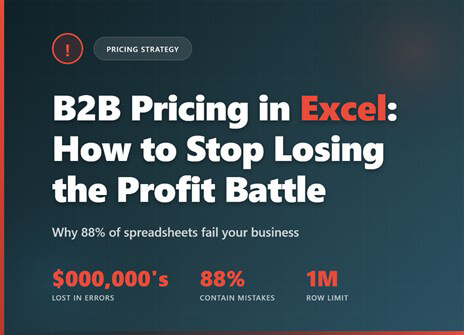
Imagine you sit at the head of a successful team steering your finance, sales, marketing, or product team members through the choppy waters of B2B markets. Pricing decisions shape your profits, fuel efficiency, and sharpen your competitive edge. Yet countless leaders cling to Excel like an old friend, unaware it quietly sabotages their bottom line.
Picture this: as a finance leader, you pore over rows of data, confident in a pricing model that promises healthy margins. One misplaced decimal, and boom, millions vanish. Real-world blunders prove Excel’s fragility in high-stakes B2B pricing.
In 2003, TransAlta Corporation, a major Canadian power generator, suffered a $24 million hit from a simple copy-and-paste error in an Excel spreadsheet during contract bids. Two years later, Kodak overstated earnings by $9 million to $11 million due to a spreadsheet typo that inflated financial reports. Continuing the horror stories, JP Morgan Chase lost $6 billion in 2012 partly because faulty copy-paste operations in Excel spreadsheets underestimated risk exposure in complex models.
Studies confirm the pattern. Research by Professor Ray Panko shows 88% of spreadsheets harbour significant errors, leaving just one in ten reliable for critical decisions. In B2B pricing, where vast datasets drive deals, these flaws amplify. A minor slip turns a £1,000 accrual into a £1,000,000 liability, eroding profits and trust.
Human error thrives in manual processes, no matter the expertise. Pricing teams juggle customer data, market trends, and costs; Excel amplifies risks with version chaos and formula quirks. Businesses lose efficiency as staff chase accuracy over strategy.
Excel tempts with familiarity and zero upfront cost, but it drags down business agility and invites disaster. This article reveals why savvy leaders ditch spreadsheets for robust pricing software tools like Velon® that deliver precision, speed, and growth.
Forget Excel – How to Win the B2B Pricing Battle
Ditch the spreadsheet shackles.
Embrace purpose-built pricing software solutions.
- ✅ Pricing software platforms unify data from all sources, wield AI for predictive insights, and test strategies at speed.
- ✅ Finance leaders optimise margins scientifically; sales pros quote confidently.
- ✅ Imagine real-time elasticity models revealing optimal prices per customer. Anomalies pop up instantly. Collaboration thrives across teams.
- ✅ Experience profit uplift post-adoption.
- ✅ Efficiency surges as manual work drops.
- ✅ Agility lets you pivot on market shifts.
- ✅ Subtly, the best tools embed AI to forecast demand, segment precisely, and simulate scenarios Excel dreams of. No more pedalling against the pack; you lead the race.
Read on for the full deep dive into the perils of sticking with Excel and how pricing software can unlock business advantages.
Why Excel Fails Mid-Level and Enterprise Pricing Needs
Excel shines for quick tasks, but B2B pricing demands enterprise-scale power. Leaders chase profit optimisation and efficiency; spreadsheets deliver neither.
Excel Cost Traps Beyond the Sticker Price
Everyone praises Excel’s free allure. “It’s cheap, quick, and universal,” they say. Yet true cost efficiency spans total ownership, productivity gains, and ROI.
Think of Excel like a fast-food joint. You grab a bargain burger, but rigid menus limit choices. No swapping chips for onion rings; extra sauce costs more. Initial savings evaporate as teams waste hours on manual tweaks.
Pricing involves dynamic variables: competitor prices, customer segments, volume discounts. Excel forces rigid formulas, stifling optimisation and the results speak for themselves;
- Finance leaders see margins slip 5-15% without advanced analytics, per industry benchmarks.
- Manual updates burn 20-30% more time than integrated tools.
- Hidden errors cost enterprises 1-2% of revenue annually.
Robust pricing software, by contrast, automates scenarios, revealing profit leaks instantly and;
- Scalable software boosts ROI through faster deal cycles.
- Sales leaders gain edge; deals close quicker with data-backed quotes.
Efficiency Killers in Data Chaos
B2B pricing craves agility. Markets shift; competitors pounce. Excel hampers with scattered files across folders, drives, and even countries.
Teams email versions, breeding inconsistency. One person’s logic baffles another. New hires rebuild from scratch. Consolidation? Copy-paste marathons invite exactly the type of TransAlta-style disasters discussed above.
Large files slow to a crawl beyond a million rows. Historical data? Shoved aside, forgotten. No anomaly alerts: blind spots persist.
Marketing and product managers suffer too. Without unified views, campaigns misalign with viable prices. Efficiency plummets as switches between CRM, ERP, and Excel multiply tasks.
Pricing software centralises data, automates workflows, and flags issues in real-time. It allows teams to focus on strategy, not survival.
Scalability Struggles for Growing Companies & Enterprises
Mid-level and enterprise companies devour data for smart pricing. Excel can choke and stall on those kinds of data volume levels
Excel caps at one million rows, inadequate for years of customer history or global segments. Siloed from BI systems, it demands constant toggling and pasting errors.
Security lags. Non-IT teams handle files sans backups or encryption. Disaster strikes; recovery fails. Compliance risks soar in regulated sectors.
Interoperability falters. Excel ignores your Salesforce or SAP, fragmenting insights. Product managers cannot simulate bundles seamlessly.
Quality pricing software scales infinitely, integrates natively, and fortifies security. It grows with your business, turning data floods into profit rivers.
Pricing Software: The Path to Pricing Victory
Break free from spreadsheet chains. Adopt purpose-built pricing software solutions designed for modern business demands.
These platforms pull data from every corner of your business, harness AI for sharp predictive insights, and run strategy tests in moments. Finance leaders can fine-tune margins with scientific precision. Sales teams deliver quotes with unshakeable confidence.
Picture real-time price elasticity models that pinpoint the sweet spot for each customer. Anomalies flash warnings instantly. Teams collaborate seamlessly across finance, sales, marketing, and product.
Companies that make the switch to pricing software report 15-30% profit boosts after adoption. Efficiency skyrockets as manual pricing tasks plummet by 50%. Agility empowers swift pivots when markets turn.
Quality pricing software tools like Velon® weave in AI to predict demand, carve precise customer segments, and simulate countless scenarios beyond Excel’s wildest reach. Like trading a rusty bicycle for a sleek race car, you surge ahead of the pack.
Key Benefits of Modern Pricing Tools
Switching unlocks a range of mid-level and enterprise-level company advantages:
- Precision Profits: AI-driven analytics spot optimisation gaps, lifting margins without guesswork.
- Next-level Efficiency: Automate workflows; reclaim hours for high-value tasks.
- Agile Scaling: Handle petabytes of data, integrate seamlessly, secure robustly.
- Team Empowerment: Unified dashboards align finance, sales, marketing, product.
- Risk Reduction: Built-in audits eliminate 88% error pitfalls.
Leaders who adopt gain competitive moats. Company profits climb and organisation-wide efficiency soars. Talk to us today to find out how.
Frequently Asked Questions
Why is Excel bad for B2B pricing?
+
Excel wasn’t designed for enterprise pricing management. The main issues are high error rates (88% of spreadsheets contain significant errors), version control nightmares, lack of integration with other business systems, limited scalability, no automated workflows, and absence of proper audit trails. For strategic pricing decisions involving millions, these limitations create unacceptable risks.
How much do Excel pricing errors typically cost?
+
Documented cases include TransAlta’s $24 million loss, Kodak’s $9 million error, and JP Morgan’s $6 billion mistake. Beyond these dramatic examples, most businesses experience ongoing losses through revenue leakage, margin erosion, and inefficient processes that compound over time that will typical equate to around 3-5% of sales or 30-40% of profit.
What should I look for in pricing software?
+
Key features include a centralised data repository, automated workflows, seamless integration with CRM/ERP/financial systems, intelligent alerts for anomalies, robust scenario testing, unlimited scalability for historical data, proper security and audit trails, and AI-powered analytics for pattern recognition and optimisation.
How long does it take to see ROI?
+
Most organisations see positive returns within 3 to 4 months. Quick wins come from reduced errors, time savings from automation, and improved pricing accuracy. Longer-term benefits include better strategic decisions, improved margins, and competitive advantages that compound over time. Research from 7Sages shows that companies typically achieve margin improvements of 100 to 500 basis points, which for a £300 million company translates to £3 to £15 million in additional operating profit. For example, pricing software investments typically deliver 30x ROI within 12 months, with first value signs appearing within weeks.
Will my team resist moving away from Excel?
+
Initial resistance is common as defined in the classic change curve. However, most teams quickly appreciate the benefits: no version control headaches, automated integration, real-time collaboration, and focusing on strategic work rather than spreadsheet maintenance. The key is proper training, clear communication, and involving team members in the selection process.
Can't we just be more careful with Excel?
+
Better processes can reduce errors, but you can’t eliminate fundamental limitations: manual data entry creates opportunities for mistakes, copy-paste remains risky, version control requires constant vigilance, integration needs manual bridging, and scalability is capped. The question isn’t whether you can be more careful, but whether relying on carefulness is acceptable risk management for such a critical business function.
What's the first step to moving away from Excel?
+
Start by documenting your current processes and pain points. Calculate hidden costs: time on manual tasks, errors that occurred, opportunities missed, and team frustration. Define what success looks like. With this foundation, evaluate pricing software against your specific needs. Many vendors offer pilots or proof-of-concept programmes to test solutions with your actual data before requiring any commitment.