
How CPQ & BOM Software Improves Your Manufacturing Margins
Consider a furniture manufacturer for a moment. They make thousands of chairs, each one assembled from a frame, a cushion, four bolts, and a length of fabric. A customer requests a custom configuration: different fabric, a reinforced frame, and an adjusted cushion depth. In a world of manual processes, that request triggers a chain of emails between sales, engineering, and procurement before anyone can confirm a price or delivery date. By the time a quote reaches the customer, the margin assumptions are already out of date.
Now picture the same scenario with bill of materials (BOM) software in place. The sales team configures the product, the system validates it against engineering rules, generates a complete costed BOM automatically, and produces an accurate, branded quote – in minutes. The margin is protected, the specification is correct, and the customer has an answer before a competitor has even been contacted.
That is the operational power of CPQ and BOM automation provided by quality vendors like Velon®, and for Operations Managers in mid-level and manufacturing businesses, it is increasingly becoming the difference between reactive chaos and confident control. And with the increase in operational efficiencies, your manufacturing margins will take a boost too. How? Read on.
What is CPQ, and How is it Related to Your BOM?
Configure, Price, Quote (CPQ) software is the engine that sits between customer requirements and commercial output. It captures what a customer needs, applies configuration and engineering rules, and produces a validated quote – complete with pricing, product definition, and a dynamically generated bill of materials.
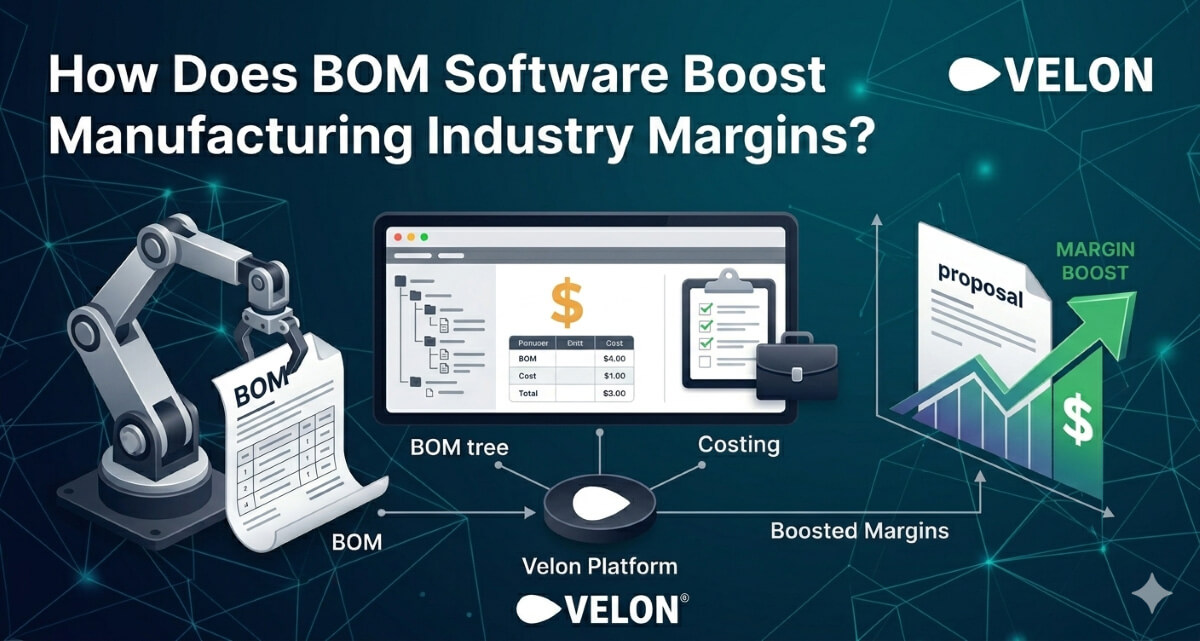
A bill of materials is the master recipe of any manufactured product. It lists every component, sub-assembly, raw material, quantity, and specification required to build a finished good. For complex products, this can mean hundreds of line items arranged in a hierarchical structure, what practitioners call a BOM tree.
Traditionally, configuration, costing, and quoting were handled as separate steps. Sales would capture requirements, engineering would validate them, procurement would cost them, and finance would apply pricing – each handoff introducing delay, error, and margin risk. As any Operations Manager will tell you, by the time a quote was produced, it had passed through too many hands and too many spreadsheets to be fully trusted.
The consequences are predictable: incomplete product definitions requiring late-stage engineering review; cost roll-ups based on stale supplier data eroding margins invisibly; rework costs eating into production budgets; and delayed responses to customer requests that should have been straightforward.
In the Manufacturing in 2030 Survey by the Manufacturing Leadership Council, 70% of manufacturers were still entering BOM data manually and 68% of them still use spreadsheets for data analysis. That is a significant portion of the industry absorbing entirely preventable risk – and losing competitive ground in the process. of the industry absorbing entirely preventable risk – and losing competitive ground in the process.
How CPQ and BOM Software Actually Boosts Margins
Good CPQ software, particularly when integrated for BOM management and with an ERP, transforms a fragmented quoting process into a single, controlled workflow. Here is how that translates to real margin improvement;
- Validated configuration at the point of sale – When customer requirements are captured inside a CPQ system, engineering rules are applied automatically. Only valid, buildable configurations proceed to quote – eliminating the late-stage rejections and redesigns that quietly consume engineering time and erode project margins before production has even begun.
- Dynamic BOM generation at the point of quote – Rather than waiting for engineering to manually produce a specification, CPQ generates a complete, costed bill of materials automatically from the configured product. Every quote rests on a validated product definition and a known cost base, not an estimate. This transforms the quote from a sales document into a manufacturable specification, removing the costly ambiguity that typically sits between sales and engineering.
- A critical distinction: internal versus customer-facing BOMs – The internal BOM used for costing, procurement, and production is often far more detailed than what a customer needs to see. Leading platforms manage this separation cleanly, generating a simplified customer-facing BOM alongside the full internal version – both derived from the same underlying configuration logic – ensuring consistency without exposing unnecessary complexity.
- Elimination of manual errors – BOM software maintains a single authoritative source of component data, updated in real time. There is no second version, no “just to be safe” copy sitting on someone’s desktop. Cost forecasts reflect reality, not a partially corrected spreadsheet from three weeks ago – and every quote sent is one the business can stand behind.
- Real-time scenario modelling – Manufacturers can simulate the margin impact of cost changes before committing to new prices – whether that is an 8% rise in steel or a supplier substitution. When BOM data is clean, connected, and feeding directly into the CPQ process, these become routine analytical tasks rather than expensive consultancy exercises.
The Collaboration Dividend – Aligning Your Departments
Beyond the direct margin impact, CPQ and BOM automation deliver something harder to put a number on: alignment. Engineering, procurement, finance, and production all work from the same data. Configuration changes propagate automatically. Revision histories are maintained and auditable. Role-based workflows clarify accountability and reduce the back-and-forth that slows decisions and frustrates customers.
For Operations Managers managing multi-site or multi-product environments, this consistency is transformative. For Finance Leaders, the improved traceability supports both compliance and more confident budgeting. And for sales teams, the ability to produce accurate, validated quotes quickly is a competitive advantage in itself.
Modern pricing-infused quotation software like Velon® is purpose-built to integrate with manufacturing data, connecting component-level cost intelligence directly to pricing strategy, margin analysis, and commercial decision-making – closing the loop between what is sold and what is built.
The BOM software market was valued at approximately $1.5 billion in 2024 and is projected to exceed $3.2 billion by 2033. Machine learning and AI are beginning to add predictive capabilities, flagging configuration risks and cost pressures before they materialise and enabling smarter, rules-driven quoting at scale.
For manufacturers weighing the investment, the question is not really whether CPQ Software and BOM automation pays for itself. The question is how much margin you can afford to miss out on while you wait. Contact one of our friendly experts to get started with automating your Bills of Materials today.
Frequently Asked Questions on CPQ and Bill of Materials Automation
Can CPQ software help with supplier substitution decisions?
+
Yes. When component data is current and connected to cost roll-ups, finance and procurement teams can model the cost impact of switching suppliers or substituting materials before making a commitment, reducing the risk of margin surprises.
Does CPQ or BOM automation require a full ERP replacement to work?
+
Many CPQ and BOM automation solutions integrate with existing ERP or MRP systems, extending their value rather than replacing them.
How does BOM automation support compliance and audit readiness?
+
Automated BOM systems log every revision with a date stamp and user record, creating a complete audit trail. In the event of a product recall or quality investigation, manufacturers can trace affected components, batches, and suppliers quickly and accurately, reducing both risk and response time.