
How CPQ Helps Manufacturers Manage Raw Material Cost Volatility
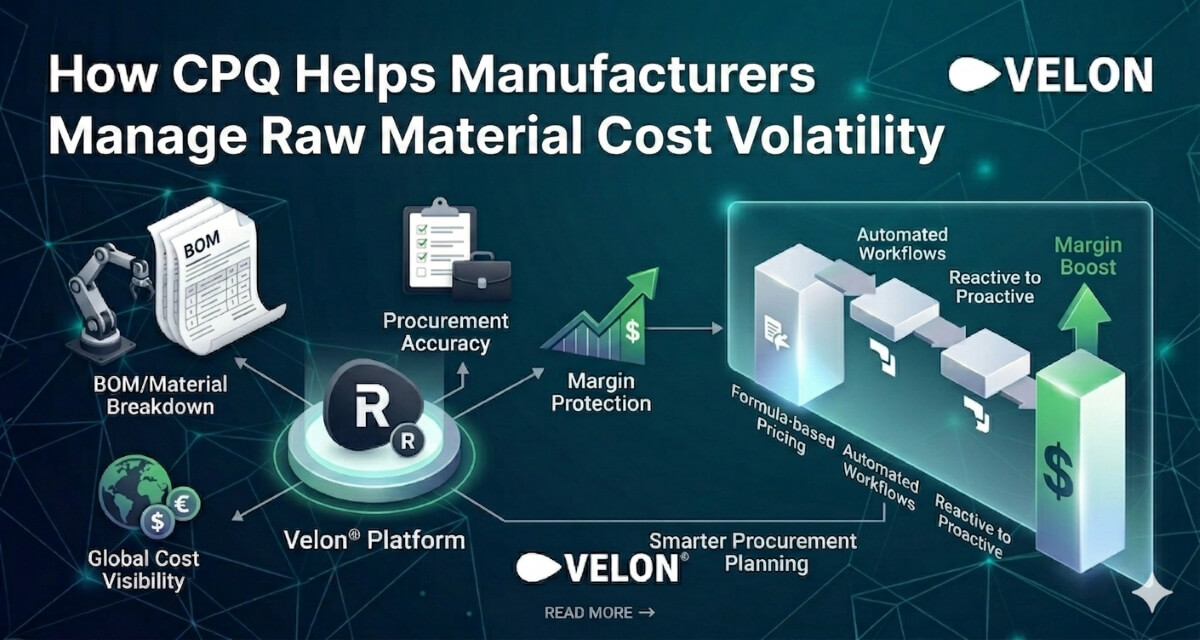
There is something quietly remarkable about the way a great manufacturing business operates – and it starts long before a finished product leaves the warehouse. It starts with how your team prices, quotes and connects procurement data to customer-facing decisions. For Operations and Finance Managers in mid-size and enterprise manufacturing businesses, those types of business efficiencies make up a huge component of whether margin is won or lost
Let’s quickly dive into the most common mistakes that many manufacturing companies make before we analyse how a fully pricing embedded CPQ quotation software solution like Velon® battles market volatilities to calculate and itemise material requirements for procurement and planning accuracy.
The Raw Materials Volatility Challenges Manufacturers Face Every Day
The problems are familiar, even if their costs are not always visible. Consider these everyday examples:
A mid-sized plastics manufacturer sources resin, colourants, packaging and fixings from multiple suppliers. Each has their own price list, revision schedule and lead times. Every time raw material costs shift, someone manually re-keys new figures into a spreadsheet, cross-references the bill of materials and hopes nothing has been missed. Multiply that across dozens of product lines and quarterly commodity reviews, and the hours lost are staggering – and the margin errors become inevitable.
Or consider a building materials manufacturer producing composite cladding panels. Timber prices spike on Monday following a supply chain disruption. The procurement team knows immediately. But on Tuesday morning, the sales team is still quoting Friday’s prices – because the pricing system has not caught up. That single day of lag can cost tens of thousands in absorbed costs that should have been passed on.
These are not edge cases. They are the everyday reality for manufacturers who have not yet connected their quotation and pricing functions into a single, live system for volatility management.
How Pricing Embedded CPQ Changes the Game of Raw Material Cost Management
Synchronising raw materials in manufacturing is not simply about buying cheaper inputs. It is about building a system where cost visibility, procurement accuracy and sales pricing are all connected and moving together in real time in a symphony of cost management.
The most immediate gain is time – that most paradoxical of resources, simultaneously every Operations Manager’s scarcest commodity and greatest ally.
A pricing update process that once consumed days or weeks – manual spreadsheet work, cross-referencing bills of materials, chasing supplier confirmations – can be completed in hours.
For a Finance Leader, that speed translates directly into live margin visibility rather than unpleasant surprises at month end. Beyond speed, the financial benefits compound:
- Complete cost breakdown visibility covering purchasing, transport and storage so every cost driver behind a finished product is fully accounted for
- Real-time tracking of raw material price movements, enabling proactive pricing adjustments rather than reactive damage control
- Formula and index-based price calculations that update automatically when commodity prices shift, eliminating manual spreadsheet re-keying entirely
- Smarter procurement planning that analyses production demand against current inventory levels, preventing overstocking and avoiding costly production stoppages caused by material shortages
- Automated approval workflows that ensure every vendor cost update is verified and accurate before it flows through to your resale pricing
Critically, those synchronised raw material breakdowns do not sit in isolation. Every quote generated through your combined CPQ and pricing system simultaneously draws on the same up-to-date material cost data, so your sales team is always quoting from accurate, current foundations rather than figures that were correct last month as quickly as possible.
The goal is simple: your procurement costs and your customer-facing prices must always be in sync. Any gap between the two is a margin leak.
From Reactive to Proactive: The Efficiency Dividend
There is a less tangible but equally real benefit worth naming: what great raw material cost management does for your team’s working life.
When cost updates stemming from market volatilities are automated and pricing flows from a connected system rather than a patchwork of spreadsheets, your Operations Manager gains responsiveness. Your Finance Leader gains clarity. And your sales team gains confidence – because every quote they send reflects the true cost of production from the moment it is generated, protecting margin at the precise point where revenue is won or lost.
Quality pricing-infused CPQ software like Velon® is designed precisely to bridge this gap between procurement and sales, ensuring the entire supply chain – from raw material purchase through to final product pricing – is fully synchronised and always current.
When raw material costs rise, as they inevitably will, your team should be able to act immediately. Live pricing alerts and updated prices mean cost increases reach your customers promptly rather than quietly eroding your margins in the background.
The manufacturers who thrive in volatile markets are not the ones with the lowest raw material costs. Talk to us today to become one of those B2B manufacturers with the clearest, fastest and most connected view of those costs at every moment.
Frequently Asked Questions on How CPQ Helps Manufacturers Manage Raw Material Cost Volatility
Can CPQ software handle multiple currencies and international suppliers?
+
Yes. Modern pricing embedded CPQ software is built to manage multi-currency supplier price lists and international supply chains within a single connected platform.
What happens to our existing supplier contracts and pricing agreements during CPQ implementation?
+
Established supplier contracts and pricing conditions can typically be imported and mapped directly into your new CPQ system, preserving existing agreements whilst adding the automation layer on top.
How does CPQ software help during periods of supply chain disruption?
+
By providing real-time visibility into material availability, cost trends and supplier performance, the software allows procurement and finance teams to make faster, better-informed decisions when supply chains come under pressure.