
Managing Economic Uncertainty: 5 Ways Pricing Software Helps
You’re sat at your desk, spreadsheet open, coffee going cold, and somewhere between cell D47 and F203, you suddenly realise something rather profound. The economic landscape has shifted beneath your feet whilst you’ve been manually updating price lists. Again – and it’s for the third time this month.
Sound familiar?
Here’s the thing about economic uncertainty. It doesn’t send you a polite email in advance. It simply arrives, unannounced and uninvited, and when it does, your ability to respond quickly and intelligently to pricing pressures becomes the difference between thriving and merely surviving.
We’ve all witnessed the headlines. Record inflation, supply chain disruptions, spiralling energy costs, and the ever-present spectre of recession. Coming out of the global pandemic and navigating through geopolitical tensions, doing business has transformed from a calculated exercise into something resembling extreme sport.
But here’s where the story gets interesting.
Rather than surrendering to turbulent economic waters, forward-thinking finance, sales, marketing and product managers are discovering something remarkable. The right pricing approach, powered by modern software, doesn’t just help you weather the storm. It helps you dance in the rain.
Now, I know what you’re thinking. You’ve been managing perfectly well with Excel or your enterprise resource planning system. These tools have served you faithfully for years. But here’s the uncomfortable truth: when economic conditions change by the hour rather than by the quarter, traditional tools become anchors rather than lifeboats.
At Velon®, we help companies just like yours transform pricing from these uncertainty hiccups into a sphere of competitive advantage. As a specialist vendor in modern AI-powered pricing software, we see the pattern time and time again: businesses start with Excel because it feels familiar and free. However, as complexity and economic volatility takes full toll mounts – with rising costs, labour shortages and fluctuating delivery charges – that once-reliable spreadsheet simply cannot keep pace with the rate of change.
Let us take you through five ways pricing software transforms economic uncertainty from a threat into an opportunity.
How Pricing Software Helps Manage Economic Uncertainty – 5 Key Ways
When you strip away all the complexity and noise, maintaining profitability boils down to five essential strategies:
- ✅ Responding Rapidly with Agile Pricing to Reduce Risk
- ✅ Taking Initiative, Maintaining Transparency and Emphasising Value
- ✅ Implementing Targeted Price Changes Across Customer and Product Segmentations
- ✅ Preventing Margin Erosion
- ✅ Closing the Gaps in Your Discount, Rebate and Promotional Spending
To dive deeper, read on for in-depth analysis of the 5 key ways that modern pricing software transforms what can sometimes feel like uncontrollable volatility into competitive advantages for your business.
1. Responding Rapidly with Agile Pricing to Reduce Risk
In stable economic climates, companies review their prices at a leisurely pace. Monthly. Quarterly. Perhaps annually. But recessions, tariffs and inflationary forces demand a different tempo entirely.
Think about it this way. Your costs are changing. Your competitors’ prices are fluctuating. Customer demand is shifting like sand beneath your feet. Pricing decisions made last month might already be obsolete.
Here’s where traditional spreadsheet approaches crack under pressure. You need capability to refine your pricing strategy promptly, with transparency into your macroeconomic environment and deep insight into your own data. Sometimes you need to generate new prices at a customer-item level on a weekly or even daily basis.
Take an average B2B manufacturing company. Their price list update process may take up to two months. By implementing modern pricing software, they can reduce that cycle to hours rather than weeks. For smaller companies or less complex enterprises, it might even be minutes. That’s faster than most people’s lunch break.
This transformation delivers immediate benefits:
- Eliminating up to two months of potential margin leakage
- Enabling rapid response to cost fluctuations
- Maintaining profitability during volatile market conditions
- Freeing pricing teams from manual spreadsheet work
With pricing software, your team can monitor approved price levels, notify customers of changes promptly, and track results in near real-time.
Pricing software transforms what was once a laborious manual process into an automated, strategic capability.
2. Taking Initiative, Maintaining Transparency and Emphasising Value
Let’s address the elephant in the room. Nobody enjoys raising prices. It’s uncomfortable, risks damaging customer relationships, and invites difficult conversations.
But here’s the truth: proactive pricing is the most powerful lever you can pull to mitigate downward pressure on margins. And when approached correctly, it can strengthen customer relationships.
The secret lies in communication and transparency.
Your customers aren’t naive. They read the same headlines you do. They expect to pay higher prices when the economy is under inflationary pressure. What damages trust is opacity and surprises.
Pricing software provides transparency that transforms potentially contentious price increases into understood business necessities. When you can show customers exactly how and why your prices are changing, backed by data and market context, you transform the conversation from confrontation to collaboration.
Effective communication strategies include:
- Explaining cost drivers clearly and honestly
- Providing advance notice of price changes
- Sharing inventory status and availability dates
- Building automated contract clauses for cost-driven increases
- Focusing messaging on the value you deliver, not just costs
Many B2B companies operate through long-term contracts governed by volume commitments. But contracts signed twelve months ago couldn’t possibly account for dramatic cost increases. Modern configure-price-quote (CPQ) software allows you to build automated clauses that accommodate cost-driven increases before they become crisis points.
Beyond communicating about price increases, focus relentlessly on value. Remember, pricing isn’t purely about covering costs. It’s about perceived value. If your express delivery service helps customers maintain their own business relationships, communicate clearly that fuel cost increases and driver shortages necessitate price adjustments to sustain that valuable service.
3. Implementing Targeted Price Changes Across Customer and Product Segmentations
Here’s where pricing becomes more art than science, more chess than Candy Crush.
Not all customers are created equal. Not all products face the same market dynamics. In times of economic flux, using pricing software to identify different segments where cost changes impact most critically becomes essential.
Product Segmentation Considerations:
- Products difficult to source or limited in supply can absorb price increases more easily
- Components representing small percentages of finished product prices meet less resistance
- Even small incremental increases add substantially to your bottom line when applied strategically
Customer Segmentation Factors:
- Highly competitive clients in price-sensitive markets require careful cost allocation
- Regional variations in cost impacts demand localised pricing strategies
- Different customer segments have varying capacities to absorb price changes
This is where data becomes your most valuable asset. Having accurate, real-time internal data (sales history, costs, projections) combined with external data (customer demand, competitor prices, channel partner information) provides the holistic market view you need.
Fully integrated pricing software brings these essential datasets together for specialised analysis. It helps you understand exactly how much revenue each transaction generates and precisely where money leaks away. The right data decreases risk by revealing profit and margin opportunities whilst helping you identify cost mitigation strategies.
4. Preventing Profit Erosion (Margin Leakage)
Margins are like water in a bucket with small holes. Left unattended, they slowly drain away until you’re left wondering where all your profitability disappeared.
Economic uncertainty creates additional holes, and protecting against margin leakage becomes critical to survival.
Common Sources of Margin Leakage:
- Unrecovered costs in service, delivery or processing
- Orders below profitable minimum quantities
- Extended gaps between order fulfilment and payment receipt
- Unenforced pricing rules and exceptions
- Manual processes that miss cost changes
The solution? Define them. Track them. Recover them.
Understanding Your Pricing Waterfall
Here is where the concept of a pricing waterfall becomes absolutely essential. Think of it as a cascading view of your revenue, starting from your list price at the top and flowing down through every discount, rebate, allowance, and cost until you reach your actual pocket profit at the bottom.
The pricing waterfall reveals exactly where your money goes. Every promotional discount, every volume rebate, every early payment incentive, every freight cost appears as a distinct step in the cascade. Without tracking as many metrics as you can systematically throughout the revenue build up and cost breakdown, you are essentially navigating in the dark. You might know your list price and final margin, but the journey between the two remains frustratingly opaque.
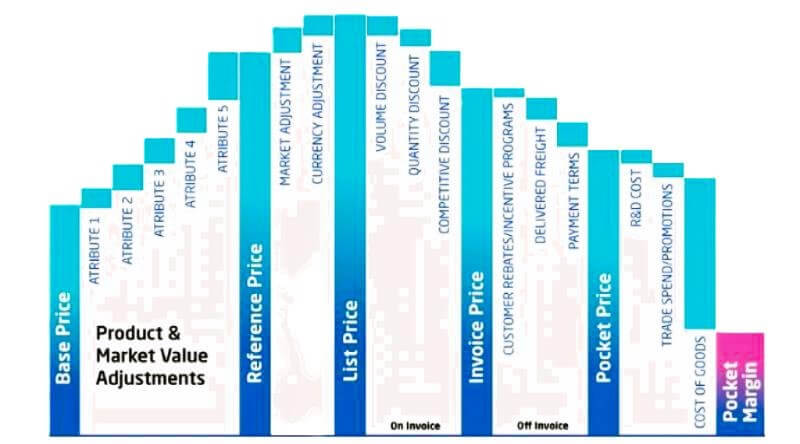
Modern pricing software makes your entire waterfall visible, letting you track dozens of metrics across both revenue build-up and cost breakdown. You can see precisely which elements contribute most to margin erosion and where intervention delivers the greatest impact.
Setting minimum order quantities and establishing them as rules in your system also ensures production and processing costs don’t erode profits on smaller orders. Some business simply isn’t profitable below certain volume thresholds, and pricing software helps you enforce those consistently.
Improving your invoicing processes through automation shortens the gap between order fulfilment and payment receipt, improving cash flow and reducing carrying costs.
Pricing software identifies these leaks systematically rather than leaving you to discover them accidentally, usually after they’ve already cost you considerably.
5. Closing the Gaps in Your Discount, Rebate and Promotional Spending
Economic uncertainty demands a critical, somewhat ruthless audit of your discounting practices. Every discount, every rebate, every promotion should justify its existence through measurable return.
Areas to Audit:
- On-invoice discounts (promotional allowances, volume discounts, discretionary discounts)
- Off-invoice deals (buying group rebates, payment term costs)
- Promotional programmes that no longer deliver ROI
- Automatic discounts that have become embedded in pricing
But here’s the important caveat: don’t throw the baby out with the bathwater. Discounting isn’t inherently evil. Sometimes it’s strategically necessary.
One particularly effective transformation involves converting discounts into rebate programmes wherever possible. This approach delivers key advantages:
- Swaps risk onto customer performance targets
- Protects margins upfront rather than eroding them immediately
- Ensures customers earn incentives through beneficial behaviours
- Maintains customer relationships without sacrificing profitability
When economic conditions eventually improve, and they always do, you can reintroduce more generous discounting as rewards for customer loyalty, knowing the immediate threat to margins has passed.
Pricing software makes this sophisticated discount and rebate management not just possible but practical, giving you control and visibility to optimise every element of your pricing waterfall.
Moving Beyond Excel: Why Now Is the Time
If you’ve made it this far, you might be thinking: “This all sounds marvellous, but I’ve been managing with Excel for years. Why change now?”
Excel is brilliant. So are enterprise resource planning systems and business intelligence platforms. They’ve served businesses faithfully for decades. But these tools were designed for a different era, one where economic conditions changed gradually and predictably.
Today’s environment demands something different. When costs can change overnight, when competitors adjust prices by the hour, you need tools built specifically for speed, agility and sophisticated analysis.
Why Pricing Software Outperforms Traditional Tools
- Automated updates versus manual spreadsheet work
- Real-time data integration versus periodic exports
- Sophisticated segmentation analysis versus basic pivot tables
- Built-in margin protection versus manual monitoring
- Systematic discount optimisation versus ad hoc decisions
Pricing software doesn’t replace your other business systems.
It augments them, bringing specialised capabilities that general-purpose tools simply cannot match.
Moreover, economic uncertainty creates the perfect catalyst for transformation.
When you’re already forced to rethink your pricing approach, that’s precisely when implementing better tools makes most strategic sense. You’re not disrupting stable processes. You’re building better processes to handle disruption.
The businesses that emerge strongest from periods of economic uncertainty aren’t those that hunker down and wait for storms to pass. They’re the ones that use turbulence as an opportunity to build capabilities that serve them long after calm returns.
How to Navigate the Volatility Storm
You now understand five ways that pricing software transforms economic uncertainty from a threat into an opportunity. Speed, communication, segmentation, margin protection and discount optimisation combine to maintain profitability even when market conditions seem determined to undermine it.
If you’re still relying on spreadsheets and manual processes, start by acknowledging their limitations honestly. Begin exploring modern pricing software options with the same rigour you’d apply to any strategic investment.
If you already use some pricing tools but they’re not delivering results, audit their capabilities against the five pillars we’ve discussed. Where are the gaps? What’s costing you money?
And if you’re ready to implement comprehensive pricing software, choose a solution that scales with your business. Look for platforms that integrate seamlessly with existing systems, provide real-time data and analytics, and adapt as market conditions evolve.
Economic uncertainty isn’t going away. It’s become the new normal, and businesses that thrive treat pricing as a strategic capability rather than an administrative task.
Because here’s the final truth: economic uncertainty creates winners and losers, but the deciding factor isn’t luck. It’s preparation, capability and the willingness to embrace better ways of working. We look forward to discussing it with you today.
Frequently Asked Questions About Managing Economic Uncertainty with Pricing Software
How quickly can pricing software deliver ROI during economic uncertainty?
+
Many businesses report measurable improvements within 6 to 8 weeks, while a 30x ROI is generally possible within 12 months. ROI typically comes from multiple sources:
- Reduced margin leakage from faster price updates
- Optimised discounting and rebate programmes
- Better segmentation leading to improved pricing decisions
- Recovered costs previously lost to manual processes
- Time savings freeing teams for strategic work
During high economic volatility, ROI often accelerates because the software’s capabilities become immediately critical rather than merely helpful.
How does pricing software help during both inflationary and deflationary economic periods?
+
Pricing software provides value in any economic condition because it’s fundamentally about making better, faster pricing decisions backed by data:
- During inflation: Captures cost increases quickly and communicates them effectively
- During deflation: Identifies which price decreases stimulate volume without unnecessarily sacrificing margin
- During recession: Reveals which customer segments are most price-sensitive
- During growth: Optimises pricing to maximise revenue opportunities
The analytics capabilities remain valuable regardless of which direction economic pressures are pushing your prices.
How do we get our team to adopt new pricing software after years of using familiar tools?
+
Successful adoption requires a thoughtful approach:
- Involve key team members in the selection process to build ownership
- Highlight specific pain points the new software solves (manual data entry, time-consuming analysis)
- Implement in phases if possible, allowing teams to build confidence gradually
- Provide comprehensive training tailored to different user roles
- Celebrate early successes publicly to build momentum
- Communicate clearly about why the change is necessary
Quick wins demonstrated early in the implementation help convince sceptics and accelerate adoption across the organisation.
Is pricing software only for large enterprises or can mid-sized businesses benefit too?
+
Modern pricing software has evolved to serve businesses of virtually any size. Consider these points:
- Many providers offer scalable solutions with pricing tiers appropriate for mid-sized businesses
- Mid-sized companies often see proportionally greater benefits due to moving from more deeply ingrained manual processes
- Fewer legacy systems in mid-sized firms can mean less implementation complexity
- The key is choosing a solution that matches your current scale whilst providing room to grow
Enterprise organisations were early adopters, but the technology has democratised significantly in recent years. Velon® has built a pricing software tool specifically designed by pricing experts for small and mid-sized business who have all the problems that come with large enterprises but not always the resources to be able to manage them.
What's the biggest mistake companies make when implementing pricing software?
+
The most common mistake is treating pricing software as purely a technical implementation rather than a strategic transformation. Successful implementations require:
- Rethinking pricing processes and governance structures alongside technology
- Establishing clear ownership and accountability for pricing decisions
- Providing comprehensive training beyond just software functionality
- Committing to ongoing optimisation rather than “set it and forget it”
- Aligning organisational culture with data-driven pricing approaches
Companies that simply install the software without addressing these factors typically see disappointing results. The software is an enabler, but organisational change is what ultimately drives results.