
Pricing Rethought: From Admin Work to B2B Growth Accelerator
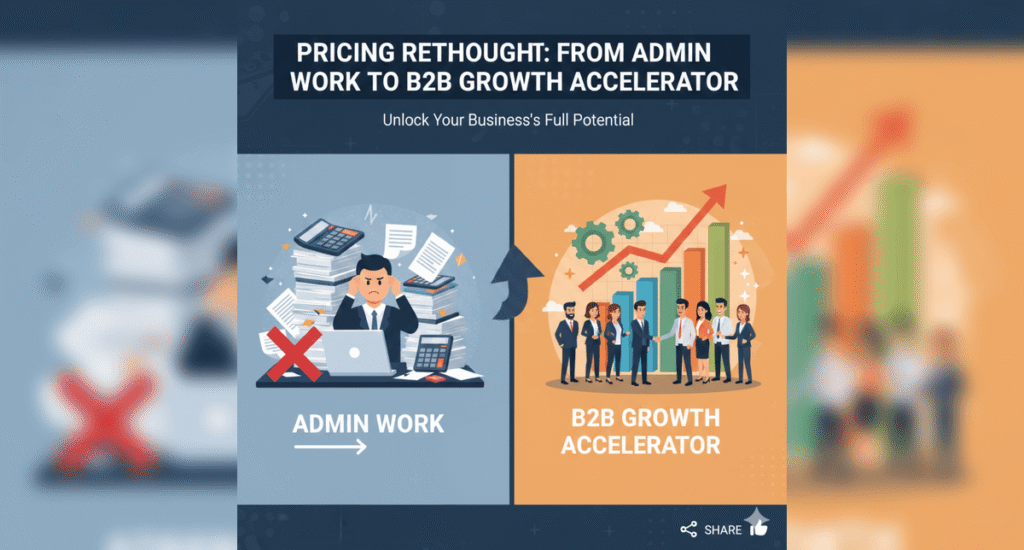
Picture this: Your team (whether its Finance, Sales, Marketing or Product Management – whoever manages your pricing) spends Monday through Thursday buried in spreadsheets, hunting down numbers from six different systems, checking formulas that break whenever someone sneezes near them, and manually updating price lists that were probably outdated before they even hit send. Come Friday, they finally get around to what they were hired to do: strategic thinking about how to grow the business and protect margins.
Sound familiar? If you’re nodding your head right now, you’re not alone. And here’s the thing: this isn’t just an inconvenience. It’s quietly draining millions from your bottom line while your best opportunities slip through the cracks.
Now imagine a different story. One where pricing isn’t something that happens to your business, but something your business actively shapes and refines. Where every price point reflects real strategy, not just cost plus margin. Where your team spots opportunities before competitors do and moves on them with confidence. This isn’t fantasy. It’s what happens when organisations stop treating pricing as a perfunctory task to be completed and start treating it as what it really is: your most powerful profit-building strategy.
The transformation doesn’t require magic. Allow us to explain that it is merely a fundamental shift in how you think about, approach, and execute pricing across your entire organisation, and how quality AI-powered pricing software like Velon® helps to bring it to fruition.
The Hidden Cost of Treating Pricing Like Paperwork
The wins of realising pricing as a B2B price accelerator are backed by solid research. When McKinsey studied the impact of pricing improvements back in 2003, they discovered something remarkable: a mere 1% improvement in price realisation could boost operating profits by as much as 8-11%. That’s not a typo. Eight to eleven percent improvement from a one percent price shift.
Now, you might be thinking that was over twenty years ago. Surely things have changed. They have, but not in the way you might expect. Markets move faster now. Customer expectations shift overnight. Your competitors can adjust prices with the click of a button while your team is still waiting for approval chains that snake through three departments and two continents.
NOW: The impact and need for pricing software is now more immediate than ever.
Research from 7 Sages Pricing tells us that businesses implementing specialised pricing approaches typically see margin improvements of 1000 basis points or returns on sales between 1% and 5%. Let’s make that real for a moment.
If your company turns over £300 million annually, we’re talking about an additional £3 to £15 million in operating profit just from getting your pricing strategy and execution right.
That’s not small change. That’s the difference between a good year and an exceptional one. That’s the budget for your next major initiative or the cushion that helps you weather the next market storm.
Why Excel Isn’t Your Enemy (But It’s Not Your Future Either)
Now, before you think we’re about to tell you to throw away every spreadsheet in sight, let’s be clear: Excel and similar business information systems have their place. They’re familiar. They’re flexible. They don’t require a big upfront investment. For many businesses just starting to think seriously about pricing, they’re a perfectly reasonable starting point.
But here’s where the story gets interesting. Excel was designed as a calculation tool, not as a pricing management platform. It’s like using a hammer when what you really need is a complete toolkit. Sure, you can hammer in those screws, but wouldn’t a screwdriver work better?
The problems start creeping in as you scale:
- Your formulas become more complex and more fragile with each passing quarter
- Version control turns into a nightmare when six people need to work with the same data
- Error rates climb because humans are, well, human
- Integration with your ERP and CRM systems requires manual exports and imports that eat up hours every single week
- Analysis that should take minutes takes days because someone must collect and clean the data first
Why a Current Excel Pricing Approach Has a Ceiling
Imagine working in a global B2B company with £300 million in turnover. They have excellent data: detailed transaction histories, competitive intelligence, manufacturing costs, the works.
Now imagine using spreadsheets to manage it all.
When a request for proposal comes in, it could take over a month just to gather and analyse the information needed to respond. A month! By the time the answer is ready, the opportunity will have moved on, or the market has shifted again.
After implementing AI-informed and powered pricing software, that response time comes down to days or even hours. Not weeks. Days. Win rates improve. Margins become healthier. The team will stop dreading RFPs and begin to see them as opportunities instead of administrative black holes.
The Six Ways Pricing Software Transforms Your Business
Modern AI-powered pricing software shifts the game from administrative burden to genuine growth accelerator. Here’s how:
1. Data Becomes Your Decision-Making Superpower
You’re sitting on mountains of data: transaction histories, customer behaviour, market trends, competitive movements, cost structures. The challenge isn’t getting data anymore. It’s turning that data into decisions that move the needle.
AI-powered pricing software automates collection, cleaning, and analysis. It visualises trends that would take weeks to spot manually and flags opportunities in real time. Your team stops being data janitors and starts being strategic advisors.
2. Value-Based Pricing Stops Being Theoretical
Most organisations know they should price based on customer value rather than cost plus margin. The question is how to do that across different segments, product lines, and geographies.
Software makes the theoretical practical by enabling you to:
- Segment customers based on actual value perception and willingness to pay
- Apply different strategies to different segments without chaos
- Test and refine based on real results
- Scale sophisticated strategies across your organisation
- Companies making this journey typically add 1% to 5% to return on sales
3. Speed Becomes Your Competitive Advantage
Markets don’t wait for quarterly planning cycles. Costs fluctuate. Competitors move. Customer needs evolve. Every day you delay responding is money left on the table.
B2B manufacturers can struggle with a 90-day cycle to execute price changes. By the time they implemented increases, markets have already shifted, and they were perpetually behind.
Quality pricing software collapses timelines from months to days or hours. You can detect changes, analyse impacts, run simulations, and execute adjustments almost in real time.
4. Errors Disappear and Processes Flow
Manual processes are error prone. When copying numbers between systems, updating formulas in spreadsheets, and managing approvals through email chains, mistakes happen.
Pricing software builds in governance, automates workflows, and becomes your single source of truth. Configure-Price-Quote (CPQ) tools ensure accurate quotes every time. Audit trails show exactly what changed and why.
One pricing mistake on a major contract can cost more than years of software subscriptions.
5. Market Intelligence Gets Embedded in Every Decision
Understanding what customers will pay is the foundation of value-based pricing, but it’s one of the hardest things to quantify. Advanced analytics, including AI and machine learning, can help you:
- Segment customers based on behaviour patterns and value drivers
- Predict churn risk before customers walk
- Quantify willingness to pay through conjoint analysis
- Integrate competitive intelligence directly into pricing decisions
These capabilities used to require specialised consultants and major projects. Now they’re standard features in leading AI-powered pricing platforms.
6. Your Team Finally Has Time to Think
Most teams spend 70% to 80% of their time on data collection, pricing list updates and administration, leaving only 20% to 30% for strategic work. Good pricing software flips that ratio completely.
When systems automatically pull transaction data, update dashboards, flag exceptions, and present insights, your team can focus on questions that matter:
- How should we respond to competitive moves?
- What pricing model would better capture value from our newest product line?
- Which customer segments are most sensitive to recent price adjustments?
That’s the work that moves margins and what becomes possible when you stop treating pricing like an administrative function.
Making the Business Case to Your Leadership Team
If you’re a sales, marketing, product or finance manager reading this and thinking about how pricing can move your organisation forward, you need more than enthusiasm. You need a solid business case that speaks the language of ROI and risk management.
Start with the numbers. Calculate what a 3% improvement in realised prices would mean for your operating profit. For most enterprise businesses, that calculation alone makes the case compelling. Then add in the efficiency gains: reduced time to respond to Request for Proposals (RFPs), faster execution of price changes, elimination of pricing errors, and freed-up team capacity for strategic work.
But also consider the qualitative factors that leadership cares about:
- Improved competitive positioning through faster response times
- Better customer relationships through consistent and defensible pricing
- Reduced compliance risk through better audit trails and governance
- Enhanced ability to scale as the business grows or enters new markets
- Protection against margin erosion in volatile markets
What to Look for When Evaluating Solutions
Not all pricing software is created equal, and the right choice depends on your specific situation. Here are key factors to evaluate:
- Integration capabilities: How well does the solution play with your existing ERP and CRM systems? Seamless integration isn’t optional. It’s fundamental.
- Functionality match: Does the software do what your business needs? Test against your specific use cases, not generic demos.
- Industry experience: Does the vendor understand the unique challenges of your sector? Software built for retail won’t necessarily work for industrial manufacturing or distribution.
- Innovation trajectory: Is this a platform that’s evolving with market needs, particularly in areas like AI and analytics?
- Implementation approach: What’s the realistic timeline to value? Some solutions promise quick wins but deliver slow pain.
- Change management support: Moving from spreadsheets to specialised software is as much a cultural challenge as a technical one. What support does the vendor provide?
- Total cost of ownership: Look beyond subscription fees to implementation costs, maintenance, training, and internal personnel time.
- Self-service capabilities: Can your team make routine changes themselves, or will you need external consultants for every adjustment?
The best approach is to create a weighted scoring system that reflects your priorities, then evaluate each potential solution objectively against those criteria.
Starting Your Journey from Admin Work to Growth Accelerator
The shift from treating pricing as administrative overhead to leveraging it as a growth accelerator doesn’t happen overnight. It’s a journey, and like any journey, it starts with a single step.
For many organisations, that first step is simply acknowledging that the current approach has limits. Excel got you this far, and that’s great. But the market is moving faster, customer expectations are evolving, and competitive pressures are intensifying.
Standing still is falling behind.
The companies that figure this out first will have a significant advantage over those that keep approaching pricing the way they always have. They’ll respond faster to market changes, capture more value from their innovations, protect margins more effectively, and grow more profitably.
The question isn’t whether your organisation will eventually make the shift to using pricing as a profit growth lever and quality pricing software like Velon® as your precision tool. The question is whether you’ll lead the charge or play catch-up. Because make no mistake, this is where the market currently is.
The good news is that you don’t have to figure this out alone. Help is right here.
Frequently Asked Questions on Transforming B2B Pricing
How long does it typically take to implement pricing software?
+
Implementation timelines vary based on company size and complexity, however on average, usually take from 6 to 8 weeks. Velon® Pricing is low-code software, and integrations are lightweight, modular, and fast to deploy – so you can start seeing value in weeks, not months.
What kind of ROI should we expect from pricing software?
+
Research shows that companies typically achieve margin improvements of 100 basis points or 1% to 5% returns on sales. For a £300 million company, that translates to £3 to £20 million in additional operating profit. The 30x ROI period is 12 months for the software investment, and first value signs are usually within weeks.
Will we need to hire additional staff to manage the new system?
+
Actually, the opposite is often true. Pricing software typically frees up 50% to 70% of your team’s time by automating data collection and routine analysis. Most companies redeploy that capacity toward strategic pricing work rather than adding headcount.
How can I handle the change management challenge of moving from Excel?
+
This is a real concern, and it’s why working with experienced pricing consultants can help. They bring change management expertise along with technical know-how. The key is involving your team early, demonstrating quick wins, and providing adequate training and support during the transition.
Can pricing software really respond fast enough for volatile B2B markets?
+
Modern pricing platforms can detect market changes, analyse impacts, run scenarios, and execute price adjustments in days or even hours rather than the weeks or months typical with manual processes. This agility is one of the primary value drivers for companies operating in dynamic markets.
What if our pricing needs are too unique for off-the-shelf software?
+
Leading pricing platforms are designed to be highly configurable rather than one-size-fits-all. They accommodate different industries, business models, pricing strategies, and organisational structures.
How do we know if we're ready for pricing software?
+
If you’re spending more time gathering and analysing data rather than driving decisions using the data, , if price changes take weeks to execute, if you’re losing deals because you can’t respond quickly enough to RFPs, or if you can’t segment and price differently across customer groups, you’re ready. The bigger question is whether you can afford to wait any longer.