
The Benefits vs the Costs of Implementing Pricing Software
A guide for Finance Leaders, Sales Leaders, Marketing and Product Managers, and C-Level Executives
There is a moment in the life of every growing business when the spreadsheet stops being a helpful tool and starts becoming a problem. You know the one. The file that only Janet or Stephen in Finance truly understands. The pricing model that takes two months to update. The margin leak no one can quite locate because the data lives in four different systems and nobody has time to reconcile them all. That moment is the beginning of a conversation about pricing software, and it is a conversation worth having properly.
The question most business leaders ask at the outset is a sensible one: what does it cost? But the more revealing question, the one that tends to reshape the entire conversation, is this: what does it cost your business not to have it? When you hold those two questions side by side, the calculus of pricing software transforms entirely. You stop looking at a line item on a budget and start looking at a strategic investment in a fundamentally better way of working.
At Velon®, we assist our customers to understand the payback they can get from pricing software so that they can track the success of their investment and go forward to get support for the purchase. There are several KPIs (Key Performance Indicators) that pricing improvement projects can move, such as win rates, resources needed to carry out processes, deal cycle times, etc. However, as important as those KPIs are, in this article we will not be touching on those in depth.
This article is not a sales pitch, but an honest, considered look at what quality pricing software delivers, implementation considerations, and why the organisations that treat it as a transformative business decision, rather than simply another software purchase, tend to be the ones that see the most impressive returns.
Why Implementing Pricing software is a Commitment to a Fundamentally Better Way of Running Your Pricing Operation
The investment is real, but so is the cost of doing nothing.
- ✅ Internal implementation costs typically run to 20 to 30 per cent of total expenditure. Plan for them properly from the outset.
- ✅ Quality pricing software can reduce price list recalculation from months to minutes, dramatically cutting margin leakage.
- ✅ Pricing software elevates your team, not replaces them. Within six months, most teams shift from busy work to high-value strategic work.
- ✅ The benefits ripple across Finance, Sales, Procurement, and senior leadership, driving a smarter, more proactive culture.
- ✅ The real question is not whether you can afford pricing software. It is whether you can afford to keep operating without it.
Pricing Software Is Not a Tool. It Drives a New Way of Doing Business.
This is perhaps the most important reframe any executive can make before evaluating a pricing solution. Customers are increasingly recognising that they are not simply purchasing software. They are investing in a transformative new operating model, one that shifts the entire culture of pricing within an organisation from reactive to strategic, from fragmented to unified, from slow to agile.
And yet, not every organisation is ready for that shift. It requires a certain level of digital maturity. It requires a willingness to move beyond cost-plus pricing methods. It requires leadership that genuinely understands both the benefits and the true costs involved after acknowledging that today’s method can be improved. If your organisation has not yet reached that point, that is worth acknowledging honestly, because a pricing software implementation undertaken without the right foundations will underdeliver on its promise.
For those organisations that are ready, however, the results can be remarkable.
The Real Costs of Implementation: What the Numbers Actually Say
Transparency here is essential. Pricing software does carry real implementation costs, and any vendor worth working with will tell you so plainly. Understanding these costs is not a reason to hesitate. It is a reason to plan well.
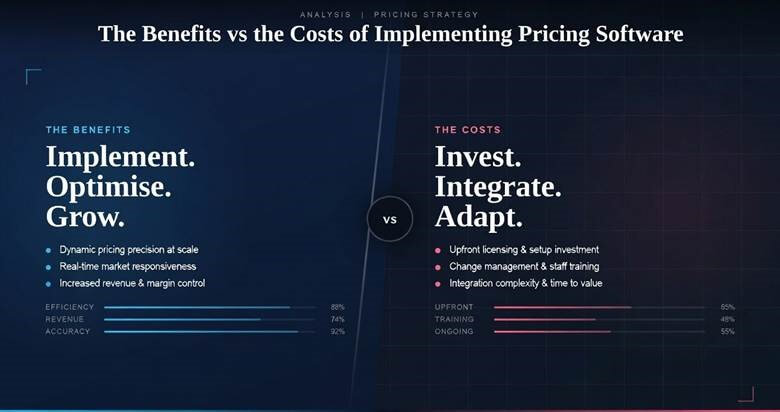
The internal costs of most SaaS implementations, covering the dedication of your own people, their time, their effort, and the change management required to bring the organisation along, typically account for somewhere between 20 and 30 per cent of the total implementation expenditure. That is a meaningful figure, and it deserves careful financial planning from the outset.
Within that, labour costs alone tend to represent approximately 15 to 20 per cent of total spend. Successful implementation requires the genuine involvement of cross-functional teams, including IT, pricing analysts, and sales staff. These are people with existing responsibilities, and their participation in an implementation project will inevitably have some impact on their day-to-day output. Underestimating this is one of the most common mistakes organisations make, and it is one of the most consequential.
Training and change management represent a further 5 to 10 per cent of the investment. These are often treated as ancillary concerns, relegated to the final stages of a project when budget and energy are already stretched. That approach is a false economy. The organisations that invest properly in training their pricing staff, sales representatives, and IT personnel, and that deploy thoughtful change management strategies to reduce resistance and build genuine adoption, are the ones that extract the most value from their investment in the shortest time.
The headline here, then, is not that SaaS pricing software is cheap (and pricing software by its nature is more niche) and for quality results, it comes at a cost.
It is that the cost of implementation, when planned for properly, is very well justified by the power of what it unlocks.
And quality pricing software, built on a robust and flexible platform, is specifically designed to minimise friction during that implementation journey.
The Benefits of Implementing Pricing Software
Now for the other side of the ledger, and it is a compelling one.
Proactive Pricing Rather Than Reactive Firefighting
One of the most powerful capabilities that advanced Ai-assisted pricing software delivers is the ability to simulate the impact of price list changes before they go to market. Rather than committing to a price change and hoping for the best, organisations can model the business consequences of any planned update in advance, accounting for all components of the relevant price waterfall including special price agreements.
This kind of proactive visibility fundamentally changes how pricing decisions get made. It shifts the conversation from execution to strategy, from “when do we do it” to “how much, when, and why.”
From Months to Minutes: Reclaiming Price List Update Time at Scale
For organisations managing tens of thousands of SKUs, the traditional approach to price setting is a slow and costly process. Manual updates executed in Microsoft Excel, reliant on drawn-out approval chains and disconnected data sources, can take months to complete. During that window, margin is leaking. Market conditions are shifting. Competitors are moving.
Advanced AI-assisted pricing software eliminates that lag. Regularly, businesses reduced their price list recalculation time from months to just minutes after implementing a next-generation pricing solution.
That is not a marginal efficiency gain. That is a complete operational transformation.
The benefits of that speed ripple outward immediately:
- Faster responses to raw material and delivery cost fluctuations
- Reduced risk of margin erosion from underpricing
- Reduced revenue loss from overpricing
- Improved visibility into optimal pricing points across the entire product portfolio
No More Wild Goose Chases Across Disconnected Systems
Pricing teams in organisations without dedicated software spend an extraordinary proportion of their time hunting data from multiple disparate systems, reconciling it into something usable, and then starting the whole process again next month. The cycle is exhausting, the visibility it provides is mediocre at best, and the strategic thinking it crowds out is incalculable.
Quality pricing software consolidates that picture. It streamlines price setting, automates the review and collation of information, facilitates collaboration across teams, and surfaces everything in clear dashboards, automatically. The time savings are not incremental. They are transformational.
What Happens to Your Team When the Software Takes Over the Menial Pricing Work?
This is where many organisations have a concern worth addressing directly. Will pricing software replace our team? The answer, clearly and unequivocally, is no. What it does instead is elevate them.
In the early months after implementation, yes, there will be a significant amount of work involved in setting up data inputs, configuring rules, and learning the system properly. That investment of effort pays dividends almost immediately. Once the solution is operational, it handles the heavy lifting automatically, freeing your team from the repetitive, time-consuming tasks that currently dominate their working days.
What they gain in place of their menial manual work is strategic capacity. Typically, within six months of implementation, the nature of a pricing team’s work shifts markedly:
- Before: Tracking down the latest Excel file, manually uploading data to the ERP, reconciling disparate reports
- After: Assessing how a proposed price change affects customer willingness to pay, determining the optimal rebate structure for desired profitability, identifying untapped margin opportunities
The team starts collaborating more meaningfully with Purchasing, to anticipate cost changes and price proactively. With Finance and Marketing, to align pricing decisions with broader strategic goals. With Sales, to help representatives understand deal-level profitability and negotiate more effectively. The value of the pricing function to the business increases substantially, and the organisation becomes more data-driven, more agile, and more commercially intelligent.
The Cultural Ripple Effect Across the Entire Organisation
This is perhaps the most underappreciated benefit of a well-implemented pricing solution, and it is the one that tends to surprise senior leaders the most.
When a pricing team transforms from reactive administrators to proactive strategists, that ethos does not stay contained within the team responsible for the pricing function. It permeates the organisation. Procurement starts leveraging greater agility to anticipate and respond to market changes. Sales gains a clearer understanding of customer behaviour and tailors its approaches accordingly. Finance gains sharper, more reliable insight into margin performance. Senior leadership receives the kind of data-driven intelligence that makes for genuinely informed strategic decisions.
Gradually, a proactive, data-led culture becomes embedded in the company’s DNA. That is a competitive advantage that no spreadsheet can replicate.
So, Can Your Business Afford Not to Use Pricing Software?
It is the question that tends to reframe every budget conversation. Pricing is challenging. It is complex. And getting it consistently right at scale, across thousands of SKUs, multiple markets, and rapidly shifting cost structures, requires technological assistance.
The initial investment in quality pricing software is real. The implementation effort is real. But so is the cost of doing nothing: the margin that leaks through outdated price lists, the revenue lost to suboptimal deals, the strategic opportunity cost of a pricing team buried in spreadsheets, and the competitive disadvantage of being slower to market than your rivals.
When those costs are placed on the scales alongside the benefits, the verdict tends to be clear. Not every organisation is ready today. But for those that are, the question is no longer whether they can afford it. The question is whether they can afford to wait any longer. We look forward to talking with you about getting started today.
Frequently Asked Questions on Getting Started with Pricing Software
How do we get internal buy-in for a pricing software investment?
+
Start with the cost of your current state rather than the promise of the new one. Map out where margin is leaking today, how long your current price update cycles take, and how much of your pricing team’s time goes on administrative work rather than strategic thinking. When those numbers are visible to Finance and senior leadership, the conversation tends to shift quickly. A well-structured business case built around your own operational pain points is almost always more persuasive than a vendor’s projected ROI figures.
What is the single biggest implementation mistake organisations make?
+
Underestimating the human side of the project. The technology itself is rarely what derails a pricing software implementation. It is the failure to invest adequately in change management, communication, and training that causes projects to stall or underdeliver. Your people need to understand not just how to use the new system, but why it exists and what it means for their roles going forward.
How do we choose the right pricing software for our business?
+
Fit matters more than features. A solution that is rich in functionality but poorly matched to your data infrastructure, your team’s capability level, or your industry’s pricing complexity will frustrate rather than accelerate. Prioritise quality AI-assisted pricing software vendors like Velon® that demonstrate genuine understanding of your specific pricing challenges, offer flexible configuration rather than rigid out-of-the-box templates, and can show you relevant case studies from businesses of comparable scale and complexity.
What should we do before we even start evaluating vendors?
+
Get your data house in order. Pricing software is only as powerful as the data it works with. Organisations that go into an implementation with fragmented, inconsistent, or poorly governed product and customer data will find the process slower and more painful than it needs to be. A data readiness assessment before vendor conversations begin will save considerable time and cost later.
Does pricing software work for businesses with highly customised, bespoke or negotiated pricing?
+
Yes, and in many ways, it is precisely where it delivers the most value. Businesses with complex, negotiated deal structures or complex bespoke products often have the greatest exposure to inconsistent pricing, undisciplined discounting, and margin erosion at the deal level. Good pricing software is built to handle that complexity, giving sales teams guardrails and visibility that improve both consistency and profitability without slowing down the commercial process.