
The Definitive Guide to CPQ Software and Why You Need It
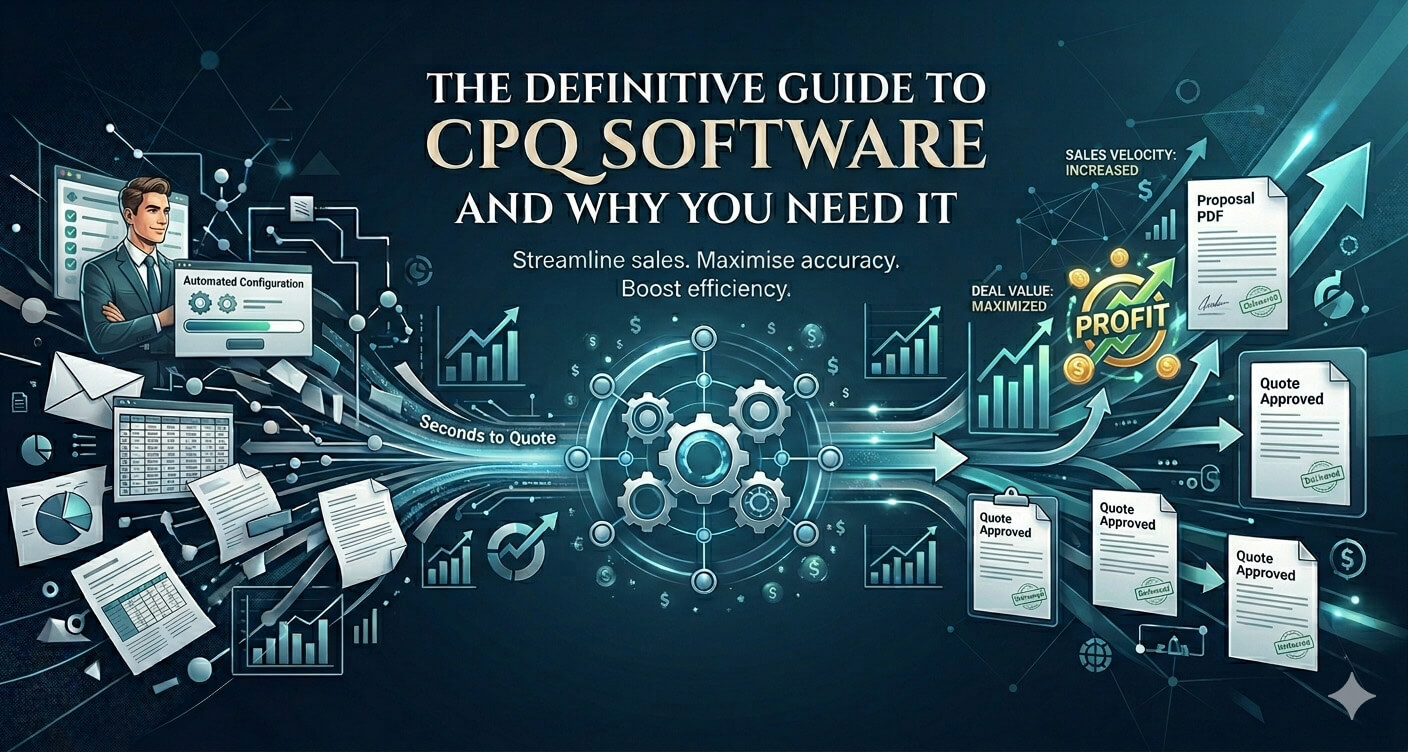
A guide for Sales, Operations, Finance and Commercial Leaders responsible for quoting, pricing and delivering complex products.
In organisations selling configurable or bespoke products, the quoting process rarely fails at the final step. It fails much earlier – and understanding why quoting breaks down in complex businesses begins with recognising the warning signs.
- A salesperson cannot complete a quote without checking multiple spreadsheets
- Product configuration rules are unclear, undocumented or inconsistently applied
- Engineering teams are pulled in to validate routine quotes
- Bills of Materials are created after the quote, not as part of it
- Costs are estimated rather than calculated
- Pricing varies depending on who prepares the quote
Each quote becomes a small project. It takes time, depends on individuals, and introduces risk at every step. More importantly, it creates a disconnect between what is sold and what can actually be delivered. This is where most commercial friction begins. And as product complexity and deal volume increase, the problem does not scale.
This is one of the most widespread and quietly costly operational failures in commercial organisations today, and it is entirely solvable. The solution is CPQ software, and this guide will show you exactly what it is, how it works, and why combining it with intelligent pricing software in a quality standalone set up like Velon® could be one of the most profitable strategic decisions your business makes this year.
What is CPQ and Why Do You Need it?
- CPQ stands for Configure, Price, Quote.
At its core, CPQ Software exists to bring structure to how complex products are defined, costed and quoted.
But in practice, CPQ is not just about generating quotes faster.
It is about ensuring that every quote is:
- Correctly configured
- Fully defined
- Costed accurately
- Priced consistently
- Ready for execution
A well-designed CPQ system sits between your CRM and ERP and acts as the decision layer that connects at the point of quote:
- Product configuration logic
- Cost structures
- Pricing rules
- Commercial workflows
Without CPQ, these elements are fragmented.
With CPQ, they are unified into a single process.
Read on for the details on what CPQ Software can change in practice for your business.
What CPQ Software Changes in Practice for Your Business
CPQ Software replaces a fragmented, manual quoting process with a structured and repeatable one.
Instead of:
- Spreadsheets holding configuration and pricing logic
- Manual validation and engineering dependency
- Costs being estimated after the quote
- Pricing applied inconsistently across deals
CPQ enables:
- Rule-driven product configuration with validated combinations
- Dynamic Bill of Materials (BoMs) generation as part of the quote
- Real-time cost calculation across materials, labour and overhead
- Pricing applied on top of a known and accurate cost base
- A quote that is not just fast, but commercially controlled and operationally ready
When combined with a structured pricing capability, CPQ ensures that quoting is no longer dependent on individuals, but on a system that consistently connects configuration, cost and pricing. In complex environments, this is the difference between quoting faster and quoting correctly.
Breaking Down the C, the P and the Q
The three letters of CPQ each represent a distinct function. Understanding CPQ Software requires looking at each component individually and then seeing how they work together.
C Is for Configure
Configuration is where complexity lives.
In many businesses, products are assembled based on:
- Customer requirements
- Technical compatibility rules
- Material and component dependencies
- Regional or regulatory constraints
Over time, these rules are captured across multiple spreadsheets, documents and individual knowledge.
Consider a building products supplier whose catalogue spans structural timber, insulation, roofing systems, flooring, fixtures and a full range of construction tooling. A customer arrives needing to kit out a residential development of twenty modular homes, requiring both the component materials and the tools to construct them.
Without CPQ, a salesperson is left to manually cross-reference hundreds of product lines, juggle compatibility requirements, apply volume pricing and remember to include the bundled tooling package. With CPQ, the system guides the salesperson through a structured set of questions: number of units, construction method, regional building regulations, preferred material specifications, timeline.
From those answers, it automatically assembles a tailored bundle, combining the right kit home components with the appropriate construction tooling, flagging compatible upgrades, applying the correct volume pricing tier and surfacing a bundled discount that makes the overall package more compelling without eroding margin.
As product ranges grow, so does the volume of parameters that need to be managed:
- Multiple versions of pricing and configuration spreadsheets
- Hundreds or thousands of product attributes and options
- Complex dependencies that are difficult to track or validate
- Changes in one area creating unintended issues elsewhere
What begins as a manageable process quickly becomes difficult to maintain.
- No single source of truth exists.
- Rules are duplicated, outdated or inconsistently applied.
- Only a small number of individuals fully understand how products should be configured.
At this point, configuration is no longer just complex. It becomes dependent on individuals rather than systems.
CPQ introduces a rules-driven configuration process where:
- Sales teams are guided through structured inputs
- Only valid combinations are allowed
- Dependencies and constraints are enforced automatically
This ensures that every quote starts from a valid product definition.
P Is for Price
Pricing is where commercial value leaks most silently.
Pricing is often where complexity becomes most difficult to control.
In many organisations, pricing is not applied to a fixed product. It is applied to a product that changes with every configuration.
As variation increases, pricing becomes significantly harder to manage.
- Each configuration introduces a different cost structure
- Pricing depends on combinations of attributes, not just individual products
- Price lists multiply across customers, regions and channels
- Small configuration changes can have a disproportionate impact on margin
At this point, pricing is no longer a lookup exercise. It becomes a calculation problem.
In practice, most organisations are not equipped to handle this consistently:
- Pricing logic is spread across multiple spreadsheets
- Cost and pricing are not always aligned
- Historical quotes are reused because recalculating pricing is difficult
- Sales teams rely on past quotes or individual judgement
The result is not just inconsistency.
It is a pricing process that is unpredictable, difficult to control, and highly dependent on individuals.
CPQ embeds pricing logic into the quoting process so that:
- Pricing reflects the configured product
- Cost is considered in real time
- Discounting is controlled within defined limits
When combined with a pricing engine, this becomes a pricing corridor, where sales teams operate within a controlled range rather than relying on guesswork.
Q Is for Quote
The quote is the final output, but it is only as good as the inputs behind it.
In complex businesses, a quote is not just a document. It is the point where configuration, cost and pricing come together into a single, commercial decision.
CPQ enables the generation of:
- Accurate, branded proposals tailored to the customer
- Complete product definitions, including configuration details
- Itemised pricing aligned to the configured product
- Clear visibility into cost and margin at the point of quote
More importantly, it ensures that every quote is:
- Based on validated configuration rules
- Supported by a dynamically generated Bill of Materials
- Costed in real time
- Priced consistently within defined parameters
This is also where a critical distinction is managed.
The internal Bill of Materials (BoMs) used for costing, procurement and production is often significantly more detailed than what should be presented to the customer.
CPQ enables a clear separation between:
- A customer-facing BoM, structured for clarity, simplicity and commercial presentation
- An internal BoM, containing the full level of detail required for manufacturing, costing and fulfilment
Both are generated from the same configuration and logic, ensuring consistency without exposing unnecessary complexity.
This changes the role of the quote.
It is no longer just a sales document. It becomes:
- A commercially validated offer
- A controlled customer-facing representation of the product
- A fully defined internal specification for execution
When done correctly, the quote is not revisited, reworked or revalidated after it is sent.
It becomes the foundation for everything that follows.
From Configuration to Cost to Quote: Where Real CPQ Delivers Value
In complex businesses, a quote is not just a price. It is the first fully defined version of what the organisation is committing to design, build and deliver.
Traditional approaches treat configuration, costing and pricing as separate steps. This leads to:
- Incomplete product definitions
- Late-stage validation by engineering
- Cost uncertainty
- Margin risk
CPQ brings these elements together into a single process:
- Customer requirements are captured
- Product configuration rules are applied
- A dynamic Bill of Materials is generated automatically
- Material, labour and overhead costs are calculated in real time
- Pricing is applied on top of a known cost base
- A validated quote is produced
A quote then becomes:
- A manufacturable product definition
- A costed structure
- A commercially sound proposal
This removes ambiguity and significantly reduces friction between sales, engineering and operations.
Extending CPQ Beyond Sales: Enabling Distributors and Partners
In many industries, growth is driven not just by internal sales teams, but by distributors, partners or franchise networks.
In these environments, the challenge is not only quoting speed but maintaining consistency and control across the wider ecosystem.
Without structure, organisations often face:
- Distributors using outdated price lists
- Inconsistent product configurations
- Limited visibility into externally generated quotes
- Margin leakage due to uncontrolled discounting
CPQ extends its value through self-service portals.
These enable distributors and partners to:
- Configure products using the same rules as internal teams
- Generate accurate quotes independently
- Access controlled pricing within defined corridors
- Submit or convert quotes without manual intervention
This creates a scalable commercial model, without increasing internal quoting dependency, where:
- Sales teams are no longer a bottleneck
- Partners operate with speed and confidence
- Pricing and configuration remain fully governed
For franchise or distributor-led businesses, this capability enables growth without loss of control.
How CPQ Supports Operations Teams
For operations teams, quoting is not just a commercial activity. It is the starting point of execution.
When quoting lacks structure, operations experience:
- Incorrect or incomplete BoMs
- Unexpected product variations
- Late procurement decisions
- Production delays
CPQ addresses this by ensuring that:
- BoMs are generated at the point of quote
- Product configurations are validated before reaching production
- Material and cost requirements are visible early
This results in:
- Reduced rework
- Faster production readiness
- Better alignment between sales and delivery
The result removes one of the most persistent issues in complex businesses: the gap between what is sold and what operations receive.
Velon: Bringing CPQ and Pricing Capability Together
A question worth addressing directly is what happens when CPQ and pricing capability are brought together under one consolidated platform as we do at Velon® unlike some vendors that manage them as separate tools. The answer is that the combination delivers something genuinely greater than the sum of its parts.
CPQ brings order, speed and accuracy to the journey from product configuration to customer proposal. Pricing capability operates at a different but complementary altitude, managing the strategic and analytical layer of commercial decision-making: maintaining price lists across complex customer and product hierarchies, automating the calculations that underpin every transaction, and harnessing artificial intelligence to recommend optimal prices in real time based on market conditions, competitive positioning, customer segmentation and historical behaviour.
When both capabilities live under the same roof, something genuinely transformative happens. The pricing engine continuously refines its recommendations based on real-world data, and those recommendations flow seamlessly into the quoting process, so that every proposal your salespeople produce reflects not just what the rules allow, but what the evidence suggests will win the deal at the best achievable margin.
CPQ provides:
- Structured configuration
- Accurate cost generation
- Reliable quote creation
Pricing capability provides:
- Control over price setting
- Visibility into margins
- Analytical insight for optimisation
When integrated, they enable:
- Pricing decisions based on real-time cost data
- Consistent execution across all quotes
- Continuous improvement of pricing strategies
This ensures that every quote reflects not just what is possible, but what is accurate, deliverable and commercially optimal.
CPQ’s Place in the Quote-to-Cash Process
Quote-to-Cash describes the complete commercial journey from a prospect expressing buying intent through to payment received and relationship renewed. It covers lead qualification, pricing, proposal generation, negotiation, contracting, invoicing and order renewal.
Quote-to-Cash covers the journey from opportunity to revenue.
CPQ sits at the centre of this process, connecting:
- CRM (opportunity and customer data)
- ERP (product, cost and fulfilment data)
- Pricing logic
By structuring quoting, CPQ ensures that:
- Deals are evaluated before commitment
- Pricing decisions are controlled
- Data flows into downstream systems without rework
As complexity grows, the need for CPQ becomes more critical.
Is CPQ the Right Fit for Your Organisation?
CPQ delivers the most value where complexity creates friction.
The case for investment is strongest when the complexity and volume of your commercial operations mean that unstructured quoting is actively costing your company business. This applies equally to ambitious mid-sized companies scaling their sales operations as it does to large, multi-region businesses managing thousands of transactions.
Your organisation is likely a strong candidate for CPQ if you recognise any of the following:
- Quotes take too long to produce
- Products are configurable or bespoke
- Engineering is required to validate routine quotes
- Pricing is inconsistent or difficult to control
- Cost visibility is limited at the point of quote
As complexity grows, the need for CPQ becomes more critical.
The question to ask yourself of your business is a simple one: is the way we quote today helping us win, or is it getting in the way?
The Commercial Case for CPQ, Stated Simply
The business argument for CPQ rests on compounding gains across multiple commercial variables at once. Published research indicates that best-in-Class CPQ Users average 5 times greater annual growth in revenue and increase profits at a 4.8-fold greater rate year-over-year compared to their peers.
These gains are not confined to large corporations. Growing businesses with expanding sales teams and widening product ranges frequently see some of the most dramatic improvements, precisely because the gap between their current process and an optimised one is so significant.
The value of CPQ comes from improving multiple areas simultaneously:
- Faster quoting
- Accurate configuration
- Real-time cost visibility
- Controlled pricing
-
These improvements lead to:
- Shorter sales cycles
- Improved win rates
- Stronger margins
Even incremental gains, when applied consistently, create significant commercial impact. These gains are not driven by speed alone, but by the combination of configuration accuracy, cost visibility and pricing control.
If your organisation is feeling the strain of slow quoting processes, configuration inaccuracies, lack of real-time cost visibility and uncontrolled pricing, switching to pricing-smart CPQ software like Velon® is not just an upgrade; it is a strategic move toward sustainable profit growth that we would love to talk to you about today.
Frequently Asked Questions on CPQ Software
How long does CPQ implementation typically take?
+
A well-prepared business with clean data can deploy in weeks. The organisations that move fastest invest in data readiness and stakeholder alignment before the technical work begins.
Will CPQ replace our existing CRM or ERP?
+
Not at all. CPQ sits as an intelligent layer between your existing systems and the customer-facing proposal. The cleaner your data going in, the stronger your CPQ performance coming out.
How does CPQ reduce margin leakage in practice?
+
By linking configuration, cost and pricing at the point of quote.
What is a pricing corridor?
+
A discount policy sets a ceiling. A pricing corridor sets both a floor and a ceiling, giving salespeople a defined range to negotiate within confidently, underpinned by real market intelligence rather than static assumptions.
How does CPQ handle complex product configuration?
+
CPQ uses rule-driven models to define attribute dependencies, valid combinations and conditional logic. Every configured product is validated before quoting, removing the need for manual checks.
How are Bills of Materials generated within CPQ?
+
The BoM is generated dynamically during configuration, capturing components, quantities, materials and costs in real time. It is created as part of the quote, not after it, ensuring alignment between what is sold and what is delivered.
How does CPQ calculate cost at the point of quote?
+
CPQ combines the dynamically generated BoM with cost models covering materials, labour, overheads and services, providing a reliable cost foundation for pricing decisions.
How does CPQ reduce dependency on engineering teams?
+
By encoding configuration rules, automating BoM generation and validating feasibility during configuration, CPQ handles routine quotes without engineering involvement, freeing teams for genuinely complex scenarios.
How is pricing applied within CPQ?
+
Pricing is applied on top of the configured product and calculated cost, incorporating price lists, customer-specific rates, discounts and regional rules. A pricing engine can guide users within defined corridors to protect margins.
How does CPQ ensure quotes are manufacturable?
+
Linking configuration rules, BoM generation and cost modelling ensures only valid combinations are quoted, required components are included and production constraints are respected.
How does CPQ integrate with CRM and ERP?
+
CPQ acts as a decision layer: CRM provides customer context, CPQ manages configuration and pricing logic, and ERP receives structured BoM and order data for seamless quote-to-production flow.
Can CPQ support distributor or partner-led sales?
+
Yes. Self-service portals allow partners to configure products, generate accurate quotes and access controlled pricing independently, scaling quoting activity without losing oversight.
How does CPQ scale as product complexity increases?
+
Configuration rules, cost models and pricing logic are structured and reusable, allowing the system to absorb growing complexity without increasing manual effort or risk.