
Why Invest in Pricing Software? 7 Key B2B Growth Benefits
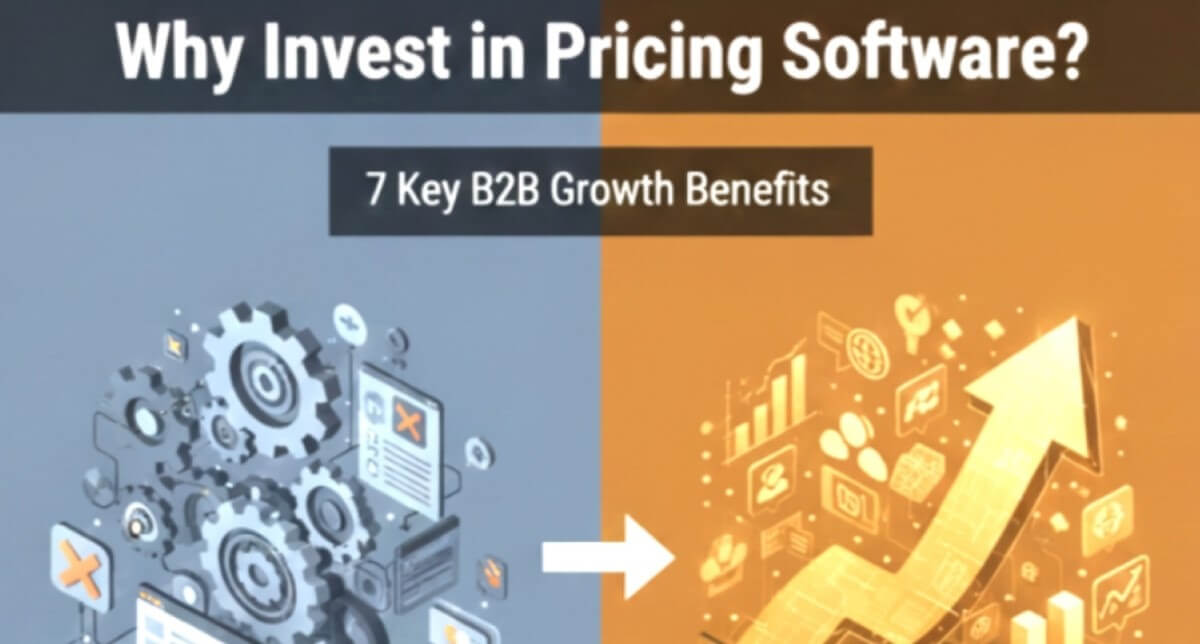
A journey from spreadsheets to strategic pricing excellenceLet us tell you a story that might sound familiar. Picture yourself sitting at your desk, staring at yet another pricing spreadsheet. You’ve got formulas stacked on formulas, tabs within tabs, and somewhere in that digital maze lives the answer to whether your latest price adjustment will sink or swim. You’ve been here before, right? Maybe it was last quarter, maybe it was yesterday. The truth is, if you’re managing enterprise pricing through Excel or legacy business information systems, you’re not alone. But one thing is almost certain – you are leaving money on the table.
We are not here to tell you that spreadsheets are the enemy. They served us well for decades, and they still have their place. But when you’re steering a ship the size of an enterprise organisation through waters that change by the hour, you need more than a compass and a prayer. You need sophisticated navigation systems that can see around corners and adapt faster than market conditions shift.
Welcome to the world of modern quality AI-powered pricing software like that from Velon® ,where data meets intelligence, strategy meets execution, and your imagined opportunities transform into measurable profit and sustainable growth.
Why Invest in Pricing Software? The Key Takeaways
- Speed and efficiency: Update thousands of price points in hours rather than weeks or months, responding to market changes before opportunities disappear.
- Real-time agility: Respond to market volatility, supply chain disruptions, and tariff changes instantly rather than waiting for quarterly reviews.
- Strategic intelligence: Transform pricing from reactive guesswork to proactive strategy with AI-driven insights that detect patterns invisible to manual analysis.
- Right price for the right person at the right time: Deliver price optimisation by offering the right price to the right customer at the right time, maximising win probability and margin through customer behaviour insights, market conditions, and sophisticated segmentation.
Read on for in-depth analysis of all 7 key B2B growth benefits and discover how modern pricing platforms turn administrative burdens into competitive advantages.
The Spreadsheet Paradox: When Good Tools Become Bottlenecks
Here’s the thing about Excel that nobody wants to admit out loud. It’s brilliant for what it was designed to do. But enterprise pricing? That’s like using a bicycle to haul freight across the continent. Sure, technically you could do it, but why would you?
When you’re managing thousands of SKUs across multiple regions, dealing with customer-specific agreements, tracking promotional effectiveness, and responding to competitive moves in real time, those spreadsheets usually start to crack under pressure. One wrong formula, one outdated data pull, one version control mishap, and suddenly your pricing strategy and its execution is built on quicksand.
The real cost isn’t just in the errors, though those add up faster than you might think. It’s in the opportunity cost. While your team spends hours updating spreadsheets and validating data, your competitors are making strategic moves based on real-time intelligence. While you’re manually checking if a quote aligns with corporate pricing policies, deals are slipping through the cracks or getting approved with margins that make your CFO wince.
The 7 Pillars of Pricing Software Excellence
Let’s walk through seven compelling reasons why forward-thinking marketing managers, sales leaders, finance directors, and product managers are making the leap from spreadsheets to sophisticated pricing platforms. These aren’t just nice-to-haves. They’re competitive necessities in today’s market environment.
1. Precision That Multiplies Your Bottom Line
The mathematics here are beautiful in their simplicity. A single percentage point improvement in price realisation translates to an 8 to 11 per cent increase in operating profit for most enterprises. Think about that for a moment. Not revenue. Profit. That kind of leverage is rare in business.
Compare that to other profit improvement initiatives:
- Cost-cutting eventually hits bone
- Volume increases require massive capital investment and market share battles
- Pricing optimisation delivers pure margin enhancement that scales across your entire operation
Modern pricing software applies sophisticated algorithms that detect patterns invisible to the human eye, even trained pricing professionals with decades of experience. These systems analyse millions of transactions, identify where you have pricing power, predict where price increases will stick, and flag where they’ll trigger customer resistance.
Unlike cost reduction programmes that eventually exhaust themselves, with price software technology, pricing excellence compounds over time. Your data assets grow richer, your pricing intelligence becomes more refined, and your competitive advantage widens with each passing quarter.
According to insights from 7 Sages Pricing, companies that adopt dedicated, sophisticated and data-driven pricing strategies commonly achieve margin gains of 1,000 basis points or see their return on sales rise by 1% to 5%.
Let’s put that into perspective.
For a business generating £300 million in annual revenue, that translates to an extra £3 million to £15 million in operating profit – purely by using AI-powered pricing software to execute your way to scalable and sustainable profit growth.
2. Agility in an Age of Volatility
Remember when pricing strategies could remain static for a quarter? Those days are gone, swept away by supply chain disruptions, tariff fluctuations, inflationary pressures, geopolitical tensions, and competitive moves that happen at internet speed. Advanced pricing software provides the agility your enterprise needs to respond to market changes in real time. Instead of quarterly pricing reviews that leave enormous amounts of money on the table, these systems continuously monitor market signals and automatically adjust thousands of price points within parameters set by your leadership team.
Think about manufacturers dealing with tariff uncertainty right now. Raw material costs swing wildly based on policy announcements that happen overnight. Traditional pricing approaches can’t keep pace. By the time you’ve convened the pricing committee, analysed the impact, and rolled out new price lists, market conditions have already shifted again.
Strategic pricing software allows you to model various scenarios before they happen. You can build in automatic triggers that adjust pricing when specific conditions materialise. You maintain control while gaining speed, a combination that’s impossible with manual processes.
The executive advantage here extends beyond tactics into strategy. When you automate routine pricing decisions with appropriate guardrails, your leadership team frees up cognitive bandwidth to focus on the minority of strategic pricing decisions that truly require senior judgement.
3. Setting Prices for New Products: A Shift from Passive to Active Price Setting
Here is where many enterprise companies stumble. Launching new products with the right pricing strategy separates market leaders from followers, yet too many organisations approach this critical decision passively. They look at what competitors charge, add a margin, and hope for the best. That’s not pricing. That’s guessing.
Pricing software transforms new product pricing from reactive guesswork into proactive strategy. These platforms embed pricing expertise directly into your organisation, making sophisticated pricing knowledge accessible to everyone involved in product launches.
The benefits extend across multiple pricing methodologies:
- Value-based pricing becomes achievable because the software quantifies customer value beyond simple cost-plus calculations
- Dynamic pricing models that require real-time data and intricate algorithms become manageable rather than overwhelming
- Competitive pricing strategies benefit from continuous market monitoring rather than periodic manual reviews
Consider the challenge of pricing a new product variant in a portfolio of thousands of SKUs. Manually analysing comparable products, adjusting for feature differences, accounting for market positioning, and setting optimal prices could take weeks. Pricing software accomplishes this in hours whilst providing confidence intervals and sensitivity analysis.
The shift from passive to active price setting means your organisation stops reacting to market forces and starts shaping them. You’re no longer accepting the prices that competition or customers expect. You’re establishing prices that reflect the genuine value of your products whilst maximising both market acceptance and profitability.
This democratisation of pricing intelligence means your team can focus on strategy rather than data collection. For finance directors, marketing bosses, product managers and sales leaders it means new product launches contribute to margin targets from day one rather than requiring quarters of price adjustments. For IT managers too, it means integration with product lifecycle management systems that already track development milestones.
4. Using Pricing Software to Address Supply Chain Concerns
In the aftermath of global events over recent years, supply chain vulnerabilities have moved from back-office concerns to boardroom priorities. The pandemic, conflicts in Eastern Europe and the Middle East, port strikes, driver shortages and regulatory changes have highlighted how quickly supply chain disruptions can devastate profitability if pricing strategies can’t keep pace.
Pricing software has become essential for navigating these supply chain complexities because it connects procurement realities with market pricing in ways that spreadsheets simply cannot match.
Consider the combined and compounding supply chain pressures facing enterprises today:
- Fluctuating tariffs on imported raw materials that change overnight based on policy announcements
- Energy costs that swing wildly based on geopolitical events beyond your control
- Port delays and logistics bottlenecks that make delivery timelines unpredictable
- Supplier reliability issues that force sudden changes to sourcing strategies
- Regulatory changes that affect product certifications and compliance costs
Traditional pricing approaches treat these as occasional disruptions requiring manual intervention. Modern pricing software treats them as constant variables requiring continuous adjustment.
This capability proves particularly valuable for distributors managing disrupted supply chains. When your products make multiple border crossings or rely on complex international logistics, pricing software helps you understand total landed costs in real time rather than discovering margin erosion months later in financial reviews.
The software doesn’t just help you react to supply chain disruptions. It helps you build resilience into your pricing architecture. Integration with procurement and ERP systems means your pricing strategy automatically incorporates supply chain realities. When lead times extend or supplier costs increase, the pricing platform can reflect these changes across your entire product portfolio without requiring manual updates to thousands of price points.
For enterprises dealing with the complexities of modern supply chains, pricing software transforms vulnerability into competitive advantage. Whilst competitors scramble to update pricing in response to disruptions, your organisation adjusts smoothly because the platform anticipated the changes and prepared appropriate responses.
5. Mastering Product Complexity at Scale
As your enterprise expands, product lines and diversifies offerings, managing pricing across portfolios becomes exponentially more complex. You’re juggling production costs, competitive positioning, customer preferences, regional regulations, local taxes, and tariff implications across potentially thousands of SKUs.
Pricing software utilises AI-driven optimisation and insights to help you optimise prices based on real-time market conditions and internal cost structures. This capability streamlines pricing processes and enhances overall operational efficiency.
For manufacturers with extensive product portfolios spanning multiple regions, the challenge multiplies:
· Different regulatory environments requiring unique compliance approaches
· Varying market demands that make one-size-fits-all pricing impossible
· Localised CRM and ERP systems across business units that resist global or organisational coordination
· Local tax structures and tariff implications that affect landed costs differently by region.
Traditional pricing approaches buckle under this complexity. Modern pricing platforms handle this through sophisticated data integration and analysis capabilities.
They embed pricing expertise directly into your organisation, making high-level knowledge accessible across teams. This democratisation of pricing knowledge ensures that everyone involved can contribute to finding optimal market prices, even as your product portfolio grows and market conditions shift.
6. Building Competitive Advantage Through Superior Intelligence
Manufacturers facing manual, error-prone pricing processes, poor customer segmentation, and lack of actionable sales insights often experience significant gross margin erosion before recognising the urgent need for change. Implementing pricing software to centralise and automate pricing processes transforms this trajectory entirely, delivering substantial margin improvements through better execution of price changes, strategic planning, and elimination of unnecessary discounting.
The transformation delivers multiple benefits:
- Establishes new price-setting strategies and policies with frequent updates
- Creates efficient, margin-rich annual price change processes
- Gains transparency regarding swift identification of low-margin, low-performing products and customers
- Enables quick and targeted pricing actions globally
These strategic advantages prove particularly pronounced in businesses facing fierce competition or commoditisation pressures. When product differentiation narrows, pricing excellence often becomes the primary profit lever available to leadership teams.
7. The Right Price for the Right Person at the Right Time
Here is a strategic reality that is often overlooked. Price optimisation stands out in the B2B landscape because it shifts the focus from broad discounting to surgical precision. By its very nature, it ensures that every quote is tuned to the specific value a customer perceives, rather than a generic market average.
Think about what true price optimisation requires:
- Deep customer behaviour analysis
- Real-time market condition monitoring
- Sophisticated customer segmentation
- Willingness-to-pay modelling
- Value-based benefit alignment
The complexity of modern B2B transactions makes manual “gut-feel” pricing impossible to scale. Leaving margin on the table is an invisible, recurring cost that most businesses fail to measure.
Precision pricing software leverages advanced segmentation to identify where to capture more value without risking the deal. By offering the right price at the right time, you simultaneously maximise win probability and protect margins, moving beyond cost-plus models to embrace value-driven strategy.
This level of sophistication turns pricing into a profit engine. By capturing the full willingness to pay and aligning it with product value, you drive immediate growth. Master this balance to transform commercial operations into a high-performance accelerator for long-term profitability.
Taking the Strategic Pricing Software Leap
The evolution of pricing software from simple rules-based systems to sophisticated AI-powered platforms has created a strategic inflection point. The gap between pricing leaders and laggards is widening, and that gap translates directly to financial performance.
Take a look at your own business and calculate what a 1% improvement in price realisation would mean to your operating profit. Consider how much time your teams spend on manual pricing tasks that could be automated. Think about the deals that slip through with suboptimal margins because your systems can’t provide real-time guidance.
Quality pricing software like Velon® isn’t merely a technical solution. It’s the technological embodiment of a fundamental strategic choice about how your enterprise will capture and defend its economic value in an increasingly complex commercial landscape.
The question isn’t why invest in pricing software. The question is whether you can afford not to whilst your competitors are already doing so. Talk to one of our experts today to play catch up.
Frequently Asked Questions on Investing in Pricing Software
How long does it typically take to see ROI from pricing software implementation?
+
A 30x ROI period is often 6-12 months for the software investment (following the 4-to-6-week implementation period), and first value signs are usually within weeks. However, quick wins in areas like new product pricing, supply chain cost pass-through, and discount governance often deliver immediate margin improvements that fund broader platform adoption.
Can pricing software integrate with our existing ERP and CRM systems?
+
Modern pricing platforms are designed specifically for integration with enterprise systems. They work alongside your existing technology infrastructure, pulling data from ERP and procurement systems, pushing guidance to CRM platforms, and ensuring your teams access pricing intelligence within their normal workflows.
What if we don't have clean data or a mature pricing strategy?
+
That’s one of the best reasons to implement pricing software. These platforms help you clean and structure your data as part of the implementation process. They also provide frameworks and best practices that help you develop more sophisticated pricing strategies over time. You don’t need perfection to start. You need commitment to improvement.
How much internal resource does pricing software require to maintain?
+
Modern loud-native pricing platforms minimise IT overhead compared to legacy systems. Most organisations find that the time saved through automation far exceeds the resources required for system administration. Your team shifts from manual data manipulation to strategic analysis and decision-making.