
How CPQ Optimises Production Capacity for Manufacturers
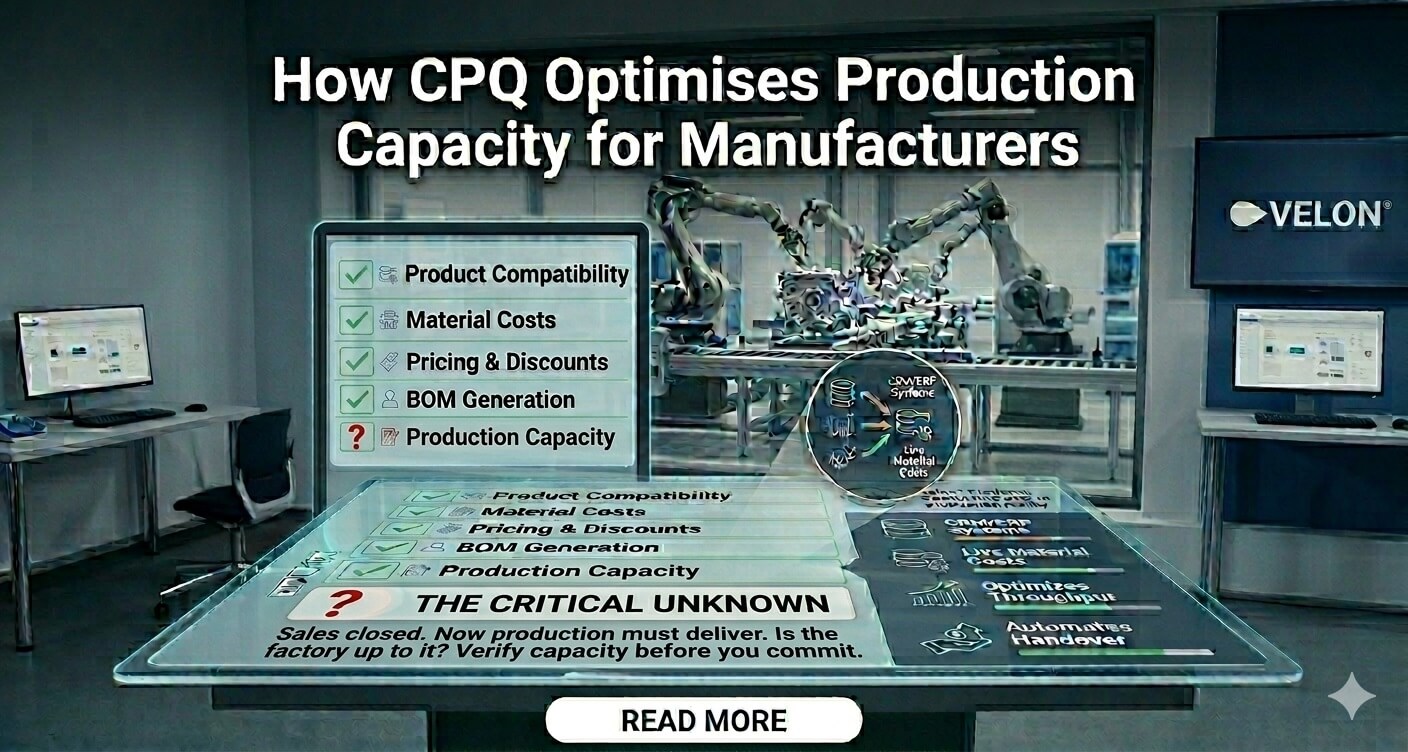
There is a stomach-dropping moment that almost every Operations Manager in the Manufacturing Industry will identify with – we know – you’ve been there and seen the movie too many times. Your sales team has just closed a deal, and champagne corks are metaphorically (if not literally) popping, and then someone quietly asks the question that changes the mood in the room: “Do we have the production capacity for this?”
It is a question that has haunted manufacturers for generations. And the honest answer, far too often, has been: “We are not entirely sure.”
That uncertainty costs money. It costs time. And in a competitive market where customers expect precision and on-time delivery, it can cost you the relationship entirely.
This is where intelligent, pricing-focused, AI-informed CPQ (Configure, Price, Quote) software like Velon® steps in, and frankly, it changes everything.
Bringing Sales and Production into the Same Conversation
Think about a mid-sized automotive parts manufacturer quoting on a large custom order. Traditionally, the sales team builds a quote using last quarter’s data, fingers crossed that production capacity holds up. The order gets confirmed. Then the production floor discovers three bottlenecks nobody accounted for (think about the computer chip shortage during Covid for example, not to mention anything raw materials dependent on passing through the Strait of Hormuz or the Red Sea in early 2026), and the delivery window collapses.
Now picture that same scenario with a modern CPQ system embedded into the workflow. Before that quote ever leaves the building, the software simulates the production run against live data including inventory levels, available labour, and current plant throughput.
While detailed scheduling and optimisation typically sit within planning systems, CPQ can incorporate capacity models and planning inputs to evaluate the feasibility of configurations at the point of quote.
If capacity cannot support the order as configured, the system flags it immediately.
No guesswork. No unpleasant surprises. Just clarity.
A second everyday example: a furniture manufacturer receiving a surge of custom orders during the holiday season. Without production-aware quoting, sales may inadvertently promise delivery dates that the factory floor simply cannot honour. Pricing-smart CPQ software integrated with ERP systems gives the sales team real visibility, so every quote is grounded in manufacturing reality rather than optimism.
What Quality CPQ Software Actually Does for Forecasting Your Production Capacity
The right pricing software does more than produce a nice-looking quote. Here is what it brings to the table for manufacturers specifically:
- Simulates production capacity before commitment: Sales teams can test-run configurations against actual plant constraints, confirming feasibility before a quote is finalised.
- Prevents overpromising to customers: By connecting with ERP data in real time, the system identifies capacity limits, helping teams avoid configurations that would create bottlenecks downstream.
- Optimises production throughput: AI-powered tools identify underutilised production lines and intelligently redistribute workloads, improving overall efficiency across the plant.
- Automates the sales-to-production handoff: Once a quote is approved, the software automatically generates the bill of materials and production documents, eliminating the manual handover errors that quietly drain time and profit.
From Spreadsheets to Smart Decisions
Many manufacturers are still running their quoting processes on spreadsheets. And while spreadsheets are familiar, they are also static. They do not know what your production floor looked like this morning.
Well-implemented CPQ software where pricing intelligence does the heavy lifting, replaces that guesswork with data-driven decision making that aligns what your sales team is promising with what your operations team can genuinely deliver. The result is shorter deal cycle times, fewer costly errors, and a production process that runs with far greater confidence.
- For Operations Managers, it means fewer firefighting moments and more predictable output.
- For Finance Leaders, that means better margin protection.
In the end, the best end-to-end CPQ software with pricing built in from the ground up does not just help you win deals. It helps you deliver on them. Contact the team at Velon® today and have a friendly chat with one of our quoting experts.
Frequently Asked Questions on Why Forecasting Production Capacity with CPQ is Important
What happens to profit margins when production capacity is not forecasted accurately?
+
Manufacturers typically absorb the cost through rushed overtime, emergency procurement, or late delivery penalties. These are margin erosion events that rarely appear on a sales report but are felt deeply on the bottom line.
Can CPQ help manufacturers handle seasonal demand spikes without overextending capacity?
+
Yes. CPQ models capacity against live operational data, allowing manufacturers to set intelligent boundaries during high-demand periods and only commit to what the business can confidently fulfil.
How does production capacity forecasting with CPQ support longer-term business planning?
+
Repeated CPQ simulations reveal where capacity constraints consistently appear, giving Finance and Operations leaders the insight to make informed decisions around equipment, staffing, and facility expansion before demand outpaces supply.
Does accurate capacity forecasting through CPQ affect customer retention?
+
Significantly. Customers who receive reliable delivery commitments develop stronger loyalty over time, and CPQ-driven forecasting quietly becomes a competitive differentiator that shows up in repeat business and renewal rates.