
The Hidden Cost of Turning ERP Systems into CPQ Platforms
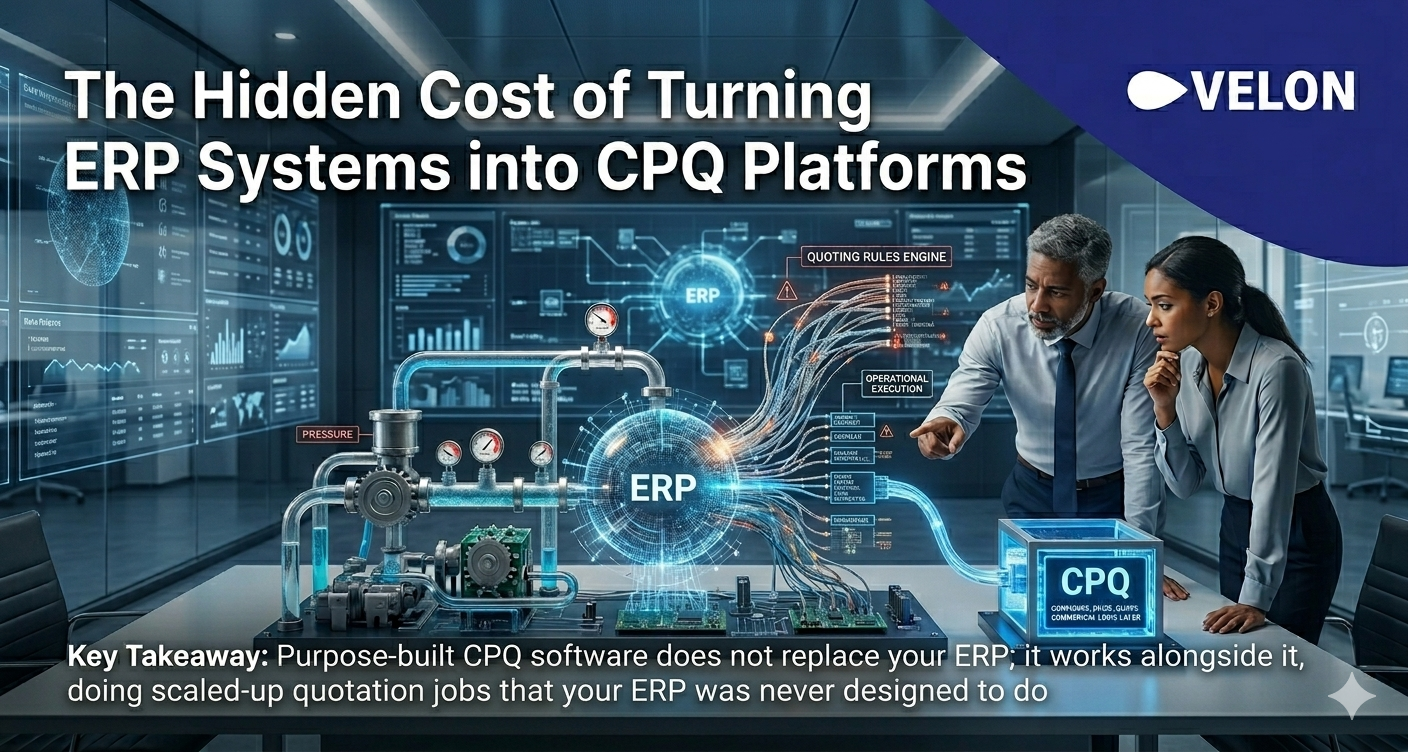
Most commercial mistakes do not announce themselves. They do not arrive with a failed project, a blown budget or a boardroom conversation anyone remembers. They arrive gradually, embedded inside a decision that was entirely reasonable at the time, made by capable people with good intentions and sensible commercial logic behind them.
However, many scaling manufacturers still find themselves quietly paying for an innocuous decision they made years ago.
For a significant number of manufacturers, that decision was this: ‘We already have an ERP system. We will extend it to handle quoting’.
And so, the extension was built. The customisation was signed off. The architecture remained consolidated, the vendor count was low, and the business moved forward. For a while, sometimes a long while, it worked. The quoting process functions. The sales team adapted. Nobody raised a flag.
But somewhere underneath the surface, a different kind of cost started accumulating. Not on any invoice. Not in any IT report. Spread quietly across engineering time, pricing inconsistency, delayed upgrades, spreadsheet proliferation and the slow erosion of commercial control.
By the time most businesses recognise it for what it is, the debt is already deep.
The good news is that for many manufacturers, there is a proven solution to this structural problem, and it goes by the name of Configure– Price-Quote Software (CPQ). Read on to discover whether a quality CPQ software solution like Velon® is the right fit for your business to work alongside your ERP.
The Hidden Costs of ERP Quoting: The Key Takeaways
Many manufacturers are quietly paying a growing hidden cost for a decision that once made perfect sense: extending their ERP system to handle complex product quoting. If your business is scaling in complexity, that decision may now be working against you.
Key takeaways:
- ERP systems are built for operational execution after a sale; CPQ governs the commercial decision-making before it
- As product complexity grows, ERP-led quoting creates performance degradation, customisation debt and spreadsheet dependency
- Every delayed ERP upgrade and every margin inconsistency has a cost that rarely appears on a single report
- Purpose-built CPQ software does not replace your ERP; it works alongside it, doing the job your ERP was never designed to do
Read on to learn more….
The ERP Quoting Logic That Made Sense
Extending ERP for quoting is not irrational. For manufacturers with contained product catalogues, limited configuration variability and straightforward pricing, ERP-led quoting can remain entirely workable for years, and no universal law says every manufacturer needs specialist CPQ from day one.
The case typically rests on sound logic:
- Existing ERP investment is protected
- A single vendor reduces commercial complexity
- Customisation feels manageable
- The quoting process appears to function adequately
None of these observations are wrong.
The problem is that they describe a point in time rather than a trajectory. And the trajectory is where things get interesting.
What An ERP Was Built For (And What It Was Not)
At its core, an ERP system is an operational execution engine, managing what happens after a commercial decision has been made: procurement, production, inventory, finance. It was designed for exactly that, and it does it well.
CPQ software governs what happens before operational execution begins. It structures complex product definitions during the sales conversation, validates technical feasibility, dynamically generates the Bill of Materials underlying a quote, and applies pricing logic across the variables that shift with every customer and every configuration.
CPQ is not simply a quoting tool. It is a commercial decision and governance layer.
Manufacturers originally customise ERP to achieve consistency, simplicity and control. Specialist CPQ platforms deliver those same goals without forcing ERP to carry computational and architectural responsibilities it was never designed to handle.
Separating the commercial logic layer from the operational execution layer solves the problem at its root.
The rules engine and dynamic configuration logic remain isolated inside CPQ.ERP receives only the confirmed operational outcome once the commercial decision has already been validated.
Each system performs the role it was designed for.
These are fundamentally different computational and logical problems.
ERP records the outcome of decisions already made. CPQ structures and governs the process of making those decisions in the first place.
Where the ERP Strain Begins to Show
The Rules Engine Problem<
Configurable products, particularly in bespoke or engineer-to-order environments, involve thousands of permutations across materials, dimensions, components, engineering constraints and pricing variables simultaneously.
When that logic lives inside ERP, the quoting rules engine must share database resources with the live operational environment. Every quote generated by a salesperson competes for processing capacity with warehouse, finance, procurement and production teams. The visible result is slower quoting. The less visible result is that ERP responsiveness across the entire business begins to degrade under concurrent load.
A purpose-built CPQ platform isolates that commercial logic entirely, operating in a dedicated decision layer and leaving ERP free to do what it was designed to do: execute.
The Bill of Materials Boundary
The Bill of Materials (BoM) sits at the precise intersection of quoting and operations, and understanding where responsibility should sit is one of the most commercially important architectural decisions a manufacturer can make.
During quoting, the BoM is a dynamic output reflecting the customer’s configuration, its technical validity and the estimated cost to build, all in real time. Once approved, the confirmed BoM passes to ERP for procurement, production scheduling and fulfilment. That is ERP’s domain.
The problem emerges when dynamic, quote-time BoM generation runs inside the same environment managing confirmed production BoMs. Blending the two creates:
- Performance bottlenecks during quoting activity
- Brittle dependencies every time products or components change
- Upgrade risk that accumulates with every ERP version
The principle is straightforward: CPQ calculates the BoM during the commercial process. ERP manages the confirmed BoM during execution. Conflating the two is where long-term structural fragility begins.
CPQ Reads & Interprets CAD Draws: A Task That ERP Was Never Designed For
During quoting, the CAD model is a dynamic output reflecting the customer’s configuration, its dimensional validity and a real-time visual representation of what will be built. ERP was designed to manage confirmed designs during production and fulfilment. That is its domain.
The problem emerges when manufacturers attempt to run dynamic CAD generation inside the same environment managing confirmed production drawings. Layering live configuration and real-time rendering on top of procurement, scheduling and inventory creates:
- Performance drag that slows both quoting and production operations
- Structural complexity that grows brittle with every product or component change
- A system doing two jobs it was never designed to do simultaneously
The principle is straightforward: CPQ drives CAD output dynamically during the commercial process. ERP manages confirmed drawings during execution. Conflating the two is where inefficiency and manufacturing error begin.
How CPQ Optimises Production Capacity and Equipment Capability for Manufacturers
A perfectly priced quote means nothing if your production floor cannot deliver on it. This is the dual challenge that intelligent CPQ software like Velon® solves by bringing sales and operations into genuine alignment.
Before a quote leaves the building, the system simulates production runs against live data – inventory levels, available labour, plant throughput, and equipment availability. Constraint-based configuration ensures only buildable combinations are presented to customers, while ERP integrations reflect real-time capacity and material constraints.
The result: sales teams stop accidentally promising what the factory cannot fulfil, costly rework is avoided, and delivery windows hold firm.
For Operations leaders, scheduling becomes more predictable. For Finance leaders, margin protection improves. The right CPQ software doesn’t just help you win business – it helps you deliver on it, profitably.
The ERP Customisation Debt That Compounds
Perhaps the least visible cost of ERP-led quoting is the maintenance burden that accumulates quietly, without a single line item on any budget.
What begins as a manageable extension gradually evolves into scripts, custom tables, bespoke integrations and approval workflows spread across the ERP environment. Each made sense individually. Together, they create a dependency map nobody fully holds in their head. Then the ERP vendor releases a new version, and what should be a routine upgrade becomes a technical project.
Over time the pattern becomes self-reinforcing:
- Every product change introduces additional dependency checks
- Every pricing rule adjustment risks unintended side effects
- Every ERP upgrade becomes a significant undertaking rather than a scheduled update
- Specialist knowledge concentrates in a small number of individuals or external consultants
Businesses in this position often delay ERP upgrades not because the upgrade is problematic, but because breaking critical quoting logic feels unjustifiable. Technical debt compounds into operational conservatism, and that conservatism has a cost that rarely appears on any balance sheet.
The Spreadsheet Dependency You Did Not Plan For
There is a reliable leading indicator that ERP-led quoting is beginning to strain: spreadsheets proliferating around the edges of the process.
When ERP cannot handle a configuration variable, someone builds a spreadsheet. When pricing logic grows too complex, another appears. When engineering needs to validate quote assumptions, a tracking file emerges. Each spreadsheet represents a failure of the architecture to serve the process, and each one introduces:
- A single point of failure held by one individual
- A version control problem
- A margin risk when it falls out of sync with the ERP
- An onboarding challenge for every new salesperson
The spreadsheet accumulation is not laziness. It is ingenuity in the face of an architecture that was never designed to carry this commercial load.
What Purpose-Built CPQ Software Solves
Quality CPQ software addresses these problems at their architectural root rather than patching them at the surface. Configuration logic, pricing rules, dynamic BoM generation and approval governance all operate inside a dedicated commercial decision layer. ERP receives clean, confirmed outcomes once that commercial logic has done its work. Neither system carries responsibilities it was not designed for.
The practical impact tends to be consistent:
- Sales teams quote with speed and confidence, without engineering involvement in routine configurations
- Pricing is applied consistently across every salesperson, region and channel
- Margin visibility is available at the point of quote, not retrospectively
- ERP upgrades become routine again, because quoting logic no longer lives inside operational infrastructure
- Tribal knowledge moves from individuals into governed, structured systems
This is not about replacing ERP. It is about giving ERP back the role it was designed to perform and giving commercial teams the specialist governance layer they need.
The ERP Nuance Worth Acknowledging
Not every manufacturer reaches this inflection point at the same time. Where product configuration is limited and pricing straightforward, ERP-led quoting can remain workable.
The strain begins when quoting becomes highly configurable, engineering-dependent and pricing-sensitive.
Bespoke manufacturers, engineered-to-order businesses and project-based producers tend to reach this point sooner.
When they do, the cost of not acting and adopting quality CPQ Software like Velon® tends to grow faster than the cost of the solution. Act now and talk to one of our friendly CPQ experts today.
Frequently Asked Questions on ERP to CPQ Transformation
What is the difference between ERP and CPQ?
+
ERP manages operational execution: procurement, production, inventory, finance and fulfilment. CPQ manages commercial decision-making during quoting, including configuration logic, pricing governance and dynamic BoM generation.
Can ERP systems be customised to handle quoting?
+
Yes, particularly in lower-complexity environments. Problems emerge when product complexity, configuration logic and pricing variability begin scaling faster than the underlying architecture was designed to support.
Is CPQ replacing ERP?
+
No. They solve different problems and operate at different stages of the business process. ERP manages operational execution. CPQ governs commercial logic, configuration, pricing and quote orchestration. They are complementary.
Why do ERP-led quoting environments become difficult to scale?
+
As quoting logic grows more complex, rules engines, configuration dependencies and dynamic BoM generation begin affecting ERP performance under concurrent operational load. Manageable customisation gradually evolves into architectural fragility.
Why do ERP upgrades become difficult in heavily customised quoting environments?
+
As bespoke quoting logic spreads across workflows, scripts and integrations, upgrades become increasingly risky. Businesses delay them fearing that critical quoting functionality may break, creating long-term technical debt.
Which manufacturers benefit most from CPQ?
+
Those with configurable products, project-based sales cycles, engineering dependencies, pricing variability and bespoke production workflows, where governed quote-time decision-making is commercially critical.
What are the hidden costs of ERP customisation for quoting?
+
Technical debt, upgrade complexity, pricing inconsistency, spreadsheet dependency, onboarding difficulty, tribal knowledge risk and ERP performance degradation as product and pricing complexity grows.
If ERP vendors support quoting, why did many acquire specialist CPQ providers?
+
Because the market reached a collective architectural conclusion. Oracle acquired BigMachines. Epicor acquired KBMax. Complex configuration logic, dynamic BoM generation and pricing governance create a fundamentally different workload from standard ERP transaction processing. Commercial decision-making and operational execution are different problems requiring different tools, and the market acted accordingly.