
What Skill Sets Are Needed to Use Pricing Software?
There is a moment that happens in boardrooms all over the world, perhaps more often than any CFO, Sales Director or Chief Executive would care to admit. A business invests a considerable sum in pricing software. The technology is sophisticated, the ambition is sound, and the potential for profit improvement is genuinely compelling. And then, slowly, the uncomfortable truth surfaces: the team does not quite know what to do with it and how to adopt it in their organisation. That is not a technology failure. That is a skills gap. And it is entirely preventable.
If you are a Finance Leader wrestling with margin erosion, a Sales Leader trying to shorten quoting cycles, a Marketing or Product Manager under pressure to defend price in a competitive market, or a C-Suite executive looking for the commercial levers that will drive your next phase of growth, then this question matters deeply to you: what does your team actually need to know in order to get the most from pricing software?
The good news is that the answer is more accessible than you might expect.
The even better news is that with a quality pricing platform like Velon®, one that is genuinely built for mid-level and enterprise business quoting and pricing complexity, does much of the heavy lifting for you. These are not rare mishaps.
In fact, expert technology like this is created by pricing experts, so your people don’t require a PhD level of pricing expertise, and the pricing tech does most of the grunt work.
But the skills and aptitudes your people bring to the table will always determine how much value you extract. So, let’s walk through it together.
The Short Version – The Skills Required to Make a Success of Pricing Software
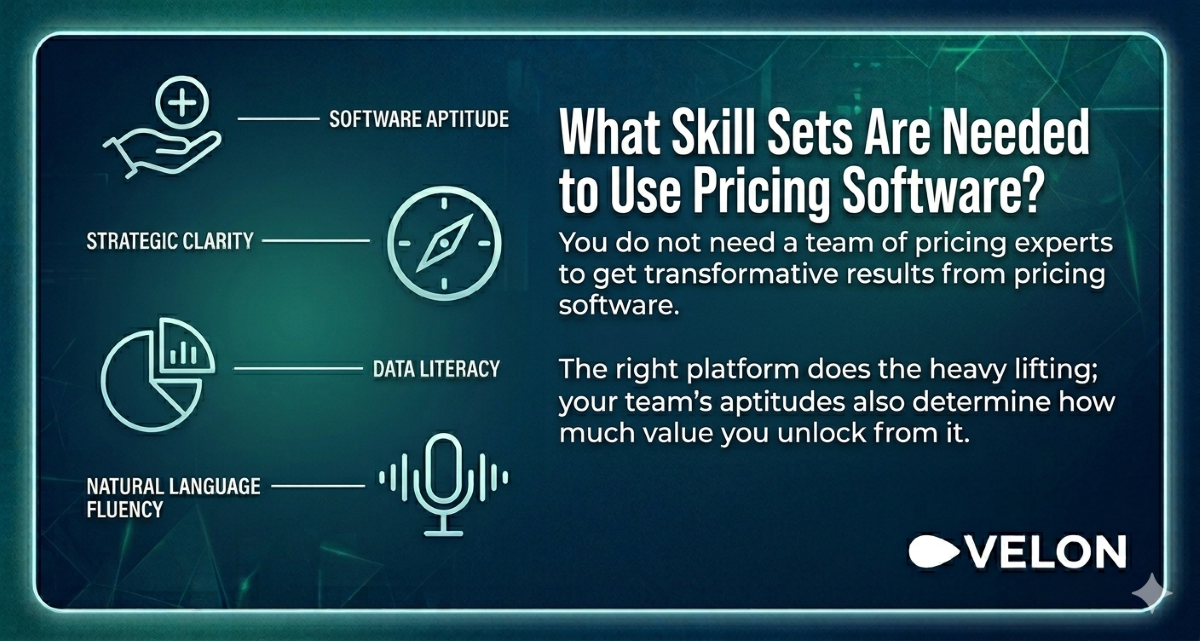
You do not need a team of pricing experts to get transformative results from pricing software.
The right platform does the heavy lifting; your team’s aptitudes also determine how much value you unlock from it. The skills that matter most are:
- ✅ Software aptitude: knowing how to apply the platform, not just operate it
- ✅ Strategic clarity: understanding what commercial outcomes you are aiming for
- ✅ Data literacy: translating numbers into pricing decisions that move the margin needle
- ✅ Natural language fluency: asking your AI-powered platform smart questions in plain English
Velon is built by expert pricers so that non-pricers can act with the confidence of experts, and when CPQ and pricing capability sit on one consolidated platform, the whole becomes genuinely greater than the sum of its parts.
Read on to learn more.
What Pricing Teams Actually Do
Before we map the skills, it helps to understand the terrain. Pricing professionals, whether you call them pricing analysts, pricing managers or members of a broader commercial team (regardless of where they sit in your organisation – Finance, Sales, Marketing or Operations), are doing far more than deciding what number goes on a price list.
They are watching competitor behaviour. They are tracking market trends and modelling how shifts in raw material costs or supply chain dynamics ripple through to margin. They are studying customer behaviour and purchasing patterns to understand willingness to pay. They are involved in quoting, in product bundling, in rebate and discount governance. They maintain price lists across customer hierarchies and distribution channels. They prepare revenue forecasts, review deal proposals and field ad hoc requests from half a dozen departments, all while trying to keep the company’s overall commercial strategy on course.
That is a richly varied role. And pricing software amplifies every single part of it, provided the person operating it has the right combination of capabilities.
The Hard Skills That Will Define Your Team’s Success
Soft skills matter, of course they do. Communication, curiosity, critical thinking, commercial judgement and the willingness to collaborate across functions are all genuine assets in any pricing professional. But what separates a capable user of pricing software from a truly effective one comes down to a specific set of hard skills. Here are the ones that count most.
1. Software Aptitude: Not Just Using Technology, but Applying It
There is an important distinction between operating a tool and wielding it. The former means you can find the relevant screen and complete the relevant task. The latter means you understand what the tool is capable of and you can adapt it to the specific commercial challenge in front of you.
Pricing and quoting software serve multiple users across a business, each with a different purpose:
- A sales representative generating a quote needs to work quickly and accurately within predefined guardrails
- A pricing analyst setting optimal price points needs to interpret segmentation models and act on AI-generated recommendations
- A rebates manager administering promotions and discount structures needs a more advanced configuration of the same system
- A senior leader reviewing commercial performance needs a clean, reliable dashboard view of what is happening to margin
Each of these users brings a different level of software aptitude to the table, and each needs tailored training and, where necessary, tailored expectations. Quality pricing software like Velon® will accommodate all of them within a single platform. But your team’s ability to apply the technology, rather than simply use it, will always be the determining factor in outcomes.
2. Strategic Planning and Analytics: Knowing What You Are Aiming For
This might be the most important skill of all, and it is also the one most frequently underestimated. Pricing software does not set your commercial strategy. It executes it. If the people operating the platform do not have a clear understanding of what the business is trying to achieve, all the analytical horsepower in the world will be aimed at the wrong target.
Is your priority to grow transaction volume? To protect gross margin in a competitive pricing environment? To reduce the administrative burden of manual quoting? To improve win rates on complex, high-value deals? To bring consistency to pricing across multiple geographies and customer segments? Each of these goals shapes how your pricing software should be configured, which metrics you track, and what success looks like.
Strategic clarity also requires industry knowledge. A pricing professional who understands the dynamics of your specific market, be it manufacturing, distribution, technology, healthcare, chemicals or any other sector, will be considerably more effective than someone applying generic pricing logic to a context they do not fully understand. Industry expertise informs not just the strategy but the judgement that sits behind every pricing decision.
3. Data Literacy: The Skill That Separates the Profitable from the Rest
There is a phrase worth committing to memory: a 1% improvement in pricing strategy can generate a meaningful uplift in operating margin, up to 11%. That is not a theoretical claim. It is a well-documented commercial reality. And it is almost impossible to achieve consistently without a team that knows how to work with data.
Modern pricing software does not require your analysts to enter thousands of rows of figures manually. Those days are behind us. What it does require is the ability to interrogate data intelligently: to understand what the numbers are telling you about customer behaviour, competitive positioning, deal performance and margin leakage; to recognise patterns and anomalies; and to translate analytical insight into pricing decisions that actually move the needle.
The companies that are winning commercially right now are the ones that have invested in data capabilities alongside their pricing technology. They are not working harder. They are working with far greater precision.
Nice-to-Have Skills That Separate Good Teams from Great Ones
Beyond the core hard skills, there are two further capabilities that consistently distinguish pricing teams that thrive from those that merely cope.
- Knowing when to ask for help. Every quality pricing software vendor offers training, support and, in many cases, a network of implementation and strategy partners. The ability to recognise the limits of your own knowledge and seek expert input is not a weakness. It is one of the most commercially intelligent things a pricing team can do. The right vendor relationship will mean you are never left to figure things out alone.
- Embracing change as a permanent condition. The pricing landscape does not stay still. Supply chain disruption, inflationary pressure, shifts in competitive dynamics, new channels, evolving customer expectations: the list of variables that can reshape your pricing strategy in a short period of time is long. Teams that treat change as an occasional inconvenience will always be catching up. Teams that treat it as the operating norm will be consistently better positioned to respond.
- A natural affinity for everyday prompting in natural language. This one is emerging as a genuine differentiator, and it is worth highlighting specifically. The best modern pricing platforms are increasingly incorporating AI-driven LLM (large language model) interfaces that allow users to interact using plain, conversational language, rather than complex query syntax or technical configurations. A team member comfortable asking “what is our current margin on this product segment in this region?” or “which deals last quarter showed the most discount drift?” will extract value faster and more consistently than one who cannot. This is not a technical skill in the traditional sense. It is prompting fluency with intelligent systems that is fast becoming as valuable as anything else on a professional CV.
When CPQ and Pricing Capability Come Together
Here is a thought worth sitting with for a moment, because it speaks directly to how the skills we have been discussing come to life at scale.
There has long been a tendency in mid-level and enterprise software to manage configure-price-quote capability and pricing intelligence as separate disciplines, often on separate platforms, governed by separate teams. That separation creates friction. It creates inconsistency between what the pricing function determines to be optimal and what ends up in a customer proposal. And it creates a skills burden, because your people must bridge the gap manually.
When CPQ and pricing capability are consolidated onto a single platform like Velon®, something genuinely transformative becomes possible. CPQ brings order, speed and accuracy to the journey from product configuration to customer proposal.
Pricing capability operates at a complementary altitude, managing the strategic and analytical layer of commercial decision-making: maintaining price lists across complex customer and product hierarchies, automating the calculations that underpin every transaction, and harnessing artificial intelligence to recommend optimal prices in real time based on market conditions, competitive positioning, customer segmentation and historical behaviour.
When both capabilities live under the same roof, the pricing engine continuously refines its recommendations based on real-world data, and those recommendations flow seamlessly into the quoting process. Every proposal your salespeople produce reflects not just what the rules allow, but what the evidence suggests will win the deal at the best achievable margin.
Beyond price optimisation, a consolidated platform typically unlocks a broader set of commercial advantages:
- Centralised, automated management of price lists across all regions, channels and customer tiers
- The ability to respond in real time to competitive moves and shifting market conditions
- Deal planning tools that model likely buyer objections and prepare structured, data-supported counterproposals
- Negotiation guidance for complex, high-value deals that keeps the commercial conversation anchored to business objectives
- Systematic controls that identify and close the sources of margin leakage before they compound
Put simply: pricing capability ensures your salespeople find their optimal pricing corridor clearly and confidently. CPQ ensures they execute within it precisely and efficiently. Together on one platform, they deliver the right price to the right person at the right time, consistently and at scale.
The skills your team develops, the software aptitude, the strategic clarity, the data literacy, the conversational fluency with AI systems, all of them become considerably more powerful when the platform itself is built to make those skills count.
Built by Expert Pricers, for Non-Pricers: The Velon Difference
Here is something that often gets lost in conversations about pricing software skill sets, and it is worth saying plainly.
The skills we have outlined in this article are genuine and developing them will always make your team more effective. But there is an equally important question sitting on the other side of the equation: how much of that expertise should your platform be providing for you?
At Velon, we were built on a specific belief. Pricing science is a deep and sophisticated discipline. The logic behind optimal price-setting, the mechanics of margin management, the behavioural economics of how customers respond to price, and the statistical modelling that underpins AI-driven recommendations: these things took decades of collective expertise to develop. The idea that every business deploying pricing software should need to rebuild that expertise from scratch inside their own team has always struck us as exactly the wrong starting point.
So, we built Velon the other way around.
Velon is pricing software built by expert pricers, for people who are not pricing experts, and that distinction shapes everything about how the platform works.
What does that mean in practice?
- The pricing logic is embedded in the platform, not dependent on your team knowing how to construct it themselves
- AI-driven recommendations surface actionable guidance in plain language, so a sales leader or product manager can act on them without needing to interpret a statistical model
- Guardrails and approval workflows are built in, so less experienced users operate confidently within boundaries that protect margin without needing to understand why those boundaries exist
- The natural language interface means that asking the platform a commercial question feels like consulting a knowledgeable colleague, not running a database query
This does not mean your team’s skills are irrelevant. Strategic clarity, commercial judgement and data curiosity will always matter. But Velon is designed so that the depth of pricing expertise your business needs is already inside the platform, working quietly on your behalf 24/7/365. Your team are there to amplify its output.
For the Finance Leader concerned about margin, the Sales Director under pressure to win deals at the right price, or the Chief Executive who wants commercial rigour without building a specialist pricing department from the ground up, that is not a small thing. That is the point.
Is Your Team ‘Pricing Ready’?
Yes, a quality pricing platform like Velon® does most of the heavy pricing and quotation lifting. The embedded expertise, the AI-driven recommendations, the automated price guardrails and fast quoting: these are not features your team needs to replicate. They are already there, working on your behalf.
What your team brings to the table is the multiplier. Clarity of commercial purpose, a curiosity for data, the adaptability to treat change as an opportunity rather than a disruption, and the confidence to have a natural, intelligent conversation with the platform: these aptitudes do not replace the software’s capability. They amplify it.
Invest in both, and the returns in margin, efficiency and competitive resilience will not disappoint you. Talk to one of our friendly pricing and quotation experts today to help your team be all it can be.
Frequently Asked Questions on Pricing Software Skills
Do I need a dedicated pricing team to get results from pricing software?
+
Not necessarily. Many organisations deploy pricing software successfully across existing commercial roles in sales, finance and marketing. What matters is clear ownership of the pricing strategy itself, even if that sits within a broader leadership team rather than a specialist function. The platform carries the pricing expertise; your team provides the commercial direction.
How quickly can a team become effective with pricing software?
+
Basic operational fluency typically develops within weeks through structured onboarding. Deeper strategic proficiency, where teams are actively interpreting outputs and refining their approach based on results, usually matures over time. The learning curve is considerably shorter when the platform is designed to guide users rather than assume prior expertise.
What most commonly prevents pricing software from delivering its expected ROI?
+
Underperformance is rarely a technology problem. It is almost always a clarity problem: teams that have not defined what they want the platform to achieve tend to use it reactively rather than strategically. Engaging fully with vendor training and support is the single most reliable corrective.
Is technical or AI expertise needed to use AI-powered pricing features?
+
No. The best platforms surface AI-driven recommendations in plain, actionable language. Commercial judgement and intellectual curiosity matter far more than any technical background. As natural language interfaces become standard, the barrier to accessing sophisticated pricing intelligence continues to fall.