
Why is Low-Code Pricing Software Better for Your Business?
There is a moment in the life of every growing business when someone in the boardroom asks a very reasonable question: why does it take us three months to change a price?
It is a question that tends to land with a particular kind of quiet. Because the honest answer involves a labyrinth of legacy systems, overextended IT queues, spreadsheets that somehow became mission-critical infrastructure, and a general sense that pricing, of all things, should not be this hard.
And yet, here we are.
Now, picture a different world. One where your pricing team, your sales strategists, your finance directors, and your product managers can log into a system on a Tuesday morning and have a new pricing model live by Thursday afternoon. No emergency developer tickets. No waiting. No risk of something breaking because someone edited the wrong cell in a shared spreadsheet.
That world exists. It is called low-code pricing software, and it is quietly reshaping how mid-level and enterprise businesses think about one of their most powerful commercial levers: price.
Let’s dive in to understand what headaches quality AI-assisted pricing software like Velon® overcomes and the problems it solves.
The Short ‘Low-Code Pricing Software Problem Solver’ Version for the Busy Executive
- ✅ Low-code pricing software deploys up to 90% faster than traditional development, putting new pricing strategies live in weeks rather than months.
- ✅ It significantly reduces costs by empowering business users to configure and manage pricing logic themselves, without constant reliance on specialist developers.
- ✅ Cross-functional collaboration improves dramatically, with finance, sales, marketing, and IT finally working from the same page at the same pace.
- ✅ Maintenance, updates, and governance become simpler, more reliable, and far less dependent on institutional knowledge walking out the door.
Now, if you are the kind of leader who makes decisions worth their weight in revenue, pour yourself something decent and read on. Every detail below is worth your time.
The Problems That Low-Code Pricing Software Solves
Traditional pricing systems, particularly in enterprise environments, were built for a different era. They were designed to be stable, centralised, and managed by specialist technical teams. In many cases, they worked. But the commercial landscape has shifted dramatically, and those old systems are struggling to keep pace.
Consider what modern pricing now demands:
- Real-time responsiveness to competitor moves and market fluctuations
- Real-time responsiveness to cost changes by suppliers
- The ability to run and test multiple pricing models simultaneously
- Seamless integration with CRM, ERP, and CPQ platforms
- Compliance with regional regulatory requirements
- Rapid iteration without disrupting live revenue streams
Traditional coded systems can do all of this, technically. But doing it often requires months of development, a budget that would make a CFO wince, and a reliance on scarce, expensive technical talent. The business case for change in the form of quality pricing software practically writes itself.
So, What Exactly Is Low-Code Pricing Software and Why is it Different?
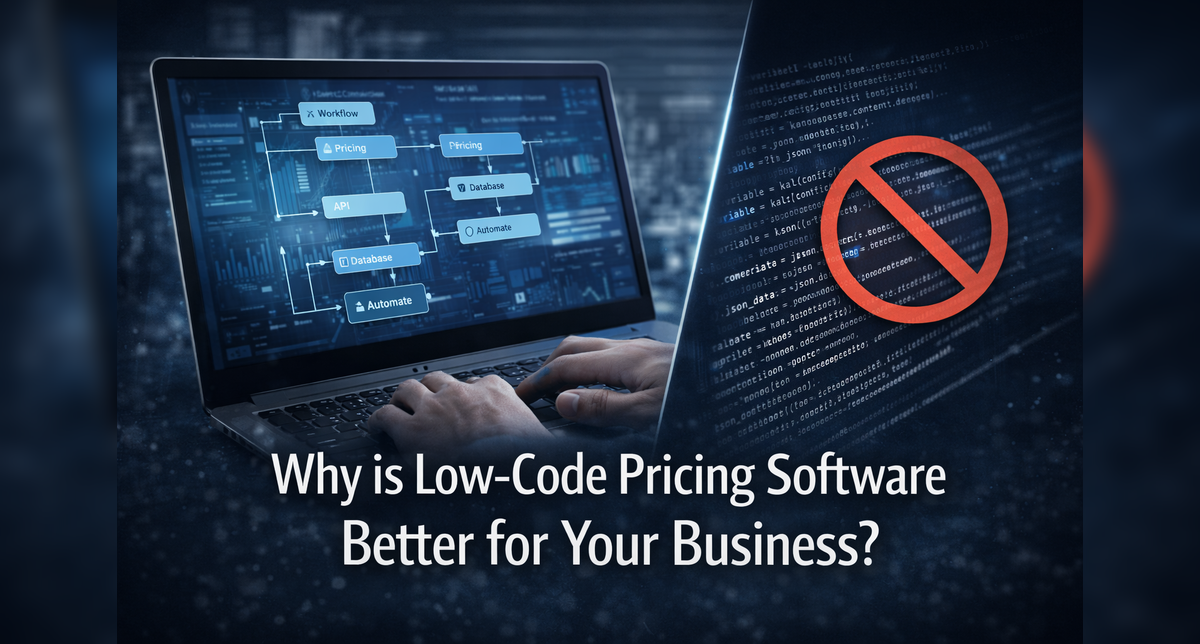
Low-code pricing software is exactly what it sounds like: a purpose-built platform that allows users to design, build, and deploy sophisticated pricing logic using visual tools, drag-and-drop interfaces, and pre-built components, rather than relying on traditional hand-written code.
Think of it as the difference between commissioning a bespoke suit entirely from scratch and working with a master tailor who hands you high-quality pre-cut pieces that you assemble and fit to your precise measurements. The result is tailored, professional, and highly functional. But the time and cost to get there is a fraction of what it once was.
This distinction matters enormously when you consider the alternative. Traditionally, building pricing logic into enterprise systems meant commissioning heavily code-configured tools – platforms that routinely ran to hundreds of thousands of dollars in implementation costs, required armies of developers and consultants, and took months or even years to go live.
By the time those projects were complete, the market had often moved on. Low-code platforms were built precisely to break that cycle: the complex architecture is pre-engineered so that your team configures rather than constructs and deploys in weeks rather than years.
For the non-technical business leaders reading this, low code does not mean low capability. It means low barrier to entry. The sophistication is built into the platform. What changes is who gets to use it – and how quickly they can make it work.
The Six Reasons Why Smart Businesses Are Choosing Low-Code Pricing Software
1. Speed That Changes the Game
In competitive markets, pricing agility is a genuine commercial advantage. The ability to respond to a competitor’s promotion within hours rather than weeks can be the difference between retaining a customer and losing them permanently. In these times of rampant and rapid price fluctuation from tariffs to pandemics to regional conflicts, being able to react quickly on price can be the difference between business success and catastrophic margin leakage.
Low-code platforms compress deployment timelines dramatically. What traditionally took development teams months to build, and test can be configured in weeks. That is not a marginal improvement. That is a structural transformation in how quickly your business can act.
For Sales Directors launching new territories, or Marketing Managers running time-sensitive campaigns, this speed is not a luxury. It is a necessity.
2. Cost Efficiency That the CFO Will Notice
Mid-level and enterprise software development costs serious money. Not just in licensing and infrastructure costs, but in the people required to make it work. Skilled developers command premium salaries, and when your pricing system needs constant maintenance or enhancement, those costs compound quickly.
Low-code platforms significantly reduce this burden. Because much of the logic is configured rather than coded, you need fewer specialist resources to build and maintain your pricing environment. Business users take on more of the configuration work themselves, guided by intuitive interfaces that do not require a computer science degree to navigate.
The result? Lower total cost of ownership, more predictable budgets, and development resources freed up for higher-value initiatives.
3. Empowering the People Closest to the Busines
Here is something worth sitting with for a moment. The people who understand pricing best, your commercial teams, your finance analysts, your product strategists, are rarely the people who build and maintain the systems that execute it. That disconnect has real consequences.
Low-code pricing platforms close that gap. They put configuration power directly in the hands of business users, people who can translate strategy into system logic without waiting for an intermediary. A Pricing Manager can test a new tiered model. A Finance Leader can adjust margin thresholds. A Product Manager can launch a promotional structure. The Sales Team have access to a guard railed price corridor that makes fast quoting simultaneously simple to understand, straightforward to defend and easy to execute. All without raising a single development ticket.
This is not about removing IT from the equation. It is about giving the business the autonomy it needs to move at the speed the market demands.
4. Better Collaboration Across Your Business Functions
One of the underappreciated costs of traditional pricing systems is the friction they create between teams. IT departments and commercial business units often operate on different timescales, with different vocabularies, and very different definitions of urgency. When pricing changes are routed through long technical development cycles, important context gets lost and working relationships fray.
Low-code platforms naturally foster a more collaborative working environment:
- Business teams can visualise and validate pricing logic before it goes live
- IT teams retain governance and oversight without becoming a bottleneck
- Shared dashboards and audit trails keep everyone aligned on the same picture
- Feedback loops between commercial and technical teams become faster and more productive
The outcome is an organisation where pricing is genuinely a shared discipline, not a handover process.
5. Operational Pricing Efficiency Through Automation
Good pricing software does not just store your pricing rules. It executes them, monitors them, and flags anomalies without anyone needing to check manually. Low-code platforms typically come with pre-built automation capabilities that streamline workflows across the entire pricing lifecycle.
Approval workflows, exception handling, discount guardrails, margin alerts, regional rule management: these are the kinds of operational processes that once required either manual intervention or expensive custom development. In a well-configured low-code environment, they run reliably in the background, day in and day out.
For an IT Manager or Operations Leader, this means fewer fires to fight and far greater confidence that the system is doing exactly what it was configured to do.
6. Maintenance Without the Headache
Perhaps one of the most underrated advantages of low-code platforms is how much easier they are to maintain over time. Traditional coded systems accumulate technical debt. Each customisation added complexity. Each new integration creates a potential point of failure. And when the developer who built it moves on, institutional knowledge walks out the door with them.
Low-code platforms are designed to be maintained visually, by the very people who use them. Updates are applied through the same intuitive interfaces used to build the original configuration. And because leading platforms are cloud-hosted with regular vendor-managed updates, you benefit from ongoing improvements without disruptive, resource-hungry upgrade projects.
What to Look for in a Quality Low-Code Pricing Software Platform
Not all low-code pricing software is created equal. When evaluating platforms, enterprise leaders should look for:
- Scalability: Can the platform handle your transaction volumes, product complexity, and geographic spread as you grow?
- Integration capabilities: Does it connect natively and reliably with your CRM, ERP, and CPQ systems?
- Governance and audit trails: Does it give IT and compliance teams the visibility and control they need?
- Configurability: How much can business users genuinely do without developer support?
- Vendor stability and support: Is this a platform built for the long term, with active development and responsive service?
The right platform will feel less like a piece of software and more like a genuine partner with commercial capability. It should make your pricing team more powerful, your finance team more confident, and your IT team considerably less stretched. When a platform does all of that, you know you have found something worth investing in.
Why Low-Code Pricing Software Lets You Play Catch-Up with Your Ambitions
Pricing is, at its heart, a decision-making process. It reflects your understanding of value, your read of the market, and your judgement about what customers will genuinely bear. The systems that execute those decisions should amplify your thinking, not constrain it.
Quality low-code pricing software like Velon® represents a real shift in what is possible. It brings speed, accessibility, collaboration, and efficiency to a function that has historically been slow, siloed, and frustratingly dependent on technical resources that always seem to be stretched thin.
For CEOs and C-level leaders, it is a route to commercial agility. For Finance Directors, it is a path to better margin management. For Sales and Marketing leaders, it is the freedom to move at the pace the market demands. For IT Managers, it is a way to support the business without being perpetually overwhelmed by the weight of it.
The technology is mature. The business case is clear. The only remaining question is how much longer your current system can afford to hold you back.
The good news is that you are not on your own to assess if you are ready. Help is right here. We look forward to talking to you today.
Frequently Asked Questions on Low-Code Pricing Software
Is low-code pricing software suitable for highly complex mid-level or enterprise pricing environments?
+
Yes, in most cases. Modern low-code platforms support multi-dimensional pricing models, tiered and bundled structures, regional rule sets, and multi-currency environments. For truly unique edge cases, some bespoke development may still be warranted, but most mid-level and enterprise pricing challenges fall well within the scope of what today’s leading platforms handle confidently.
How long does implementation typically take?
+
Because low code removes much of the custom coding work, initial deployment can often be achieved in weeks rather than months. Many organisations go live in four to eight weeks, with additional configurations rolled out incrementally as confidence grows.
Will our IT team lose control or visibility over the system?
+
Quite the opposite. IT teams retain control over architecture, security, and integrations, while business users configure pricing logic within clearly defined parameters. Comprehensive audit trails and role-based access controls ensure oversight is never compromised.
How to make the internal business case for switching platforms?
+
Start with an honest accounting of your current approach: development time, maintenance costs, slow pricing cycles, and risk exposure from legacy systems. Then model the efficiency gains. For most businesses, the return on investment becomes strikingly apparent once those numbers sit side by side.
What happens to our configurations when the vendor releases platform updates?
+
Reputable platforms are designed so that infrastructure updates do not disrupt existing configurations. This is one of the key long-term advantages over fully custom systems, where even minor updates can require significant regression testing and remediation work.
Can pricing rules be tested before going live?
+
Yes. Sandbox environments and simulation tools allow pricing teams to model the commercial impact of new rules before deploying them to production, giving leaders the confidence to move quickly without flying blind.