
How AI CPQ Solutions Are Transforming B2B Quoting Software
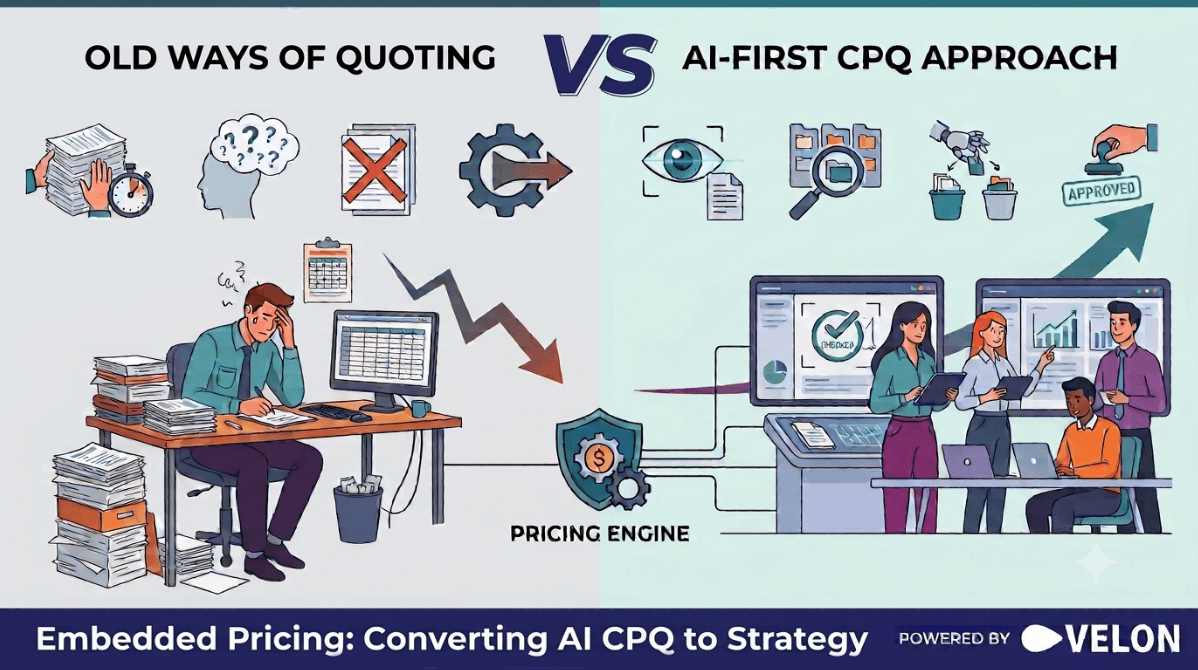
There is an old truth in business that never goes out of fashion: a company only ever moves as fast as its slowest decision. And for manufacturers, distributors and industrial suppliers, few decisions carry more weight, or more friction, than the humble quote. Get it right, and you win the deal at a fair margin. Get it wrong, and you either lose the business or win it at a loss. For decades, that decision leaned entirely on human memory, spreadsheets and the patience of an engineer willing to double check someone else’s arithmetic. Now, something has shifted. AI CPQ (Configure Price Quote) software has arrived not as a replacement for that human judgement, but as its most capable assistant yet.
That distinction matters more than most vendors are willing to admit out loud. There is a world of difference between native AI CPQ and AI Agents that are built upon shaky hallucinatory AI foundations, and true AI-first quoting technology, engineered as a blanket over the firm established foundations of data governance, solid outcomes, trust, interoperability, experienced human decision making and explainability.
The first approach chases headlines and quick (hopefully) fixes. The second, an AI-first approach like that of Velon® , quietly reshaping how quotes get profitably built, priced and delivered.
This article is not about imagining some AI-native future where machines run the business unsupervised. It is about the practical, provable ways AI powered CPQ software is transforming B2B quoting today, for the finance leaders watching margins, the operations managers watching throughput, and the production managers watching the shop floor.
How AI CPQ software is changing how B2B manufacturers and distributors quote, price and deliver complex products
AI CPQ software is changing how B2B manufacturers and distributors quote, price and deliver complex products, not by replacing human judgement, but by removing the manual grunt work that slows quoting down.
The real gains come from an AI-first approach that keeps people firmly in control, rather than an AI-native promise of machines running the show unsupervised.
- ✅ AI reads drawings and specifications to catch errors before they reach the shop floor
- ✅ Historical quotes and engineering knowledge become searchable, not just remembered
- ✅ RFQs (Requests for Quotes) and BOMs (Bills of Materials) get processed and validated automatically, cutting hours to minutes
- ✅ Manufacturing planning and forecasting draw on real data, not guesswork. Every recommendation still passes through a human decision maker before it counts
- ✅ AI driven price guidance applies consistent pricing or margin guardrails and pricing rules to prevent unprofitable quotes
Read on for full details.
Transforming B2B Quoting: Why the Old Way Stopped Working
Traditional quoting broke down for a simple reason: complexity grew faster than the tools meant to manage it. Product ranges expanded, customisation became the norm rather than the exception, and every new variant multiplied the number of ways a quote could go wrong.
The symptoms are familiar to anyone who has sat through a quoting review meeting:
- Salespeople chasing engineers to validate configurations that should never have needed validation
- Costs estimated rather than calculated, because nobody had time to do the sums properly
- Pricing that shifted depending on who happened to be holding the pen
- Bills of Materials assembled after the quote was sent, rather than before
None of this was anyone’s fault. It was simply what happens when manual processes meet growing complexity. AI CPQ solutions do not solve this by adding intelligence for its own sake. They solve it by giving structure back to a process that had quietly lost it and then layering genuinely useful automation on top.
CPQ Use Cases: The Solid Foundation that AI Builds Upon
Before any AI CPQ software can add value, it needs a solid foundation to work from. That foundation is the core discipline of Configure, Price, Quote itself, and it covers more ground than people often assume:
- Automating the quotation process itself, cutting turnaround times and replacing manual spreadsheet calculations with consistent, repeatable logic
- Centralising product, BOM, labour and overhead costing, so margin guardrails are applied automatically rather than hoped for
- Guided product configuration that validates dimensions, materials and finishes against the rules that actually govern what can be built
- Managing the flow from quotation through to work orders and shop floor visibility, without duplicating what the ERP already does well
- Structured customer portals for RFQ submission, document exchange and status tracking
- AI price guidance to apply systematic pricing or margin guardrails and develop floor, ceiling, and target price recommendations in line with your profit goals and business objectives.
This is the sturdy scaffolding of quotation software. AI does not replace it. It sharpens it, speeds it up, and removes the friction that still lingers even in well run quoting departments.
AI Use Cases: Where the Real Quoting Transformation Happens
This is where the story becomes genuinely interesting, and where the AI-first philosophy earns its keep. Rather than promising some distant, self-governing future, AI-first CPQ focuses on well defined, immediately useful tasks that save real hours and prevent real mistakes.
Document & Drawing Intelligence
Every quoting team knows the frustration of a tender pack: pages of drawings, specifications and PDFs, each one a potential trap for a missed dimension or an overlooked material callout. Document and drawing intelligence changes that dynamic entirely. It reads technical drawings and specification documents, extracts dimensions, materials and quantities, and flags discrepancies between what one document says and what another implies. A drawing to BOM validation check, run in seconds, can catch an inconsistency that might otherwise have surfaced only after the product reached the shop floor.
RFQ & BOM Processing
Closely tied to that same discipline is the handling of incoming RFQ files and Bills of Materials, which arrive in every conceivable format, from tidy spreadsheets to scanned attachments that barely resemble one another. AI supported RFQ and BOM processing ingests and classifies these files automatically, normalises inconsistent component descriptions into a common language, and identifies manufacturer part numbers even when they are written differently across documents. It also flags anomalies, such as parts nearing the end of their lifecycle or components that do not match anything in the current catalogue, well before a quote reaches the customer. What once took an estimator an afternoon of cross referencing now takes minutes, and with considerably less risk of something slipping through unnoticed.
Historical Intelligence & Knowledge Retrieval
Sales and engineering teams have always relied on a handful of experienced colleagues who simply know things: which customer wants which configuration, which combination causes problems, which historical quote is worth reusing. Historical intelligence and knowledge retrieval AI tools make that institutional knowledge available to everyone, not just the people who have been in the business longest. They search and surface similar past quotations, configurations and engineering decisions the moment a comparable job comes through the door. When a near identical project was quoted eighteen months ago, that precedent should inform the new quote in seconds, rather than depending entirely on whether the right person happens to remember it.
Guided Selling & Assistance
Guided selling and assistance AI tools build directly on that retrieved knowledge, helping translate what a customer actually wants into a configuration that is valid and buildable. They interpret customer design intent, suggest appropriate options, and act as a copilot for answering technical product questions drawn straight from internal documentation. This is not a chatbot inventing answers on the fly. It is a retrieval system putting existing expertise where it is needed, exactly when it is needed, so newer sales staff can quote with the confidence of a twenty-year veteran.
AI-Driven Price Guidance Ensuring Your Margins
AI-driven price guidance brings intelligent pricing governance to every quote, applying consistent margin guardrails and pricing rules that keep profitability protected from the first calculation onward. Rather than relying on guesswork or static spreadsheets, the system develops clear floor, ceiling, and target price recommendations aligned to your profit goals and wider business objectives.
This means cost models, margin controls, and approval workflows work together automatically, catching unprofitable quotes before they ever reach a customer. Sales teams gain the confidence to move quickly, knowing every price they offer sits within boundaries the business has already sanctioned, while finance leaders retain full oversight of discounting and approval processes. The result is systematic, defensible pricing that protects margins at scale, without slowing down the deals that matter.
Manufacturing Planning
Once a configuration is confirmed, the next question is always how it gets made. AI supported manufacturing planning recommends operations, routing and machine sequences, and estimates setup and cycle times based on historical data and established engineering rules. For production managers, this means fewer surprises between what sales promised and what the floor can realistically deliver, and a far tighter connection between the quote and the reality of the workshop.
Data Management
Behind every clean quote sits a mountain of product data, and that data is rarely as tidy as anyone would like. AI assisted data management detects duplicate or near duplicate parts, manages revisions properly, and helps structure information sensibly during new product launches, before messy data becomes a problem baked into every quote that follows.
Forecasting & Analytics
Finally, once quoting activity accumulates over months and years, it becomes a rich source of insight that most businesses barely tap into. AI forecasting and analytics capabilities analyse historical orders, quotations and pipeline data to sharpen sales forecasting, predict the likelihood that a given quote converts into an order, and surface commercial risks before they become losses. For a finance leader, this turns quoting from a purely transactional activity into a genuine early warning system for the health of the business.
Why AI-First Beats AI-Native for Real Businesses
Here is the honest distinction worth holding onto. An AI-native platform is often built around the idea that artificial intelligence should drive the process end to end, sometimes with humans reduced to an approval click. An AI-first platform, by contrast, treats artificial intelligence as a powerful contributor within a process still owned by people who understand the business, the customer and the risk involved. It reads the drawing, but the engineer confirms the interpretation. It suggests the configuration, but the salesperson makes the call. It flags the pricing risk, but the finance leader sets the guardrail.
There is a meaningful distinction between a CPQ system that manages configuration and an AI-informed CPQ platform that is genuinely infused with pricing intelligence. The former brings structure. The latter brings strategy
This is precisely the philosophy behind pricing infused CPQ platforms such as Velon® , where AI capability sits alongside genuine pricing intelligence rather than instead of it. The pricing engine continuously refines its recommendations using real-world data, and those recommendations flow directly into the quoting process. Sales teams are not just operating within rules. They are operating with evidence. The result is not a system promising to think for you. It is a system that removes the tedious, error prone parts of quoting so your people can spend their time on judgement, relationships and strategy, the things machines still cannot do and, frankly, should not be asked to.
This is the difference between knowing what you are allowed to quote and knowing what you should quote to win the deal and protect the margin simultaneously. Start a discussion with us today to begin your journey to smarter and more profitable quoting.
Frequently Asked Questions on How Transformative AI Powered CPQ Software Can Be
How quickly can a business expect to see returns after adopting AI CPQ software?
+
Most organisations notice improvements in quote turnaround and configuration accuracy within the first few weeks, since these gains come from automating existing bottlenecks rather than waiting on new behaviours to form. Expect a 10x return on investment in the first 12 months, followed by a 20x return after that.
Does introducing AI into quoting increase the risk of pricing errors slipping through unnoticed?
+
Properly implemented, AI CPQ solutions eliminate the risk rather than increase it, because margin guardrails and validation rules are applied consistently and flagged for human review rather than left to individual judgement alone.
What kind of internal data does a business need before AI features become genuinely useful?
+
Reasonably organised historical transaction data including quotes, product and BOM records, and consistent document formats are enough to start, and much of that tidying can happen alongside implementation rather than beforehand.
Will AI CPQ software replace the need for experienced quoting and engineering staff?
+
No, and this is precisely the point of an AI-first approach. It preserves and extends the value of experienced staff by making their knowledge searchable and reusable, rather than attempting to substitute their judgement.
How does AI CPQ software fit alongside an existing ERP or CRM system?
+
It sits as a decision layer between the two, drawing on ERP product, cost and transaction data and CRM customer data, without duplicating either system’s core functionality. We can connect to any ERP or CRM system whether designed for small organisations like Sage, or HubSpot or very large systems such as SAP, Salesforce or Microsoft Dynamics.