
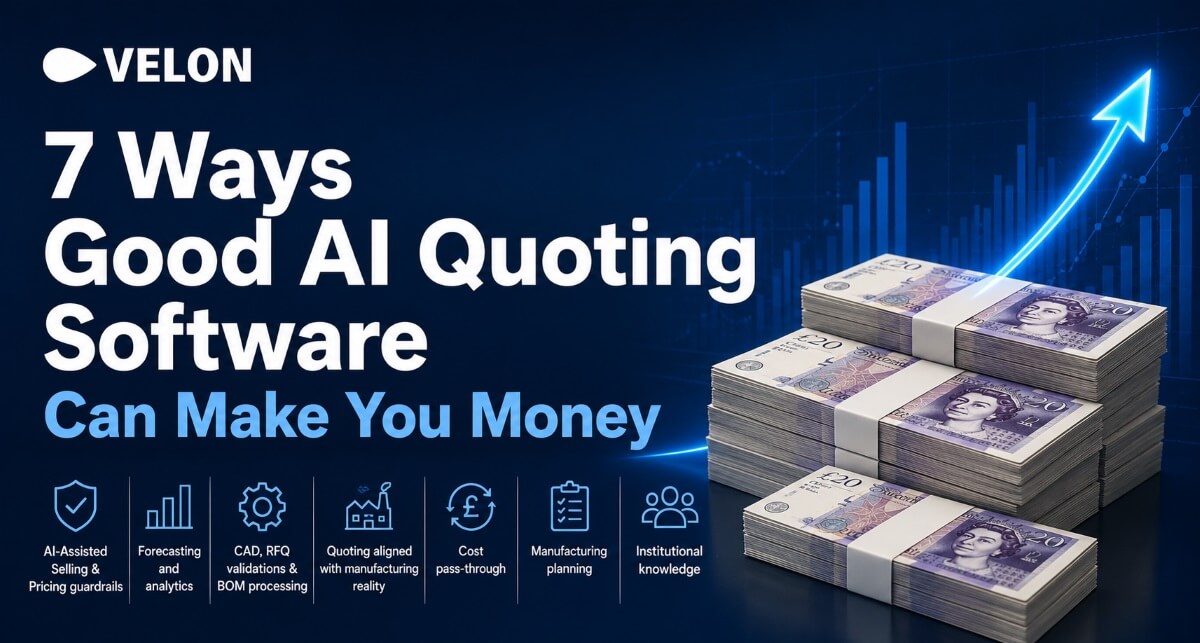
7 Ways Good AI Quoting Software Can Make You Money
Long before the sextant existed, a ship’s navigator used a compass to guide his vessel and its crew safe and quick passage. He didn’t abandon the magnetic compass. When sextant came along, he used both, the compass for speed and certainty, the stars for judgement and course correction, and together they got the ship home faster and safer than either could alone. That, in essence, is the story of what is happening in B2B quoting right now. The sextant has arrived and it is called artificial intelligence (AI). And the navigators, your finance leaders, your sales teams, your production managers, are the ones who still decide where the ship is heading.
This distinction matters more than any software vendor brochure will care to admit. There is a world of difference between AI that quietly assists the people running your business and AI that promises to run the business itself. One approach, AI-first quoting like Velon®, keeps human judgement at the centre and uses automation to remove friction. The other, AI-native, dreams of a future where algorithms make the calls unsupervised.
This article concerns itself entirely with the former, because that is where the real, provable money is being made today, not in some speculative tomorrow.
Let’s examine the top 7 ways that good AI-informed Configure – Price – Quote (CPQ_ software can make your business money.
The Short Version on AI Quotation Software Value: For Readers Who Value Their Time
Good AI-first quoting software makes money by removing the friction, delay and inconsistency that quietly erode margin in every manual quoting process. Here is the shape of it, one sentence per reason:
- ✅ AI-Assisted Selling & Pricing guardrails enforce the discipline your business already decided on, consistently, on every single quote.
- ✅ Forecasting and analytics turn historical quoting activity into an early warning system for the health of the business.
- ✅ Computer-Aided Design (CAD) drawing and Request for Quote (RFQ) validations and Bill of Materials (BOM) processing that once took hours now completes in minutes, freeing your team to focus on strategy and catches costly errors before they ever reach the shop floor.
- ✅ Quoting aligned with manufacturing reality ensures what gets sold matches exactly what production can actually build
- ✅ Cost pass-through becomes a proactive, evidence-based strategy rather than a reactive scramble against yesterday’s numbers.
- ✅ Manufacturing planning keeps what was promised and what gets built firmly in sync.
- ✅ Institutional knowledge stops living in a handful of heads and becomes searchable by the whole team.
Every one of these gains comes from AI working alongside your people, not instead of them.
Read on for the full story behind each one
1. AI-Assisted Selling & Pricing Guardrails Turn Good Intentions into Consistent Outcomes
Manual pricing tends to drift, and it drifts in ways nobody notices until the numbers are added up at year’s end. One salesperson quotes at a healthy margin because they have the seniority and confidence to hold the line. Another, chasing a deal against quarter-end pressure, quietly lets it slip by a percentage point or two. A third splits the difference and hopes the volume makes up for it later. None of this reflects a lack of discipline on anyone’s part. It reflects the simple fact that humans, left to manual processes and inconsistent information, will always behave inconsistently, no matter how good the sales training has been.
When a number falls outside the agreed range, it gets flagged for the appropriate person to review rather than quietly waved through under deadline pressure. This is not automation replacing strategy. It is AI-assisted selling enforcing the strategy you already chose, consistently, at scale, regardless of who happens to be holding the pen that day, so your margin targets stop being aspirational and start being real.
2. Forecasting Turns Quoting History into an Early Warning System
Once quoting activity accumulates over months and years, it becomes a genuine source of insight that most businesses barely tap into, treating each quote as a one-off transaction rather than a data point in a much larger pattern.
On the other hand, AI-driven forecasting and analytics analyse historical quotes, orders and pipeline data to sharpen sales forecasts, estimate the likelihood that a given quote converts, and surface commercial risks before they turn into losses that show up unexpectedly on a management report.
This works because patterns that are invisible to any one person become obvious once enough quotes are analysed together. A customer segment that consistently negotiates hard but rarely closes. A product line whose margins erode every time a particular competitor is in the mix. A quote-to-order lag that quietly stretches out during certain seasons. For a finance leader or a chief executive, this is the point where quoting stops being a purely transactional activity and becomes a genuine barometer for the health of the business, one that speaks well before the quarterly numbers do.
3. CAD Drawings and BOM Specifications Get Checked Before They Cost You Anything
Every estimator knows the dread of an incoming tender pack: pages of CAD drawings, technical specifications and PDFs, each one a small opportunity for a missed dimension, an overlooked material callout, or a discontinued component nobody thought to check. AI-first document intelligence reads those files, extracts the dimensions and materials automatically, and flags where one document quietly contradicts another, the kind of inconsistency that a tired estimator on their fourth tender pack of the day might reasonably miss.
What once consumed an entire afternoon of manual cross-referencing a CAD-to-BOM validation check that would consume an estimator’s entire afternoon now completes in minutes, with considerably less risk of something slipping through unnoticed.
The system catches when a drawing calls for a material your supplier has discontinued, or when dimensional tolerances conflict with your current machine capabilities and it does so with considerably more consistency than a human working under time pressure.
More importantly, the discrepancy can be caught before the quote leaves the building, not after it reaches the shop floor, where the same mistake costs considerably more to fix, both in wasted material and in the awkward conversation that follows with the customer. This is the kind of quiet, unglamorous win that rarely makes it into a boardroom presentation, yet it protects margin every single week.
4. Quoting Gets Aligned with What Can Actually Be Manufactured
There is a gap that exists in almost every manufacturing business, and most people only notice it once it starts costing them real money. A salesperson builds a quote, the customer signs off, and production opens the file only to discover that what was promised bears little resemblance to what can be built, at that cost, in that timeframe.
Consider a mid-sized fabrication firm quoting on best judgement alone, or a plastics manufacturer whose raw material costs shift weekly while a quote sits on last month’s numbers.
These are not rare mishaps.
They are the everyday cost of running a quoting process disconnected from the factory floor.
AI-first alignment closes that gap at the source. Dynamic routing sends a quote to the right reviewer automatically, whether that is an engineer checking a specification or a finance lead approving a discount. The configured product maps directly onto real production routing, so what is sold matches how it will be made. Live connections to ERP and supply chain data mean every quote reflects current costs, not historical assumptions, and rule-based validation catches dependency and compatibility errors before a customer ever sees them. The result is a quote that is not merely attractive. It is operationally honest, and margin protection begins well before production ever picks up a single component.
5. Cost Pass-Through Becomes a Strategy Not a Scramble
Traditional CPQ systems handle rising costs the way a weary accountant handles a stack of invoices: reactively, and usually a few days too late to matter. A supplier raises prices, someone fights the new numbers into a spreadsheet by hand, and by the time the adjustment reaches a live quote, several deals have already gone out at yesterday’s margin, quietly costing the business money nobody will notice until the month closes.
AI-assisted quoting flips that sequence entirely, turning cost pass-through from a backward-looking correction into a forward-looking strategy. Rather than applying a static formula after the fact, it analyses live cost data alongside customer history to determine exactly when a cost increase should be passed through, how much of it should be absorbed, and which customers can reasonably bear which percentage. A price-sensitive account might see a modest increase spread carefully over time. A strategic partner might absorb more, based on evidence and relationship history rather than guesswork or gut feeling. The human still makes the final call. The AI simply hands them the case file first, fully prepared.
6. Manufacturing Planning Stops Guessing What Sales Promised
The moment a quote is confirmed, a new question begins, one that determines whether the deal is profitable: how does this get built, and at what real cost? In too many organisations, production discovers the true bill of materials only after the order lands, sometimes learning that the quote assumed a material, a process, or a lead time that no longer applies by the time work begins.
AI-supported manufacturing planning recommends routing, sequencing and setup times based on the specifications confirmed in the quote, drawing on historical performance rather than optimistic assumptions made under sales pressure.
For a production manager, this closes one of the oldest and most expensive gaps in manufacturing: the space between what sales promised in good faith and what the workshop can realistically deliver on schedule and on budget.
7. Institutional Knowledge Becomes Everyone’s Knowledge
Every organisation has a person who simply remembers things, the one colleague everyone quietly relies on. Which configuration caused trouble last year and why. Which historical quote is worth pulling out and reusing. Which supplier substitution worked out fine despite everyone’s initial concerns. The trouble is, that knowledge tends to live in one head, and heads occasionally go on holiday, retire, or move to a competitor, taking years of hard-won experience with them.
AI-first knowledge retrieval surfaces relevant historical quotes and engineering decisions the moment a comparable job arrives, cross-referencing years of past work in the time it takes to make a coffee. This means a newer member of the sales team can quote with something approaching the confidence of a twenty-year veteran, not because they have memorised the same history, but because that history is now searchable rather than locked away. This is not invention. It is retrieval, placing existing expertise exactly where and when it is needed, so the business stops depending on any single person’s memory to get a quote right.
What AI Quoting Means – Whoever You Are in the Business
A finance leader gains margin visibility and fewer month-end surprises. A sales leader gains a team that quotes faster and with more consistent confidence, regardless of tenure. An operations or production manager gains a tighter, more reliable link between what was promised and what gets built. A pricing lead gains enforcement of the strategy already agreed, without having to police every quote by hand. And a CEO gains a quoting process whose quality no longer depends on which desk a job happens to land on.
None of this requires machines running unsupervised. It requires AI CPQ Software like Velon® doing what AI does well, the tedious cross-referencing, the constant recalculation, the pattern recognition across years of data, so that the people who understand the customer, the product and the risk can spend their time on judgement, relationships and strategy. That is the AI-first philosophy in full, and it remains the only version worth building a business around.
Take your company’s first step to building AI quoting capabilities by speaking with our team today and discover how your organisation can make more money ASAP.
Frequently Asked Questions on AI Quoting Software
How is AI-first quoting different from AI-native quoting?
+
AI-first keeps a human decision maker in the loop at every meaningful step, using AI to remove manual friction. AI-native aims to run the process end to end with minimal human oversight, which introduces considerably more risk than reward in a manufacturing context.
Does adopting AI-first quoting mean fewer jobs for experienced staff?
+
No. It preserves and extends their value by making their knowledge searchable and reusable, while removing the repetitive work that slows them down.
What happens when the AI encounters something it has not seen before?
+
A properly designed AI-first system flags the unfamiliar case for human review rather than guessing. That safeguard is precisely what separates AI-first thinking from AI-native overreach.
How much clean data do we need before this becomes useful?
+
Nobody’s data is 100% clean, so starting with imperfect data will always be the case. Reasonably organised historical quotes, product records and bills of materials are enough to start, and much of the tidying can happen during implementation.
How quickly can a mid-sized manufacturer expect to see results?
+
Most organisations notice improvements in quote turnaround and accuracy within the first few weeks, since these gains come from automating existing bottlenecks rather than waiting for new habits to form.