
How to Build a Business Case for Quotation Software
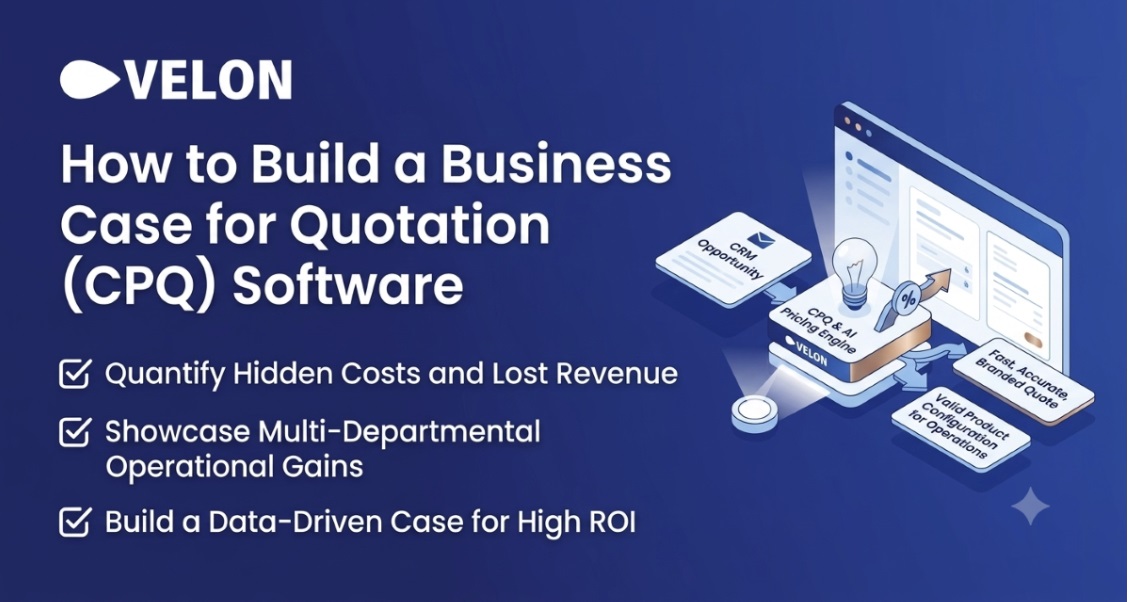
There is a light bulb moment that many B2B business leaders can identify with, even if they have never put a name to the money the company loses through a poor or inefficient quotation system. For many, their salesperson sits down to prepare a quote. They open a spreadsheet. Then another. They fire an email to engineering to check if they have the production capacity to fulfil the potential. They call someone who “knows the pricing” but they are either sick, in Portugal on holiday for a week or taking personal leave. Eventually, some days later, a (hopefully) accurate quote finally lands in the customer’s inbox. By that point, your competitor has already sent their quote last week.
This is not a rare story. At Velon®, we hear this scenario play out from companies in need of assistance regularly. In complex manufacturing and distribution businesses, it plays out dozens of times each week, quietly costing revenue, margin and momentum in equal measure.
Building a business case for quotation software begins with recognising this pattern for what it is: not a people problem, not a training problem, but a systems problem. And systems problems, thankfully, have systems solutions.
Let’s dive right in and discuss the potential system problems in depth and how quality quotation software can quickly solve these conundrums for companies just like yours.
Why Do You Need Quotation Software? – The Top 5 Points to Consider
Building a business case for quotation software means putting a number on that cost and presenting a clear framework for change.
Here are the key takeaways from this article:
- ✅ Slow, inconsistent quoting directly impacts revenue, margin and operational efficiency across sales, finance and production teams
- ✅ Configure Price Quote (CPQ) software connects configuration, cost and pricing into a single controlled process, eliminating guesswork at every stage
- ✅ The strongest business cases address not just quoting speed but the downstream operational gains from reducing errors, rework and commitment risk
- ✅ AI-powered pricing embedded within a quotation platform goes further still, optimising every deal in real time against market conditions, capacity and cost
- ✅ Quotation software ROI compounds across faster cycles, stronger margins and improved alignment between what is sold and what can be delivered
Read on to get the full picture.
The Hidden Cost: What Unstructured Quoting Actually Costs Your Business
The instinct in most organisations is to underestimate the cost of a slow or inconsistent quoting process. After all, quotes do eventually get sent. Deals do occasionally close. But the real cost of unstructured quoting does not live in the deals that fail outright. It hides in the margins that quietly erode, the cycles that stretch longer than they should, and the operational chaos that begins the moment a poorly specified quote is accepted.
Consider what is happening behind the scenes when quoting lacks structure:
- Pricing is applied inconsistently, with different salespeople calculating differently from the same product range
- Engineering teams are repeatedly pulled in to validate configurations that should never have reached them
- Bills of Materials are assembled after the quote is sent, introducing cost uncertainty into commitments already made
- Historical quotes are reused without recalculation, because rebuilding from scratch simply takes too long<
For any organisation evaluating quotation software ROI, this is where the numbers begin to speak clearly.
Published research shows that structured quoting correlates with five times greater annual revenue growth and nearly a five-fold improvement in year-over-year profit growth compared to peers.
That is not a marginal gain. That is a structural commercial advantage and will be a much larger number than you might ever consider.
That is not a marginal gain. That is a structural commercial advantage and will be a much larger number than you might ever consider.
Research shows that companies typically achieve margin improvements of 100 basis points or 1% to 5% returns on sales. For a £300 million company, that translates to £3 to £20 million in additional operating profit. The first value signs are usually within weeks with a payback inside 6 months.
For a Finance Leader, the business case practically writes itself in those numbers. For a Sales Leader, it is the story of cycles that shorten and win rates that improve, along with higher prices, and revenue without the need for volume gains. For an Operations Manager, it is the difference between a production line that flows with connection to the commercial team and one that stalls at every new order.
Understanding What Configure Price Quote Software Actually Does
At its most useful, it acts as the decision layer between your CRM and your ERP. It connects the moment a customer expresses a requirement to the moment a commercially sound, operationally executable proposal is ready to send. That sounds straightforward. In practice, it is transformative.
- Configure means your sales teams are guided through structured product rules. Only valid combinations are permitted. Dependencies and constraints are enforced automatically. No more calls to engineering for routine configurations. No more guesswork.
- Price means pricing logic is embedded directly into the quoting process. As configurations vary, as they always do when operating pricing software for complex businesses, pricing adjusts in real time against a known cost base. Discounting operates within controlled corridors. Margin visibility exists at the point of quote, not as a post-sale discovery.
- Quote means the final output is accurate, branded, commercially validated and operationally ready. The customer receives a clear proposal. Operations receive a fully defined internal Bill of Materials. Both are generated from the same logic, without duplication or rework.
This is not simply about sending quotes faster. It is about sending quotes that your business can actually deliver on.
CPQ Operational Efficiency: Where the Business Case Gets Even Stronger
Here is something that often goes unspoken in conversations about CPQ software for manufacturing and distribution: the value does not stop at the point of sale.
Complex manufacturing and distribution businesses are inherently supply-chain-heavy environments. When a quote is accepted, what follows is a cascade of operational commitments: production planning, procurement, fulfilment, logistics, inventory management. If the quote was built on estimated costs, incomplete configurations or unvalidated product rules, every downstream step carries risk.
Reducing quoting errors in manufacturing is not simply a commercial priority. It is an operational one. Quotation software addresses this directly by generating a dynamic Bill of Materials at the point of quote rather than after acceptance, giving operations the lead time and clarity they need before a commitment has already been made. Material requirements become visible early. Capacity constraints can surface before they become delivery failures. The gap between what sales commits and what operations can deliver begins to close.
This is the argument that Finance Leaders and CEOs often find most compelling. Speed and margin control are commercially attractive. But the ability to eliminate friction between sales and operations, together with the costly rework and delay that friction generates, is where the return on investment becomes genuinely undeniable.
The Quoting & AI Pricing Platform Compounding Advantage: Revenue Execution Meets Operational Reality
The conversation around quotation software for enterprise is evolving quickly, and any serious CPQ software business case today should account for where intelligent pricing and quoting is heading.
A CPQ software with AI-informed pricing engine like Velon® can recommend optimal prices in real time, drawing on market conditions, competitive positioning, customer segmentation and transaction history. When this capability is embedded within a quotation platform like this, (rather than operated as a separate tool), results compound. Every quote a salesperson sends reflects not just what the rules allow, but what the evidence suggests will win the deal at the best achievable margin.
But here is where the operational dimension becomes critical once mores to answer fundamental questions: Is this product feasible to build? What is the realistic lead time? What does production actually cost? Do we have the capacity? What is the delivery risk?
Without an intelligence layer that connects an AI-informed pricing and quoting platform to those operational realities, you risk something genuinely damaging; autonomous revenue execution that optimises deals that operations teams simply cannot deliver on.
This is the frontier where the most capable quotation platforms, those that bring pricing intelligence and operational connectivity together under one roof, create the greatest separation from their competitors.
Building Your CPQ Software Business Case: A Framework for Decision-Makers
With that context established, how does a leader construct a compelling internal argument for quotation software investment? The quote-to-cash process optimisation argument is powerful, but it needs to be grounded in the specific realities of your own operation.
Start with the evidence closest to home:
- How long does a typical quote take to produce today, from first customer requirement to proposal sent?
- How often do quotes require engineering validation for what should be routine configurations?
- How frequently does cost uncertainty emerge after a deal has been accepted?
- What is the discounting behaviour across your sales team, and is it consistent?
- How many production issues can be traced back to incomplete or inaccurate quote specifications?
These questions surface numbers that tend to be uncomfortable. Quoting processes that take days when they should take hours. Margin variances across deals that should be priced identically. Operational rework that ties directly back to sales commitments made without sufficient configuration rigour.
Once those numbers are visible, the financial case for change becomes straightforward to construct. Faster quoting cycles lead to shorter sales cycles. Shorter sales cycles improve conversion rates. Improved margin control compounds across every deal, every quarter. Reduced operational rework is a cost saving that does not require growth to materialise; it begins the moment the system goes live.
Every year a business operates without structured quotation software, the cost accumulates quietly. Quotes that arrive too late. Margins that drift. Operations that absorb the consequences of commitments made without full visibility into what they require.
The business case for quotation software is not built on aspirational projections. It is built on the compounding value of getting this right, consistently, at every deal, across every team, every single time a customer asks what something costs.
That is a case very much worth making.
For businesses evaluating platforms, the most powerful question to ask is whether the solution treats pricing and quoting as a single integrated capability or as separate tools requiring parallel maintenance. Solutions that bring both together, as Velon® does with its pricing-infused quotation platform, deliver a level of commercial cohesion that bolt-together alternatives rarely achieve in practice.
Talk to us today to begin delivering commercial cohesion for your business now.
Frequently Asked Questions on Building a Business Case for CPQ Software
How long does quotation software typically take to implement in a complex business?
+
Implementation timelines vary depending on product catalogue complexity and the number of systems requiring integration. Most businesses working with a well-structured platform can expect an initial deployment within a matter of weeks, with phased rollouts for more complex environments. The more important consideration is not the implementation timeline itself, but the quality of the configuration logic built into the system from day one, as this determines the long-term value the platform delivers.
Does quotation software require us to replace our existing CRM or ERP?
+
No. A well-designed quotation platform sits between your CRM and ERP rather than replacing either one. It acts as the decision and configuration layer connecting customer opportunity data with product, cost and fulfilment information. Most platforms offer pre-built integrations with major CRM and ERP systems, making the transition additive rather than disruptive to the broader technology stack.
What makes AI-informed pricing-embedded quotation software different from a standalone pricing tool?
+
When pricing intelligence is embedded within the quoting platform rather than operated separately, recommendations flow directly into the quote at the point of creation. This means every proposal reflects real-time commercial insight without requiring manual transfer between systems. The result is not simply faster pricing decisions, but more consistently optimised ones, applied at scale across every deal your team produces and anchored to the operational realities that determine whether those deals can be fulfilled.