
Ditch the Spreadsheets: Why Velon Quoting 2.0 Beats Excel for Pricing Strategy, Analytics & Beyond the Hype AI

A new product release for a smarter quoting and pricing system, built by pricers for non-pricers.
There is something quietly remarkable about a piece of software that understands the business it serves. Not software that promises the universe in a slide deck and then leaves your team wrestling with spreadsheets six months into implementation. Real pricing and quoting software systems working as a single unit is conceived and crafted by people who have spent careers inside the world of pricing, who understand its pressures, its politics, its peculiar joys and its very costly mistakes.
That is the world Velon® was built for. And with this latest product release, the platform takes a significant step forward, one that Finance Leaders, Sales Directors, Product Managers and Chief Executives will want to understand, because the quoting capabilities being introduced touch directly on margin performance, commercial efficiency and the quality of decisions your teams make every single day. And what’s best? – you can finally say goodbye to that ridiculous Excel price list you’re using.
“THE_ACTUAL_Real_PriceList_Not_The_Old_One_Mike_Sent_IGNORE_THAT_v12-USE.THIS.xlsx”
The latest Velon® software release is organised around three major pillars: smarter pricing strategy configuration, a new analytics engine, and AI capability that goes beyond the hype. Let us walk through each one.
No Time to Read the Entire Article? – What’s New in Velon Quoting at a Glance
Velon’s latest release is a significant step forward for businesses that want pricing to work harder, smarter and more profitably. Built by pricers for pricers, this update delivers major capability upgrades across strategy, analytics and AI that directly impact margin performance and commercial efficiency:
- ✅ Pricing strategy configuration now supports sophisticated cost and commercial price list management across customer segments, geographies and channels at scale
- ✅ Multi-period quoting enables period-by-period contract pricing across quarters, half-years or years, with volume and inflation variables built in
- ✅ A three-tier analytics engine delivers off-the-shelf, self-service and bespoke commercial insights, anchored by an upgraded pricing waterfall that shows exactly where pocket margin is being lost
- ✅ AI-driven price guidance surfaces floor, target and stretch prices per SKU, giving sales teams a confident pricing corridor grounded in historical data
If margin visibility, smarter quoting and AI that earns its place matter to your business, read on.
Pillar One: Pricing Strategy Configuration Gets Serious
At its heart, a pricing software platform serves two fundamental masters. The first is the operational side, getting the mechanics of pricing right. The second is strategy, ensuring that the prices your organisation goes to market with reflect your commercial objectives, your cost realities and your competitive position.
This release advances both fronts considerably.
Cost and Commercial Pricing, Working Together
The Velon® platform now supports more sophisticated cost price modelling, giving pricing and finance teams a structured way to work from the first lever of costing upward. Above that sits commercial pricing, including price list management that allows businesses to manage hundreds, even thousands, of SKUs across different customer segments, geographies and channels without relying on heroic manual effort.
Think about what that means in practice.
A manufacturer supplying both retail and trade customers does not treat those segments the same way when quoting, and nor should they.
Different customers carry different margin expectations from B2B trade accounts. A business operating across multiple geographies needs the flexibility to reflect local competitive conditions in its pricing without creating an administrative nightmare.
And when you are managing thousands of line items, doing any of this manually is not just inefficient. It is a commercial liability.
The price list management capability within this release automates that complexity and makes it governable, giving commercial teams the ability to pursue differentiated pricing strategies with confidence rather than chaos. The increased speed of automated price list management also means for more immediately reactive pricing, responding to sudden market fluctuations quickly and protecting your margins in as close to possible as real time.
Multi-Period Quoting: A Game-Changer for Contract-Based Businesses
One of the most significant operational enhancements in this release is the introduction of multi-period quoting. This is capability that enterprise businesses with contract-based revenue models have long needed, and it is now built into the platform.
Here is what it solves. When a manufacturer signs a three-year supply contract for, say, 10,000 units of a product delivered across three years at varying volumes per year, a single static price is rarely the right commercial answer. The first year might carry 3,000 units, the second 4,000, the third 3,000. Different volumes. Different market conditions. Potentially different cost structures as inflation or raw material costs shift.
Multi-period quoting allows businesses to:
- Structure contracts with period-by-period pricing, whether quarterly, half-yearly or annual
- Apply volume-specific pricing within each period
- Factor in inflation adjustments or other period-relevant variables
- Build the full commercial picture of a multi-year contract within a single quote
The air conditioning industry offers a vivid illustration. Seasonal volume swings are entirely predictable. Summer demand for cooling units is simply not the same as winter demand. Multi-period quoting lets a business reflect that commercial reality in the contract itself, rather than averaging it out into a single price that serves nobody particularly well. It is the kind of nuanced capability that competitive tendering increasingly demands, and that customer retention increasingly rewards.
Pillar Two: Analytics That Actually Drive Decisions
If pricing strategy is about setting the right prices, analytics is about understanding whether they are working, and where the next opportunity lies. This release introduces a three-tier analytics architecture that gives commercial leaders genuine visibility into portfolio and customer performance. And sitting at the heart of that architecture, newly upgraded and more powerful than ever, is the pricing waterfall.
The Pricing Waterfall: Where Revenue Reality Lives
There is a number almost every Finance Leader knows and every Sales Leader quietly dreads. It is the gap between the price you quoted and the price you collected. Every discount, rebate, freight allowance and promotional spend chips away at that number until what lands in the accounts bears little resemblance to what appeared on the quote.
That gap is represented on the price waterfall. And for most enterprise businesses, it is wider than leadership realises.
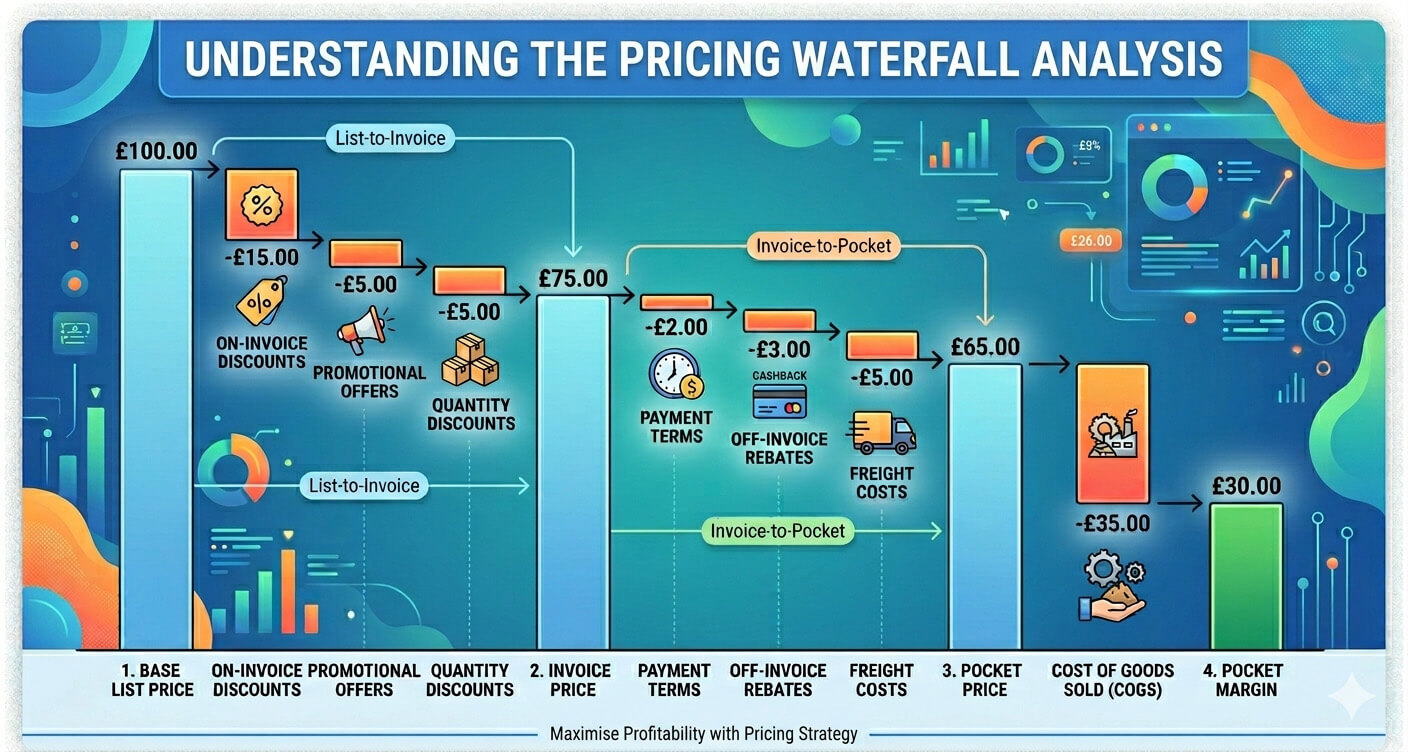
The upgraded waterfall capability gives commercial teams a structured, visual and granular view of exactly where pocket margin is being lost at every stage of the pricing journey:
- List price down through negotiated price and order discounts
- Invoice adjustments and off-invoice deductions
- Final net margin, comparable across customers, segments and product lines
Businesses that cannot see this clearly tend to repeat the same costly mistakes. They grant discounts without knowing the true cumulative cost of a customer relationship. They protect headline margins on paper while bleeding quietly through off-invoice rebates. And they treat all revenue as equal, when in practice some customers are genuinely profitable and others simply are not.
The upgraded waterfall ends that guesswork. Combined with multi-period quoting data, it also reveals how margin behaves across the full arc of a contract, period by period, as volumes shift and commercial conditions evolve. And when you can clearly see which customers consistently sustain strong net margins without heavy discounting, you are looking at the clearest possible evidence of perceived value. That is the foundation on which a value-based pricing strategy is built.
The Three New Flavours of Analytics Insight
The analytics capability in this release comes in three distinct forms, each serving a different level of analytical maturity and internal capability.
- Off-the-shelf insights are curated by the Velon team, drawing on deep pricing domain expertise. The product portfolio mix analysis is a good example. It allows commercial leaders to see, at a glance, which products are performing in terms of both margin and volume, how they cluster across a quadrant view, and which SKUs are pulling their weight versus those that are quietly dragging performance down. For example, the system can surface which 20% of products are generating the lion’s share of commercial value and then drill down to SKU-level recommendations. For a CFO or Sales Director, this kind of clarity is genuinely rare.
- Self-service analytics empowers teams who want to go further. Rather than waiting for Velon to build a new report, commercial teams can construct their own analytical views using the platform’s built-in builder. They define the parameters, they choose the lenses, and they get the insights that matter most to their specific business questions. Customer distribution patterns, product mix by channel, margin trends by segment: these become explorable rather than fixed.
- Bespoke analytics takes things to the deepest level, for organisations with the internal data capability to go directly into the underlying data environment and build fully customised analytical workstreams. This is not for every business, but for those who are ready for it, it represents a genuinely powerful extension of what the platform can do.
It is worth pausing here to note something important. When your analytics engine is surfacing granular data on which products command the strongest margins across which customer segments, you are not just looking at a performance dashboard. You are looking at the raw material for value-based pricing strategy. The insight that certain customers or segments consistently accept higher prices (willingness to pay) for specific products because they perceive greater value in them is exactly the kind of intelligence that underpins a shift from cost-plus thinking toward pricing that captures what you are genuinely worth. That journey starts with data, and this analytics layer is where that data becomes visible.
And within the analytics section, multi-period quoting data sits as a natural companion: the ability to track how period-specific pricing decisions perform over contract life, giving pricing teams the feedback loop they need to sharpen future contract negotiations.
Pillar Three: AI Beyond the Hype
Let us be honest about something.
The general AI conversation in mid-level and enterprise software has become, in many corners, a mix between the reality and an extraordinary exercise in wishful thinking and science fiction.
Bold claims abound.
Vendors who built a basic pricing and/or quotation software product in a few weeks using AI-assisted development tools announce themselves as AI-native platforms. White papers declare that traditional SaaS is finished and that AI agents will simply know your business better than you do.
We find that last claim particularly worth examining.
For example, a food manufacturer who has built their business over thirty years possesses accumulated knowledge, expertise and commercial judgement that no software system can replicate by claiming to have processed their data. The idea that an AI agent simply knows your business better than you do is not just overconfident. It is, in practice, a recipe for decisions you will later regret.
What’s more, while AI is great, for the deeply complex and often misunderstood pricing and quoting functions, the quick fixes often cited by proponents of AI Agents can often do more harm than good.
To maximise impact, AI should be applied to specific use cases with a transparent path to profitability. Success requires a robust data infrastructure where tools are integrated by software directly into operational workflows, instead of standalone software, and governed by a ‘human-in-the-loop’ approach.
Our latest release takes the latter position. AI is used precisely where it is fit for purpose and not deployed as a cosmetic feature designed to win procurement tick-boxes.
Price Guidance: Pricing AI That Earns Its Place
The AI capability being introduced in this release centres on price guidance, and it works like this. Drawing on historical transaction data, the system performs intelligent segmentation across your product portfolio and customer base. It identifies the factors that have historically influenced pricing outcomes, whether that is customer segment, geography, product category, order volume or some combination of those. It then uses that analysis to surface, for each SKU, a recommended price spectrum: a floor price, a target price and a stretch price.
For a commercial team building a quote, this is transformative. Rather than relying on instinct, tribal knowledge or last year’s price list, the salesperson has a data-informed pricing corridor in front of them. They know where they can go, what they are aiming for, and what their ceiling looks like. That confidence is visible to buyers. It accelerates decisions. And it protects margin at precisely the moments when sales pressure might otherwise erode it.
Claude Integration: Navigating Velon by Conversation
Perhaps the most forward-looking AI element moving forward is the integration of Claude as a navigational and operational interface within the Velon platform itself. Users will be able to interact with Velon conversationally, asking questions, retrieving insights, navigating workflows and surfacing data, all through a natural language interface that sits natively within the platform experience.
This is not general-purpose AI. A general-purpose model like a standalone chatbot is fine for many things, but it does not know your pricing data, your contract structures, your customer segments or your approval workflows. This integration is purpose-built around the CPQ and pricing environment. That specificity is what makes it genuinely useful rather than merely impressive in a demonstration.
The result is that pricers, sales managers and finance leaders can interact with the platform in the way that feels most natural to them and get answers that are grounded in their actual commercial reality.
Velon: A Powerful & User-Friendly Quoting and Pricing Tool Built by Experts- So You Don’t Need to Be
Every capability described in this release traces back to the same foundational conviction: that quoting and pricing software should be built by people who understand what pricing demands. Not just technically, but commercially, strategically and operationally.
Pricing is not a back-office function. It is one of the most powerful levers a business has access to, and the organisations that treat it that way, with proper tools, proper data and proper intelligence, consistently outperform those that do not.
This latest Velon® release moves the platform meaningfully forward across all three of its major pillars. Smarter strategy configuration gives commercial teams the structure to execute differentiated pricing at scale and deliver the quote at your best possible price. A three-tier analytics engine gives leaders the visibility to understand what is working and, crucially, to begin the journey toward value-based pricing strategy. And AI capability, grounded in real-world utility rather than vendor hype, gives every pricing decision a sharper, more confident edge.
For Finance Leaders tired of margin erosion they cannot explain. For Sales Directors whose teams are leaving money on the table with slow quoting processes. For CEOs who know their pricing could be working harder. This is where that journey gets easier, and considerably more profitable. Talk to us today to begin your journey to better and more profitable quoting.
Frequently Asked Questions on the latest Velon Product Release
The article mentions value-based pricing as a direction the analytics can support. How does that differ from what most businesses are doing today?
+
Most businesses price from cost upward, adding a target margin and adjusting for competitive pressure. Value-based pricing asks a different question: what is this product worth to this specific customer? The analytics in this release begin to make that answerable, surfacing which products sustain stronger margins across which segments and under what conditions buyers consistently accept higher prices. That data is the prerequisite for making the shift.
How does multi-period quoting interact with existing ERP or CRM systems?
+
Multi-period contracts generate data across their full lifecycle, including volume performance by period, pricing versus actuals and margin trajectories. The platform is designed to work within existing commercial infrastructure. The practical benefit is that your ERP does not need to carry the commercial intelligence that sits within the quoting and pricing layer. That intelligence lives where it belongs, in a purpose-built pricing environment, and communicates outward.
Our sales team already struggles with pricing governance. Will more sophisticated tools make that harder?
+
The opposite tends to be true. Governance fails most often because of ambiguity: salespeople unsure of the floor, managers lacking data to evaluate exceptions. AI-guided price corridors define the acceptable range clearly. Salespeople operate within it confidently, and genuine exceptions become identifiable rather than buried in email threads.
Is the Claude integration available immediately, or is it on a future roadmap?
+
Claude integration is in active development. It represents a deliberate and technically grounded approach rather than a rushed announcement, which is consistent with how the platform approaches AI capability generally.
What kind of businesses benefit most from multi-period quoting?
+
Any business with contract-based revenue where volume, price or conditions vary across delivery periods. Manufacturing supply agreements, distribution contracts, tiered service level agreements: these are its natural home. If your team is currently managing multi-year contracts in spreadsheets, the gains are immediate.
How should a CFO think about the ROI case for upgrading to this release?
+
Start with margin leakage. Unstructured discounting, slow quoting and misaligned price lists are all quantifiable costs. Add the time currently spent on manual analytics work and the case builds quickly. The analytics layer itself is often where the ROI conversation begins, because it makes the leakage visible for the first time.