
How Better Quotes Aid Net Zero & Cut CBAM Overhead
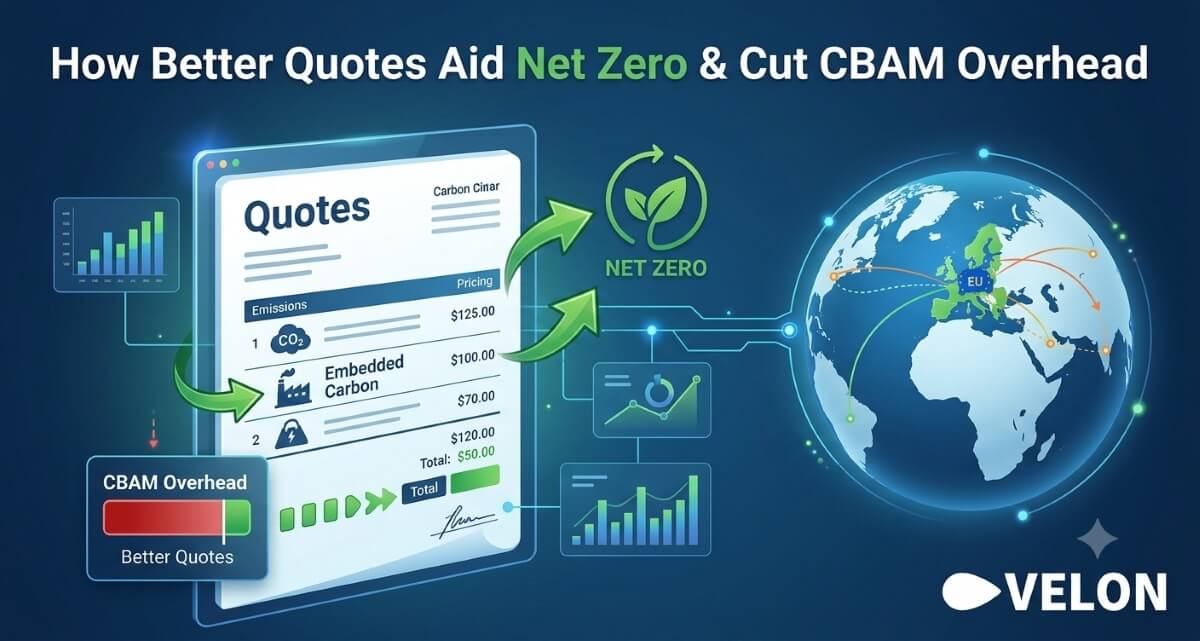
Somewhere between Derby and Nottingham inside a mid-level manufacturing office at a quoting desk on a cold and wet February Tuesday morning, a sales manager is putting together a quote for a customer in Rotterdam who wants steel components. Buried in the client’s request for proposal is a single line asking for the embedded carbon figure per tonne. Ten years ago, that line item was simply not there. Today it decides whether the quote gets shortlisted at all.
This is the quiet revolution happening inside sustainable manufacturing right now. Carbon reporting and Net Zero are no longer footnotes in a sustainability report published once a year. It has become a genuine line item, sitting right there in the commercial conversation, expected at the point of quote rather than months later when the paperwork catches up. And for Finance Leaders, Operations Managers and Production Managers alike, that shift changes what a good quoting process needs to deliver.
It is worth being honest about something here. CPQ was not designed to operate as sustainability reporting software or CBAM (carbon border adjustment mechanism) compliance software, and quality pricing-embedded CPQ Software like Velon® is no exception to that rule.
But by something of a happy accident, a properly connected, AI-informed and pricing embedded CPQ system turns out to be rather well suited to a second job it was never hired for.
Because emissions data can be attached to the same product configurations already used to calculate cost, a business often finds itself better equipped to meet its net zero obligations and reduce CBAM overhead almost as a side effect of doing its core commercial work properly.
Sustainability and CBAM reporting requirements end up sitting quietly inside the quotes a business generates anyway, rather than living outside the CPQ and pricing system in the kind of fragmented, quietly ageing spreadsheets that nobody quite trusts by the time an audit comes around.
Sustainability and CBAM reporting requirements end up sitting quietly inside the quotes a business generates anyway, rather than living outside the CPQ and pricing system in the kind of fragmented, quietly ageing spreadsheets that nobody quite trusts by the time an audit comes around.
Let’s dive into the topic a little deeper.
Don’t Have Time to Read the Entire Article? Here are the Key Takeaways on Sustainable Manufacturing and CBAM Reporting
Carbon reporting and Net Zero are no longer footnotes in a sustainability report published once a year.
- ✅ Sustainable manufacturing, now shapes buying decisions, so carbon data needs to sit alongside cost and pricing, not in a separate spreadsheet.
- ✅ CBAM reporting demands accurate emissions data tied to specific goods and getting it wrong carries real financial risk.
- ✅ CPQ was never built for CBM compliance, but linking emissions data to product configurations means CBAM figures can sit inside quotes automatically.
- ✅ Net zero manufacturing is now a live commercial advantage, making credible suppliers easier to buy from.
Read on to learn more.
Why Sustainable Manufacturing Now Lives Inside the Quote
For years, sustainability sat in its own department, quietly separate from commercial operations. Sales sold. Operations produced. Another department or section reported. Three functions, three timelines, rarely speaking the same language.
That separation no longer holds up. Customers across Europe, and increasingly beyond it, are asking suppliers to prove the environmental cost of what they are buying, not simply promise it in a brochure. A quote that cannot answer basic questions about carbon intensity, material sourcing or energy use is a quote that risks losing the deal before price is even discussed.
For manufacturers, this means:
- Carbon data can sit inside cost and pricing data, not in a separate spreadsheet nobody checks until the audit.
- Sales teams need visibility into which product configurations carry a heavier environmental footprint than others.
- Every quote becomes, whether anyone intended it or not, a small statement about how seriously the business takes sustainable manufacturing.
None of this is abstract idealism. It is fast becoming table stakes for winning business in manufacturing and distribution sectors that trade across borders.
Understanding CBAM Reporting and the Cost of Getting It Wrong
Here is where things get properly interesting, and where a great many Finance Leaders start paying very close attention indeed. CBAM is the European Union’s answer to a longstanding problem. If European manufacturers must pay for their carbon emissions but overseas competitors do not, the playing field is not level. CBAM closes that gap by placing a carbon cost on qualifying imported goods, calculated against the embedded emissions of what is being brought into the bloc.
For businesses caught within its scope, CBAM reporting is not a once-a-year formality. It requires accurate, defensible emissions data tied to specific goods, specific suppliers and specific shipments. Get the reporting wrong, whether through poor data or simple oversight, and the financial exposure lands squarely on the balance sheet.
The trouble many manufacturers face is that this data rarely lives in one place. It can be scattered across supplier certificates, production records and logistics documentation, much like pricing data used to be scattered across fragmented spreadsheets before quotation software brought it together. CBAM reporting suffers from precisely the same fragmentation problem that pricing and quoting has suffered from for years, just with a regulator watching more closely.
How Better Quotes Aid Net Zero & Cut CBAM Overhead
This is where quotation and CPQ software genuinely earns its place in the conversation, not as a compliance tool built for auditors, but as a commercial tool that happens to solve a compliance headache along the way.
When carbon and emissions data are connected into the same system that handles product configuration, cost and pricing, something useful happens.
A quote can be built with the embedded carbon figure already attached to it, drawn from the same validated data used to calculate cost.
Rather than treating CBAM reporting as a separate exercise performed after goods have shipped, the groundwork is laid the moment the quote is created.
Pricing infused, well configured CPQ software like Velon® can help by:
- Attaching known emissions data to specific product configurations, so the figures required for CBAM reporting already exist rather than needing to be reconstructed later.
- Reducing the administrative overhead of chasing down supplier certificates and production records after the fact, because the relevant data was captured earlier in the process.
- Giving Finance Leaders earlier visibility into which deals carry heavier carbon exposure, so pricing decisions can reflect that reality rather than discovering it in arrears.
None of this replaces a dedicated carbon accounting system, and no sensible vendor would claim otherwise.
What it does is remove one of the more painful sources of duplicated effort, the gap between what sales promises and what compliance later must prove.
Net Zero Manufacturing as a Genuine Commercial Advantage
There is a temptation to treat net zero manufacturing as a distant target, something for the sustainability report to worry about in five years’ time. That view is ageing quickly. Customers are asking about it now; procurement teams are scoring suppliers on it now, and the businesses moving fastest are treating it as a live commercial differentiator rather than a future obligation.
A manufacturer that can demonstrate genuine progress towards net zero manufacturing, and back that progress with credible data at the point of quote, is simply easier to buy from. It removes friction from procurement conversations that increasingly include sustainability questionnaires as standard practice.
The connection back to quoting is straightforward once you see it. Every quote is, in effect, a small commitment about what will be produced and how. Getting that commitment right increasingly means getting the pricing strategy behind it right too, which is where a specialist like 7Sages Pricing comes in, helping B2B manufacturers build the strategic pricing capability to turn this kind of commercial differentiation into real margin.
When the systems generating that quote already understand cost, capacity and carbon together, sustainability stops being a bolt on exercise and becomes simply part of doing business properly. Start a conversation with us today to begin your journey to sustainable quoting.
Frequently Asked Questions on Sustainable Manufacturing and CPQ
Who falls within the scope of CBAM, and is it only relevant to exporters into the EU?
+
CBAM applies to importers bringing specific goods into the EU, covering sectors such as steel, aluminium, cement, fertilisers, hydrogen and electricity. Manufacturers outside the EU supplying into these sectors need to understand it just as closely as EU based importers, since the data burden often falls back on them to provide accurate figures.
Does improving sustainability credentials help win business, or is it mostly a compliance cost?
+
Increasingly, it does both. Procurement teams at larger customers are building sustainability criteria into supplier scoring, meaning a manufacturer with credible data and lower embedded carbon can win deals purely on that basis, quite separate from price.
How does a business even begin connecting carbon data into its quoting process without a huge system overhaul?
+
Many manufacturers start small, by identifying which product lines carry the most significant emissions exposure and ensuring that data is captured accurately at source. From there, quotation software capable of holding that data alongside cost and pricing information can build on what already exists, rather than demanding a wholesale change all at once.