
How Do Cost Pass-Through Changes Affect B2B Quoting?
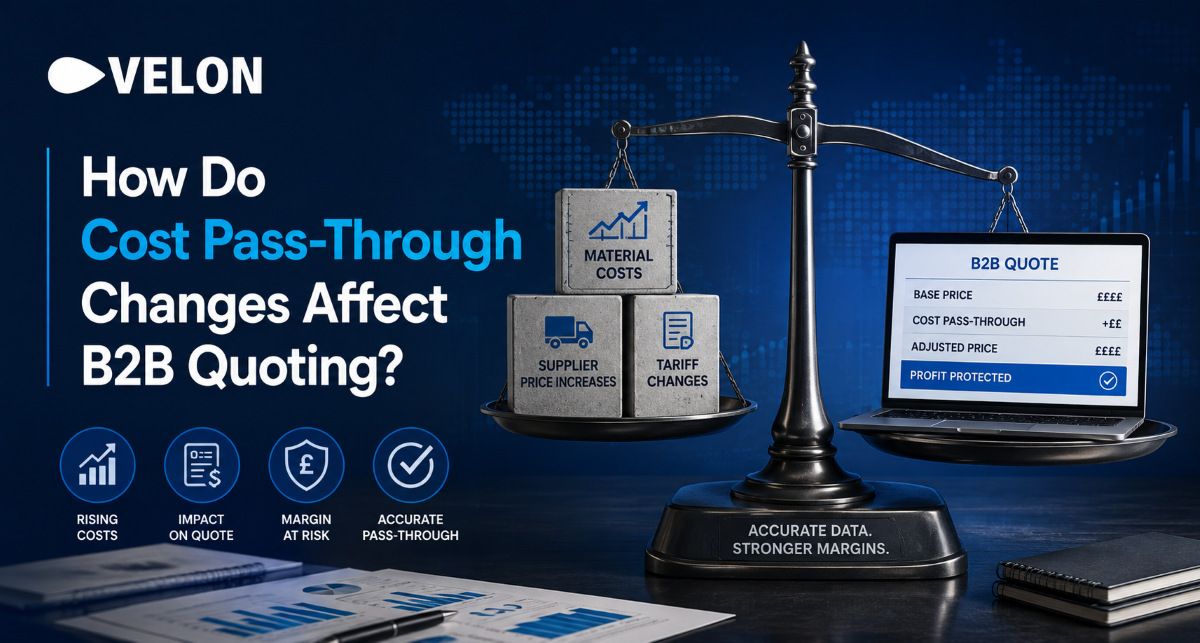
Somewhere in your supply chain right now, a cost just moved. A material supplier raised prices. Tariffs shifted. A commodity index ticked up. Your procurement team will know about it within hours. Your sales team will not.
This gap, between what your costs actually are and what your quoting system believes them to be, is not a small administrative inconvenience. It is one of the major points of maximum margin leakage in modern manufacturing. One quote sent on yesterday’s material costs is one quote priced on false foundations. Fifty quotes sent that way, which is unremarkable in a mid-market business, represents real money leaving your company unrecovered. And it happens every week in organisations still managing cost pass-through changes through spreadsheets and manual coordination.
The mathematics are brutal and reliable. For finance leaders watching margins, operations managers watching throughput, and production managers watching the shop floor, this is the daily cost of not having a system that responds to cost volatility as fast as costs themselves move.
The question is not whether these pressures will arrive. In manufacturing, they always do. The question is whether you have a B2B quoting process powered by a quality system like Velon® that can respond to them fast enough to protect what matters: your profit.
No Time to Read the Full Article? Here’s the Short Take What You Need to Know on AI-powered Cost Pass-Through Management
- ✅ Cost pass-throughs are broken in most manufacturers – manual spreadsheets create days of lag between cost movements and updated pricing, costing margins in every quote
- ✅ AI-first quoting (not AI-native) keeps humans in control – algorithms automate the tedious work of tracking costs and calculating pass-throughs, while your people make the strategy decisions that matter
- ✅ Dynamic cost-plus automation means pricing updates in minutes, not days – real-time links to your ERP and supplier data eliminate the spreadsheet shuffle and constant repricing cycles
- ✅ Finance leaders gain margin visibility, operations get predictability, production avoids surprises – when costs are tracked and passed through intelligently, the entire business moves in sync
Read on to learn in more detail.
What Are Cost Pass-Throughs, and Why Do They Matter?
A cost pass-through is elegantly simple in concept. When your supplier raises their prices, you raise yours. When raw material costs climb, you pass that increase along to your customer. The theory is straightforward. The practice is where things fall apart for most manufacturers still operating on spreadsheets and manual coordination.
Consider a building materials manufacturer sourcing timber, resin and hardware from a dozen suppliers. Each maintains their own price list. Each publishes revisions on their own schedule. Every time costs shift – and in volatile markets, they shift constantly – someone must manually update a spreadsheet, cross-reference product bills of materials, verify the math, and hope nothing gets missed. Multiply that across fifty product lines and quarterly market reviews, and the hours disappear into a black hole of administrative work.
Worse, by the time those changes flow through to your sales team, time has passed. A full day’s lag means a full day of quoting on yesterday’s costs. In volatile markets, that is not a small thing. It is margin leaking out the door, one quote at a time.
The traditional approach to managing cost pass-throughs is reactive. Costs move. You notice. You respond. By then, damage is already done.
The Problem with Reactive Cost Pass-Through Management
Here is what reactive quoting looks like in practice. Your procurement team catches a cost increase on Tuesday. By Wednesday, they have wrestled the data into the system. Thursday morning, sales finally has updated pricing to use. That means Wednesday’s quotes, Thursday’s early quotes, and possibly Friday’s quotes – they are all baked at the old cost structure. The financial impact compounds across an organisation.
Consider a mid-sized manufacturing business processing fifty quotes a week.
If just five of those quotes, on average, miss a cost adjustment, and the average deal size carries 30% margin, then one week of lag costs you real money.
Across a year, those losses can become a staggering P&L line item
More insidious still is the inconsistency. Without a centralised, automated system, different salespeople handle cost pass-throughs differently. One applies the full increase immediately. Another spreads it over two quotes to ease customer concerns. A third simply discounts it away, hoping to win the deal. Your pricing becomes scattered, inconsistent, and unprofitable.
This is not anyone’s fault. It is simply what happens when manual processes collide with the speed of modern cost volatility.
Enter AI-First B2B Quoting Software: The Intelligent Middle Ground
Here is where language matters. There is a world of difference between AI-native CPQ (systems built on the assumption that algorithms should drive decisions end-to-end) and AI-first B2B quoting software, which treats artificial intelligence as a tool within processes still controlled by humans who understand the business and the risk.
An AI-first approach to cost pass-through means giving algorithms one specific job: identifying exactly when, how much, and to whom costs should be passed through, while keeping humans in control of margin guardrails and customer relationships.
- Dynamic Cost-Plus Automation connects your CPQ directly to real-time cost data – your ERP, supplier systems, or commodity feeds. When material costs move, pricing recalculates instantly. Surcharges for fuel, tariffs, or logistics adjust automatically based on rules you define. Your sales team quotes from current numbers, not yesterday’s snapshot.
- Segmented Pass-Through Intelligence recognises that not every customer absorbs the same price increase. AI evaluates how different segments have responded to increases historically, their price sensitivity, and their alternatives. A price-sensitive customer might see a 3% pass-through, while a strategic account might absorb 7%, all based on evidence rather than guesswork. The human makes the final call, armed with data.
- Margin Guardrails and Approval Workflows ensure cost pass-throughs never create unprofitable deals. Set a minimum margin floor – say 22% – and the system flags any quote that drops below it. When costs spike steeply, automated workflows route quotes to finance for sign-off.
The result is a system that removes tedious administrative work while keeping humans in control. It is not the machine deciding what to charge. It is the machine ensuring your people have the cleanest, most current information when they decide.
How AI CPQ Software Transforms Quoting Across Your Business
For a Finance Leader, this is margin protection at scale. You gain live visibility into cost pass-throughs flowing through the pipeline. You see when increases hit and track how quickly pricing responds. Guardrails apply consistently across hundreds of quotes. Month-end surprises shrink dramatically. You can analyse whether your pass-through strategy is working: are you passing through 100% of increases or just 80%? That data becomes actionable intelligence.
For an Operations Manager, this is predictability. When sales commit to delivery, production knows exactly what materials will cost. No mid-project discoveries that the bill of materials was priced on costs that changed months ago. The quote and production plan move in sync, fewer surprises.
For a Production Manager, this is visibility into feasibility. AI-assisted manufacturing planning estimates cycle times and setup sequences based on materials specified at the quoted cost. When prices spike and your quote swaps in an alternative material, the system recalculates manufacturing sequences automatically. You know immediately what that change means for your schedule.
How AI CPQ Software Creates Competitive Advantage
Manufacturers responding to cost changes within hours, not days, win deals their slower competitors lose. They hold pricing confidently when conditions are volatile, acting on real-time data instead of fear. They spot opportunities to improve economics when costs fall, because they track movements continuously.
This is disciplined business process augmented by intelligence that catches patterns at speed. It is an AI-first philosophy applied to manufacturing’s oldest problem: ensuring the numbers you quoted are the numbers you can execute.Cost pass-through changes are not a problem to solve. They are permanent. The question is whether you manage them reactively, discovering your pricing is stale, or proactively, responding to cost movements within hours.
The businesses thriving in volatile markets are not the ones with lowest material costs. They have the clearest, fastest view of those costs—and the disciplined systems to pass them through intelligently, protecting margins and customer relationships simultaneously.
That is what AI-first B2B quoting software like Velon® does. It removes guesswork. It keeps humans in control. It transforms cost pass-through from anxiety into competitive advantage.
This is the difference between manufacturers who respond to cost changes and manufacturers who react to cost damage. In volatile markets, speed is strategy. The businesses outpacing their peers are not the ones with the lowest material costs. They are the ones with the clearest, fastest view of those costs and the discipline to pass them through intelligently every single time. Start a discussion with us today to discover how your organisation can gain that competitive edge and understand your opportunity for stronger, faster margins.
Frequently Asked Questions on Managing Cost Pass-Through Changes with AI CPQ Solutions
How quickly can AI-powered B2B quoting software pass through a cost increase to customer pricing?
+
With real-time cost data connected to your CPQ system, cost-plus rules update pricing within minutes. Automated surcharges trigger immediately. The lag that used to consume days or weeks collapses to hours. Your sales team is quoting current prices by morning, not guessing at yesterday’s costs.
How quickly can a business expect to see returns after adopting AI CPQ software?
+
Most organisations notice improvements in quote turnaround and configuration accuracy within the first few weeks, since these gains come from automating existing bottlenecks rather than waiting on new behaviours to form. Expect a 10x return on investment in the first 12 months, followed by a 20x return after that.
Does passing through cost changes to customers more frequently damage relationships?
+
Transparency wins. Customers seeing cost changes passed through methodically and fairly – with clear explanations – respect that more than discovering later you absorbed increases you should have passed along. AI-first systems communicate the logic clearly, backed by evidence. That builds trust.
What if a competitor does not pass through costs and undercuts us?
+
This is where data wins. If your cost structure truly allows you to absorb increases your competitor cannot, your system shows that. If a competitor is genuinely pricing lower, you see it through competitor monitoring and market data feeds integrated into your CPQ. You make an informed decision rather than reacting in panic. And if the competitor is simply buying margin at the expense of profit – which they cannot sustain – your disciplined approach outlasts their recklessness.
Do we need perfect historical data before AI-first quoting helps with cost pass-throughs?
+
No. The system works with what you have. Cost-plus automation and surcharge logic deliver value immediately. Even basic rules, consistently applied and centrally managed, beat manual spreadsheet coordination on day one.
How do long-term contracts work with dynamic cost pass-through?
+
That is where contract amendment features come in. For recurring revenue or long-term service agreements, AI CPQ systems can automate pass-through escalations based on agreed-upon formulas. If a contract says costs adjust quarterly based on commodity indices, the system calculates and proposes those adjustments automatically, then routes them for approval and customer notification. No surprises, no forgotten escalations.