
AI-Powered CPQ: How AI-First CPQ Exposes Weak Quoting Systems
Ask any B2B salesperson what happened the first time their business switched on an AI-powered quoting tool and watch their face carefully. Some will smile. A good number will pause, then admit the AI worked exactly as promised, and what it handed back was only as strong as the process feeding it. To be fair, it has been hard for quoting processes to keep up as 67% of manufacturers now describe their product configurations and requests as very or extremely complex – 20% more than only 12 months ago.
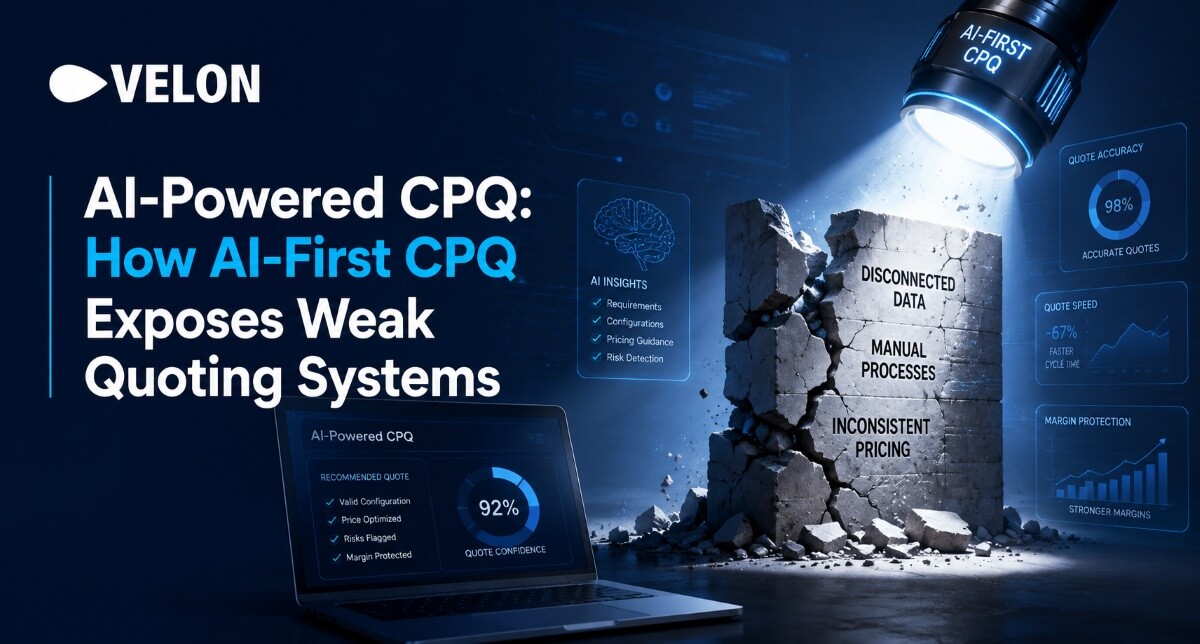
That is the real story behind AI-powered CPQ Software, and it cuts both ways. AI does not eliminate the weaknesses lurking inside a manufacturer’s quoting process or data, it shows them clearly. This is the part of the AI conversation that quotation software pitch decks tend to skip. Artificial intelligence (AI) does not eliminate the weaknesses lurking inside a manufacturer’s quoting process. It switches the lights on and shows everyone exactly where they are, usually faster and more publicly than anyone would have chosen.
But built on a solid foundation, that same AI becomes something genuinely powerful: faster quotes, tighter margins, fewer errors reaching the shop floor, and a process every function in the business can trust.
For manufacturers managing configurable products, shifting material costs and quotes that pass through half a dozen hands before reaching a customer, that distinction matters enormously.
This is where pricing-embedded AI-first CPQ platforms such as Velon® come into the conversation, though not in the way the more breathless corners of the internet tend to describe AI as a Swiss Army knife ‘do it all’ tool.
Let’s dive into a full explanation.
No Time for the Full Article? Here’s a Snapshot of Real-World AI Use Cases in B2B Quoting
AI does not create weak quoting systems. It exposes the ones that already existed, often within days of going live. The fix is not less AI. It is solid foundations for the AI to stand on
- ✅ AI-first, not AI-native: people still verify the drawing, choose the configuration and set the pricing boundaries
- ✅ Quicker, more precise quotes: automated Requests for Quotes (RFQ) handling, spec verification and consistent pricing on every single quote
- ✅ AI-based price guidance applies steady margin thresholds and pricing rules so quotes stay profitable
- ✅ RFQs and BOMs (Bills of Materials) are processed and checked automatically, turning hours of work into minutes
- ✅ Unusual configurations are flagged for review rather than assumed, so the process remains fully transparent
- ✅ Every department stays in sync:, product, engineering, finance, sales and operations all work from the same information
- ✅ Genuine ROI: businesses typically see gains within the first few weeks, with returns strengthening over the following year
Read on for greater detail.
The Quoting Process Was Already Complex. AI, Built Right, Brings Order to It
Manufacturing quotes were never straightforward, but there was a time when they came close. Fewer variants, fewer bespoke tweaks, fewer opportunities for a figure to slip quietly out of place. As product ranges widened and customers pushed for ever more tailored builds, the ordinary quote grew into one of the most intricate documents a business puts together, pieced from engineering know-how, past pricing, supplier costs and whichever colleague’s memory happened to still be on site that particular week.
None of the intricacy came about through carelessness. It came about because complexity outpaced the tools meant to keep it in check, and much of that missing groundwork was quietly held together by capable people putting in the hours, rather than by systems designed to carry the load properly.
That patchwork has sometimes occasionally survived for years, sometimes decades, because people are remarkably good at compensating for gaps in a process. An experienced salesperson can often remember which customer needs which tolerance. A production manager just knows a particular alloy runs slower than the spec sheet suggests. AI-first CPQ does not discard that expertise. It makes it available to everyone, every time, rather than depending on whoever happens to be at their desk that day.
From Manual Quoting to AI-Assisted Selling
Most manufacturers move through three stages of quoting maturity before AI-assisted selling becomes genuinely useful. Manual CPQ, built on spreadsheet pricing and disconnected product data, tends to produce slow, inconsistent quotes and heavy operational effort. Governed CPQ, with a unified catalogue, codified pricing and automated approvals, delivers faster cycles and considerably less revenue leakage. AI-assisted CPQ then adds intelligent recommendations, guided selling and predictive pricing on top of that already solid foundation, producing faster quoting, tighter margins and genuinely scalable growth.
The lesson worth holding onto is that no business can skip the middle stage. Deploying AI over fragmented commercial processes does not fix them. It simply makes their inefficiency move faster.
Why This Matters for Every Function in the Business
For a finance leader, this means quotes that already respect the margin guardrails the business agreed to, long before they reach a customer. For an operations manager, it means far fewer surprises between what sales promised and what the shop floor can actually deliver. For a sales leader, it means every salesperson, however new, quotes with something close to the confidence of the most experienced person in the building.
What AI-First CPQ Delivers When the Foundation Is Solid
Built on properly governed product data, pricing rules and approval workflows, AI stops being a novelty bolted onto quoting and starts becoming the difference between a good estimator and an entire team quoting like one.
- Document and drawing intelligence reads technical drawings and specifications, extracts dimensions and materials, and flags discrepancies before they ever reach the shop floor. A drawing to BOM validation checks that once took an afternoon now takes seconds.
- RFQ and BOM processing ingests incoming requests and Bills of Materials in whatever format they arrive, normalises inconsistent descriptions, and identifies manufacturer part numbers even when they are written differently across documents.Anomalies such as end of life parts get flagged automatically, well before a quote reaches the customer.
- AI-driven price guidance applies consistent margin guardrails and pricing rules to every quote, developing clear floor, ceiling and target recommendations aligned to the business’s own profit goals.
- Faster quoting – Sales teams move quickly, knowing every price they offer already sits within boundaries the business has sanctioned.
- Historical intelligence surfaces similar past quotes, configurations and engineering decisions the moment a comparable job comes through the door, so a project quoted eighteen months ago informs the new one in seconds rather than depending on someone happening to remember it.
None of this requires imagining machines running the business unsupervised. It requires giving genuinely useful AI something solid to stand on.
Not All “AI CPQ” Is Equal: AI-First Versus AI-Native
Two quite different philosophies are currently trading under the same “AI CPQ” label, and the space between them decides whether AI makes a quoting process stronger or simply pushes an unresolved mess through faster than before.
An AI-native approach pictures software handling the whole quoting journey unaided, with people left to sign off near the finish line almost as a formality. That reads wonderfully in a slide deck. It reads a great deal less wonderfully the day an invented material spec makes its way onto the shop floor unnoticed.
An AI-first approach starts from the opposite premise entirely. It positions artificial intelligence as a genuinely capable partner to the people who understand the business already, not a stand-in for their judgement. It interprets the drawing, but the engineer signs off on it. It proposes the configuration, but the salesperson makes the final call. It surfaces the pricing risk, but the finance leader decides where the guardrail sits. The pace picks up considerably. Nothing moves forward without a person watching it.
This is the model of AI quoting worth staking a business on, and it is the same model behind platforms such as Velon®, where AI sits above a solidly governed CPQ base rather than standing in for one.
Building the Right Foundation That AI Can Actually Stand On
Getting there starts with a single governed source of product and BOM data, consistent across every team and channel, so AI can recommend a configuration with genuine confidence that it can actually be built.
It continues with codified pricing rules, complete with floor, ceiling and target guidance, so AI operates within boundaries the business has genuinely agreed to. And it finishes with approval workflows that route automatically against real thresholds, so the speed AI creates never sits idle in someone’s inbox waiting to be noticed.
Do that, and the payoff shows up everywhere at once. Product, engineering, finance, sales and operations all work from one shared truth instead of five slightly different versions of it. Unfamiliar configurations get flagged for a human to review rather than guessed at, which keeps the whole process fully explainable the day a customer, an auditor or simply a curious finance director asks how a price was reached. And the returns tend to arrive quickly. Most manufacturers see measurable improvements in quote turnaround and accuracy within the first few weeks, with strong ROI building up to 20x steadily across the first year as the AI’s recommendations improve alongside the data feeding them.
This is precisely the shift AI-first CPQ platforms like Velon® are built for. Not a promise that AI will think on a manufacturer’s behalf, but a system that removes the friction so people can spend their time on judgement, relationships and the decisions that were always going to need a human in the room anyway.
Ready to explore what this looks like for your business? Talk to one of our friendly experts now to get started.
Frequently Asked Questions on AI-First CPQ
How quickly can a manufacturer expect to see results from AI-first CPQ?
+
Most organisations notice improvements in quote turnaround and configuration accuracy within the first few weeks, since these gains come from automating existing bottlenecks rather than waiting on new behaviours to form. Strong ROI of typically builds over the first twelve months. Expect a 10x return on investment in the first 12 months, followed by a 20x return after that or check out our free ROI calculator to calculate your company’s unique potential benefits.
Does AI-first CPQ replace the need for experienced salespeople and engineers?
+
No, and this is precisely the point of an AI-first approach. It makes their knowledge searchable and reusable across the whole team, rather than depending on whoever happens to be available that day.
What happens when AI encounters a configuration it hasn't seen before?
+
A well-built AI-first platform flags the unfamiliar configuration for human review rather than guessing, which keeps the process fully explainable and prevents errors from reaching the shop floor.
What does a manufacturer need in place before AI-first CPQ delivers real value?
+
A reasonably consistent source of product and BOM data, codified pricing rules with clear margin guardrails, and approval workflows tied to genuine thresholds. Much of that can be tidied alongside implementation rather than beforehand.
How does AI-first CPQ keep pricing consistent across a whole sales team?
+
By applying the same floor, ceiling and target guardrails to every quote automatically, regardless of who is building it, so pricing consistency no longer depends on individual judgement alone.