
How CPQ Software Can Maximise Upselling and Cross-Selling (And Why Your Bottom Line Depends On It)
Something we have noticed at Velon® time and again in our conversations with customers across complex commercial environments, is that the businesses feeling the most frustration with their revenue performance are rarely struggling because of a weak product or a poor sales team. They are struggling because of what happens between the moment a customer expresses interest and the moment a quote lands in their inbox.
That gap, that often chaotic, spreadsheet-dependent, engineering-interrupted, margin-uncertain stretch of commercial activity, is where growth quietly stalls. And what makes it particularly striking is that most of the business leaders we speak to already sense this. They know the quoting process is costing them. They just have not yet had a clear picture of what fixing it would look like in practice.
What we have also seen, and this is what genuinely excites us, is what happens when businesses do fix it. When structure replaces guesswork, when pricing intelligence replaces individual judgement, and when every quote becomes a commercially optimised opportunity rather than a race to produce something accurate enough to send, the results are not incremental. They are transformational.
And nowhere is that transformation more visible than in how businesses upsell and cross-sell.
That is what this article is about. Not the theory of CPQ software, but the lived commercial reality of what it unlocks, and why, for Finance Leaders, Sales Directors, Operations Managers and CEOs alike, understanding it is no longer optional.
The Key Takeaways on How You Can Maximise Upselling & Cross-selling With Smart Quotation Software
CPQ software transforms the quoting process from a chaotic, spreadsheet-dependent exercise into a commercially optimised, revenue-generating engine.
For businesses selling configurable products, it is one of the most impactful levers available for improving upsell and cross-sell performance without adding headcount or complexity.
Key takeaways:
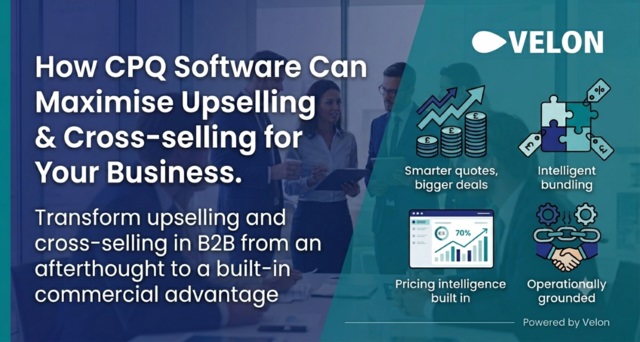
- ✅ Smarter quotes, bigger deals – CPQ identifies upsell and cross-sell opportunities, ensuring no revenue is left on the table
- ✅ Intelligent bundling – rules-driven configuration presents customers with compelling, margin-controlled bundle options in real time
- ✅ Pricing intelligence built in – embedded pricing logic means every quote is not just accurate, but commercially optimised for margin
- ✅ Operationally grounded – the best CPQ platforms connect commercial and operational data, so every deal that is won can actually be delivered
Read on for the full upselling and cross-selling maximisation story.
The Problem With How Most Businesses Sell Today
Picture this. A salesperson sits down to prepare a quote for a new customer. The product is configurable. The customer has specific needs. Somewhere in a shared drive, there are seven versions of a pricing spreadsheet, three of which may or may not be current. Engineering has been cc’d on the email chain. Someone from finance is waiting to approve the margin.
Four days later, a quote goes out. It is (maybe) accurate enough. Probably. And the opportunity to offer that customer something more valuable, something that would have genuinely benefited them and meaningfully increased revenue, has quietly slipped away because the quoting process consumed every available minute just to produce the baseline offer.
This is not a rare story. Studies show that up to 94% of spreadsheets used in the B2B environment contain errors. It is the default operating reality for a significant number of complex businesses. And it is entirely solvable.
What CPQ Actually Does (Before We Talk About What It Unlocks)
CPQ stands for Configure, Price, Quote. But describing it purely by those three letters is a little like describing an orchestra as “people with instruments.” Technically correct. Wildly underselling the experience.
In practice, a well-implemented CPQ system sits between your CRM and your ERP and acts as the intelligent decision layer that connects:
- Product configuration logic and validated rules
- Real-time cost structures across materials, labour and overhead
- Pricing frameworks, corridors and discount controls
- Commercial workflows that remove individual dependency
What this means in plain terms is that when a salesperson builds a quote, they are no longer doing so with spreadsheets, memory and crossed fingers. They are guided through a structured, rules-driven process that produces a quote which is correctly configured, accurately costed, consistently priced and commercially sound before it ever leaves the building.
That is the foundation. Now here is where it gets genuinely interesting.
Upselling and Cross-Selling with CPQ Software: The Revenue That Is Already in the Room
Every sales leader reading this knows the arithmetic. Acquiring a new customer costs significantly more than growing an existing one. Yet most quoting processes are designed purely to respond to what the customer has already asked for, rather than to intelligently surface what else they need.
CPQ software changes that equation entirely.
Because a CPQ system holds detailed information about customer preferences, purchase history, product relationships and configuration patterns, it becomes the most informed voice in the room when it comes to identifying what a customer might benefit from next.
Upselling with CPQ works because the system can:
- Identify customers who have previously purchased mid-tier products and flag premium upgrade paths during the quoting process
- Automatically prompt sales teams with higher-value configurations that meet the same customer requirements at a better margin
- Ensure that no salesperson, however experienced or inexperienced, misses an obvious step-up opportunity simply because they were focused on completing the base quote
Cross-selling with CPQ is where the compounding effect becomes truly powerful. A customer purchasing structural materials for a residential development should also be seeing the right tooling packages, the compatible insulation systems, the relevant installation accessories and, where appropriate, the bundled offer that makes the whole package more commercially compelling than the sum of its parts.
Without CPQ, identifying and presenting all of that coherently in real time is an extraordinary ask of any individual salesperson. With CPQ, it is simply how the system works.
Bundling: The Quiet Genius of Intelligent Configuration
One of the most underused revenue levers in complex businesses is the bundle. Not the lazy bundle, where products are grouped arbitrarily and discounted indiscriminately, but the intelligent bundle that is constructed around what a customer actually needs to achieve their goal.
AI-informed CPQ Quotation Software enables this through rules-driven configuration that understands product relationships at a component level. When a customer’s requirements are entered into the system, it does not just assemble the minimum viable product. It identifies compatible upgrades, surfaces complementary additions and presents structured bundle options with pricing that reflects real cost and real margin.
For Finance Leaders, this is particularly significant. Bundled pricing that is anchored to a known cost base, calculated in real time and controlled within defined discount parameters, is a very different commercial proposition to a salesperson constructing a bundle from memory and applying a discount they believe to be reasonable.
One is commercially controlled. The other is commercially exposed.
What Happens When Pricing Intelligence Is Embedded in CPQ
Here is the dimension of this conversation that too many businesses overlook. CPQ, operating alone, brings extraordinary order to the quoting process. But when CPQ is embedded with a genuine pricing intelligence capability, something genuinely transformative occurs.
A pricing engine operating at the strategic level manages price lists across complex customer and product hierarchies, applies recommended optimal prices in real time based on market conditions and competitive positioning, and continuously refines those recommendations based on real-world commercial data.
When that intelligence flows directly into the CPQ quotation process, every proposal a salesperson produces reflects not just what the configuration rules allow, but what the evidence suggests will win the deal at the best achievable margin.
That is the difference between a quote that is fast and a quote that is optimal. And for a business producing significant quote volumes across a complex product range, the margin impact of that distinction is substantial.
The CPQ Operational Dimension That Cannot Be Ignored
There is a dimension to this conversation that Finance and Operations Leaders in particular will recognise immediately. The promise of upselling and cross-selling through intelligent CPQ is only as valuable as the organisation’s ability to actually deliver on what is sold.
In complex manufacturing or distribution environments, those are inherently supply-chain-heavy businesses. Production planning, fulfilment, logistics and inventory networks are often just as technically complex as the commercial stack itself.
This matters because AI-driven revenue systems that optimise deals without access to operational reality are dangerous. A quote that wins a deal the business cannot actually deliver is not a commercial success. It is a liability.
The most capable CPQ implementations, particularly those with embedded pricing intelligence, answer the fundamental operational questions at the point of quote:
- Is this feasible to produce within the required timeframe?
- What is the realistic lead time given current capacity?
- What does it actually cost, including raw materials, fulfilment and logistics?
- What is the delivery risk, and how should it affect the commercial offer?
Without that intelligence layer in place, you risk autonomous revenue execution that operations teams simply cannot deliver on. With it, every upsell and cross-sell opportunity is not just commercially optimised. It is operationally grounded.
Grow Your Business with CPQ Software
Research into CPQ adoption consistently shows that best-in-class users achieve significantly greater annual revenue growth and profit improvement than their peers. These are not gains confined to large corporations. Mid-sized growing businesses with expanding sales teams and widening product ranges frequently see some of the most dramatic improvements precisely because the gap between their current process and an optimised one is so significant.
The value of CPQ in the context of upselling and cross-selling comes from improving multiple commercial variables simultaneously:
- More relevant offers presented at the right moment in every quote
- Bundled solutions that increase average deal value without eroding margin
- Consistent pricing that does not depend on individual memory or judgement
- Real-time cost visibility that gives commercial leaders genuine confidence
The question for any organisation still relying on spreadsheets and individual expertise is not whether CPQ would improve commercial performance. It is how much opportunity has already been left behind.
Solutions like the Velon® pricing-infused CPQ platform are designed specifically to bring configuration, pricing intelligence and operational awareness into a single, unified quoting process, so that every quote becomes a commercially optimised, operationally deliverable and genuinely customer-focused proposal. Start by using our ROI Calculator to estimate your potential margin improvements, savings and win rate impacts with CPQ Software or talk to us today to find out more.
Frequently Asked Questions on Maximising Upselling and Cross-selling with CPQ Quotation Software
Can CPQ software integrate with our existing CRM and ERP systems?
+
Yes, and integration is precisely what makes CPQ so powerful in practice. A well-implemented CPQ system sits between your CRM and ERP as the connecting intelligence layer, pulling customer and opportunity data from your CRM and product, cost and fulfilment data from your ERP to produce quotes that are commercially accurate and operationally ready.
How does CPQ software help with margin control when offering discounts for upsells or bundles?
+
CPQ embeds pricing logic and discount controls directly into the quoting process. Sales teams operate within defined pricing corridors, meaning they can offer compelling bundled or upgraded proposals without the risk of uncontrolled margin erosion. Every discount is applied against a known cost base, calculated in real time.
Is CPQ software only suitable for very large enterprises?
+
Not at all. While the complexity of large organisations makes CPQ particularly valuable at scale, mid-sized businesses with configurable product ranges and growing sales teams often see some of the most significant improvements. The return on investment is frequently proportional to the gap between the current quoting process and what a structured CPQ system enables.
How does pricing-embedded CPQ software differ from standard CPQ?
+
Standard CPQ structures the configuration and quoting process. Pricing-embedded CPQ adds a strategic intelligence layer that uses market data, customer segmentation and historical behaviour to recommend optimal prices in real time. The result is a quoting process that is not just fast and accurate but commercially optimised for margin performance on every individual deal.
What should we look for when evaluating CPQ vendors?
+
Beyond configuration capability and integration flexibility, the most important questions concern pricing intelligence, operational connectivity and scalability. The best platforms bring these together so that every quote is not just commercially sound at the point of sale but deliverable in practice, with full visibility into cost, production capacity and fulfilment from the moment a quote is generated.