
How Smart Quotation Software Turns Volatility into Advantage
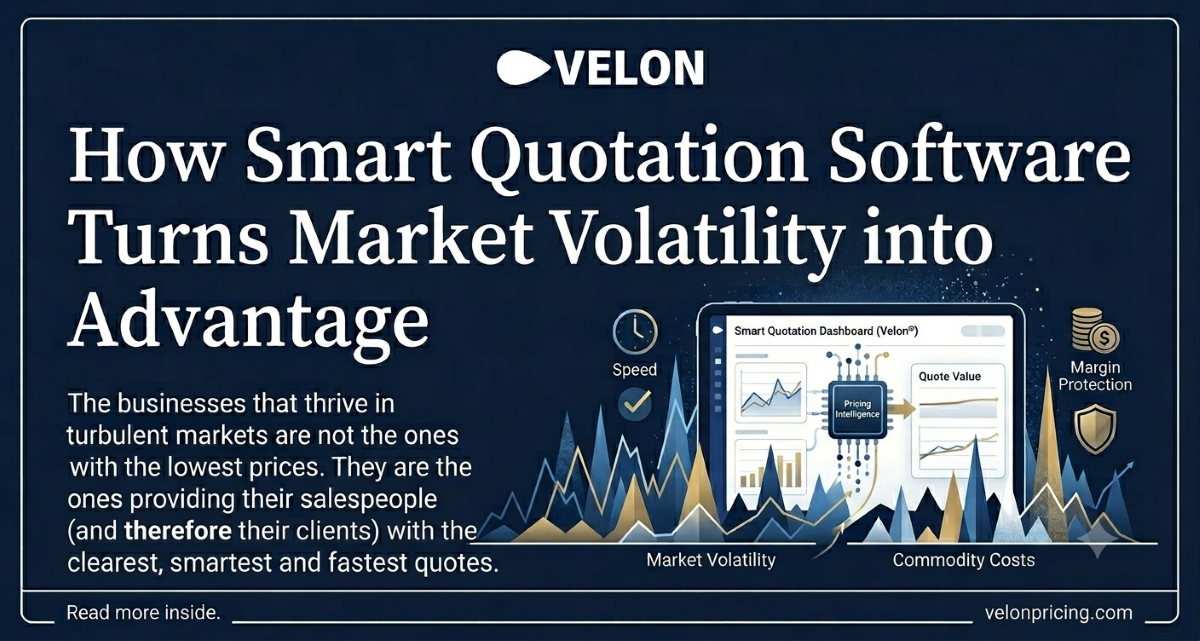
The businesses that thrive in turbulent markets are not the ones with the lowest prices. They are the ones with the clearest picture.
In mid-level and enterprise B2B businesses, the organisations that hold their margin through turbulent market volatility tend to share one quiet advantage: they know exactly what they are quoting, and how, and why. Markets can now shift overnight. Commodity costs are spiking without warning these days. Customer expectations are tightening. And somewhere in the middle of all that current noise, a salesperson opens a spreadsheet, manually cross-references three price lists, makes an educated guess about margin, and sends out a quote that may or may not still make sense by the time it is approved.
That is not a technology problem. That is a strategy problem. And it is entirely solvable.
Here is the truth that most leaders in sales, finance and operations already sense but rarely say aloud: in a volatile market, the speed and intelligence of your quotation process is one of the most powerful competitive levers your B2B business can have. Not your product range. Not your brand. Your ability to look a customer in the eye, confidently and correctly, and say, “here is exactly what this costs, here is why, and here is what it will do for you.”
Smart quotation software like Velon®, particularly when it is built with pricing intelligence at its core, transforms that pricing moment from a guess into a guarantee.
The Key Takeaways on How Pricing-Smart Quotation Software Transforms Market Volatility into Competitive Advantage
In volatile markets, your quotation process is a strategic weapon – but only if it’s built on real-time intelligence rather than manual guesswork. Here’s what you need to know:
- ✅ Manual quoting leaks margin – outdated price lists, recycled quotes, and gutfeel discounting silently erode profitability deal by deal.
- ✅ CPQ software connects configuration, cost, and pricing in real time, eliminating the gap between what is quoted and what is commercially sound
- ✅ Pricing intelligence goes beyond speed – the most capable platforms learn from market data to recommend optimal price points at the moment of quote.
- ✅ Operational reality must match commercial commitments – smart quotation software flags delivery feasibility before a deal is signed, not after
- ✅ Every leader benefits – from finance gaining margin visibility, to sales closing faster, to operations avoiding costly surprises
Read on to discover in full on how volatility is an advantage for businesses with intelligent quotation capability and how competitors still scrambling with spreadsheets simply cannot keep up.
Why Market Volatility Exposes the Weakness in Manual Quoting
Let us be honest about what happens to manual quoting processes when markets become unpredictable.
- Price lists drift out of date faster than anyone can maintain them
- Sales teams reuse old quotes because recalculating everything is too time-consuming
- Margins are estimated rather than calculated in real time
- Engineering and operations teams get pulled into validating routine quotes
- Discounting decisions are made on instinct rather than data
The result is not just commercial inconsistency. It is a systematic margin leak that compounds quietly until the financial reports make it impossible to ignore.
In volatile conditions, the lag between market reality and quoted price can represent the difference between a profitable deal and a loss-making one. When the cost of raw materials shifts mid-quarter, or when supply chain disruption reshuffles lead times, businesses with manual quotation processes absorb the damage silently and invisibly, one bad quote at a time.
The CPQ Quoting Difference: Connecting Configuration, Cost and Pricing in Real Time
Configure, Price, Quote (CPQ) software exists to solve precisely this problem. It brings structure to what is otherwise a fragmented, individual-dependent process. But the real power of modern CPQ is not just in the “Q” at the end. It is in what happens before the quote is ever generated.
Configuration ensures that every product combination a salesperson proposes is valid, manufacturable and complete. No more engineering callbacks. No more missed dependencies. The system guides the user through structured inputs and only allows combinations that work.
Pricing is where commercial value is most quietly lost in complex businesses. In any organisation selling configurable or bespoke products, pricing is not a lookup exercise. It is a calculation problem. Every configuration change shifts the cost structure. Every customer segment carries different price sensitivity. Every deal sits within a margin range that needs to be protected.
Pricing-smart CPQ embeds pricing logic directly into that calculation, so that when a salesperson generates a proposal, they are working within controlled parameters rather than relying on memory or judgement.
Quote – The quote itself then transforms into something more than a sales document.
It becomes a commercially validated offer, a manufacturable product specification, and an operational instruction, all at once.
The Quoting Intelligence Layer That Changes Everything
Here is where the conversation moves from efficiency to genuine strategic advantage.
The most capable quotation platforms today do not just apply pricing rules. They learn. They analyse historical deal data, market conditions, competitor positioning and customer behaviour to recommend optimal price points in real time, not based on what you charged last quarter, but based on what the market will bear right now and what your cost base actually supports.
This is the distinction between a quotation system and a pricing-intelligent quotation system. The former speeds up a process.The latter improves the commercial outcome of every single deal.
When pricing intelligence is embedded at the point of quote, several things happen at once:
- Sales teams gain confidence because they are no longer guessing
- Finance teams gain visibility because every proposal is tied to real-time cost data
- Operations teams gain reliability because every quote reflects what can be delivered
- Leaders gain control because pricing decisions are governed by data, not individual discretion
Volatility Is Not the Real Threat. Unpreparedness Is.
There is a compelling case to be made that market volatility, properly managed, is a competitive advantage for businesses with intelligent quotation capability.
When your competitors are scrambling to recalculate margins manually and delaying proposals while they seek internal approvals, a business with a pricing-embedded CPQ platform can respond to the same conditions with accuracy and speed. The customer receives a well-structured, commercially sound proposal. The competitor sends an email asking for more time.
In enterprise sales environments, that difference in responsiveness is often decisive.
But there is a deeper layer to this advantage that goes beyond just speed. In complex manufacturing or distribution businesses, the revenue side of the equation must stay connected to the operational side. These are inherently supply-chain-heavy environments.
A deal that looks good on paper but cannot be delivered is not a win. It is a liability.
The most forward-thinking quotation platforms are beginning to close this gap by building intelligence that reaches into operational systems to answer the questions that matter before commitment is made:
- Is this product configuration feasible to produce?
- What is the realistic lead time given current capacity?
- Do we have the inventory or sourcing capability to fulfil this?
- What is the delivery risk at the proposed timeline?
Without that intelligence layer in place, you risk autonomous revenue execution that optimises deals that operations teams simply cannot deliver on. Pricing-embedded quotation software that connects commercial decisions to operational reality is not a luxury in these environments. It is the architecture that makes growth sustainable.
What Modern Quotation Software Means for Leaders Across the Business
The value of smart AI-informed quotation software is not siloed in one department. It touches every commercial leader differently, but consistently.
For Finance Leaders, it means margin visibility at the moment of quote rather than the moment of reconciliation. Every deal is costed in real time against an accurate cost base, with discounting governed by defined parameters.
For Sales Leaders, it means shorter cycles, higher win rates and a team that spends time selling rather than validating configurations and chasing internal sign-offs.
For Operations Managers, it means fewer surprises. Bills of Materials are generated at the point of quote, not after the deal is signed. What is sold is what can be delivered.
For Product and Marketing Managers, it means pricing strategies are executed in the field, not reinterpreted by individual salespeople applying their own logic.
For CEOs, it means a commercial infrastructure that scales without adding proportional complexity or headcount.
The Velon Advantage: When Quoting and Pricing Capability Share the Same Roof
Not all quotation platforms are equal, and the distinction matters most precisely when markets are most volatile.
Platforms like Velon® that manage configuration and pricing as separate tools create a gap, however small, between what the quote says and what the pricing strategy intends. That gap is where margin slips.
The most commercially effective approach is one where CPQ capability and pricing intelligence are unified within the same platform. When both operate together, pricing recommendations informed by real market data flow directly into the quoting process. Every proposal reflects not just what the rules allow, but what the evidence suggests will win the deal at the strongest achievable margin.
Velon® is designed with this integration at its core, bringing together structured configuration, dynamic costing, and AI-informed pricing in a single environment built for complex commercial organisations.
In volatile markets, that is not just a feature. That is an edge. Talk to us to today to transform market volatility into advantage for your business.
Frequently Asking Questions on Transforming Market Volatility into Competitive Advantage
If my business already has a CRM and an ERP, do I still need quotation software?
+
Yes, and here is why: CRM manages your customer relationships and opportunities, while ERP manages your back-office operations. Neither is designed to govern the commercial logic that sits between them, specifically how products are configured, costed and priced at the point of quote. Quotation software fills that gap, ensuring the data flowing into your ERP from a sales commitment is accurate, validated and operationally ready from the start.
How does pricing-intelligent CPQ software actually respond to market volatility, in practical terms?
+
Rather than relying on static price lists that are updated manually, a pricing-intelligent CPQ system uses real-time cost data and market signals to continuously recalibrate recommended price points. When input costs shift or competitive conditions change, the system reflects those changes in the pricing corridors available to your sales team, without requiring manual intervention across hundreds of product lines.
At what point does a growing business genuinely need quotation software rather than better-managed spreadsheets?
+
The inflection point typically arrives when quoting has become dependent on specific individuals, when engineering is regularly pulled into validating routine proposals, or when pricing decisions vary noticeably from one salesperson to another. These are signals that the complexity of your commercial environment has outgrown the tools managing it, and the cost of that mismatch, in time, margin and missed deals, is almost certainly larger than it appears.
What is the connection between quotation software and delivery risk management?
+
This is an underappreciated dimension of the value of quotation software. When a quotation system is connected to operational data, including production capacity, inventory and lead times, it can flag feasibility concerns before a deal is committed rather than after. For complex manufacturing or distribution businesses, this prevents one of the most damaging commercial outcomes: winning a deal that operations cannot profitably fulfil.