
Why Configuring Manufacturing Industry Quotes is Difficult (And How to Fix Them with AI Quotation Software)
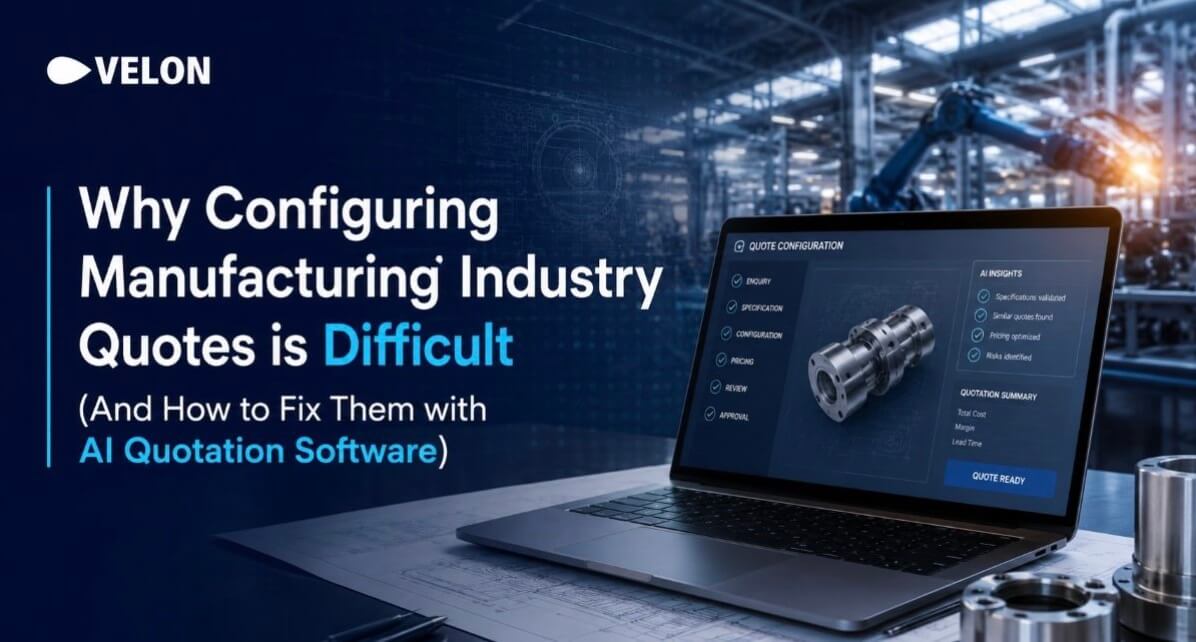
Ask any production manager how many versions a single quote went through before it landed on a customer’s desk and watch them squirm and pause before they answer. Three revisions? Sometimes five? More than that? Each one triggered by a question that should have been answered hours earlier: does this material actually meet spec, does the margin still hold at this configuration, has anyone checked the drawing against the Bill of Materials? None of this happens because people are careless. It happens because the modern manufacturing quote has quietly become one of the most complex documents a business produces, and the tools built to manage it were designed for a much simpler industry.
Manufacturing industry quotes were never simple, but they used to be simpler. Fewer variants, fewer customisations, fewer ways for a number to go wrong. As product ranges expanded and customers demanded more tailored solutions, the humble quote became one of the most complicated documents a business produces, built from engineering judgement, historical pricing, supplier costs and no small amount of institutional memory. When that memory lives only in a handful of experienced heads, the whole business becomes fragile the day one of them takes a day off.
This is where AI quoting and AI quotation software like Velon® enters the conversation, though not in the way the more excitable corners of the internet describe it and might have you believe.
Let’s dive into a full explanation.
No Time for the Full Article? – Here’s the Snapshot on How Configuring Complex Manufacturing Quotes is Easier and More Profitable
Manufacturing quotes have grown far more complex, and traditional CPQ tools weren’t built for that complexity. AI-first quoting software, like Velon®, closes that gap by supporting human expertise rather than replacing it
- ✅ AI-first, not AI-native: humans still confirm the drawing, decide the configuration and set the pricing guardrails
- ✅ Faster, more accurate quotes: automated RFQ processing, spec checking and pricing consistency across every quote. With AI-based price guidance, consistent pricing or margin thresholds and pricing rules are applied to ensure quotes remain profitable
- ✅ RFQs (Requests for Quotes) and BOMs (Bills of Materials) get processed and validated automatically, cutting hours to minutes.
- ✅ Unfamiliar configurations get flagged, not guessed at, keeping the process fully explainable
- ✅ Every function stays aligned: product, engineering, finance, sales and operations work from one shared truth
- ✅ Real ROI: businesses typically see improvements within weeks, with strong returns building over the first year
Read on for the full breakdown of why AI-first quoting is becoming a competitive necessity.
AI-First, Not AI-Native: The Distinction That Actually Matters
There are two very different philosophies wearing the same “AI CPQ” badge, and the difference between them is the difference between genuine transformation and genuine risk.
An AI-native approach imagines a world where algorithms run the quoting process end to end, humans reduced to a rubber stamp on the way out the door. It sounds impressive in a pitch deck. It sounds considerably less impressive when a hallucinated material specification reaches the shop floor.
An AI-first approach takes the opposite view. It treats artificial intelligence as a formidable assistant (for example, AI-assisted enquiry interpretation) to the people who already understand the business, rather than a replacement for their judgement. It reads the drawing, but the engineer confirms it. It suggests the configuration, but the salesperson decides. It flags the pricing risk, but the finance leader sets the guardrail. Everything speeds up. Nothing slips through unsupervised.
This is the version of AI quoting worth building a business around, and it is the version underpinning genuinely useful Quote Automation Software today.
What an AI-based Quote Configuration Platform Actually Does
Strip away the marketing language, and a properly built AI-based quote configuration platform earns its place by solving specific, well understood problems:
- Reading technical drawings and specifications to catch discrepancies before they reach production
- Processing Requests for Quotations (RFQs) and Bills of Materials automatically, regardless of the format they arrive in
- Surfacing historical quotes and engineering decisions the moment a similar job appears
- Applying consistent pricing guardrails so margin protection does not depend on who happens to be holding the pen that day
- Recommending manufacturing routing and sequencing based on real historical data, not optimistic guesswork
None of this requires imagining a science fiction future. It requires imagining Tuesday afternoon, when an estimator would otherwise spend three hours cross referencing a supplier catalogue that a well-built Quotation AI tool can search in seconds.
Quoting AI as the Decision Layer, Not the Decision Maker
Here is a distinction worth sitting with. A quotation software quote built on solid Configure – Price – Quote (CPQ) foundations brings structure. Quoting AI built on those same foundations brings intelligence, but only when it is designed to sit alongside human expertise rather than instead of it.
Think of it as a highly capable colleague who never forgets a detail, never gets tired of checking a specification twice, and never resents being asked to do it a third time. That colleague does not replace the engineer, the estimator or the finance leader. It simply removes the tedious, error prone parts of their day so they can spend their energy where it actually matters: on judgement, relationships and strategy.
An AI quote maker built this way earns trust precisely because it does not overreach. It offers a recommendation. A person decides. The paper trail behind that decision remains fully explainable, which matters enormously the day an auditor, a regulator or simply a curious CFO asks how a particular price was reached. With AI-based price guidance, consistent pricing or margin thresholds and pricing rules are applied to ensure quotes remain profitable.
Quote Execution Is the Real Competitive Advantage
There is a temptation, understandable but ultimately misplaced, to believe that competitive advantage in pricing comes from designing something clever. A new pricing model. A new discounting structure. A more sophisticated margin formula.
The harder truth is this: the challenge was never designing the pricing strategy. The challenge has always been executing it, consistently, across every function that touches a quote;
- Product defines what can be sold
- Engineering confirms what can actually be built
- Finance models what it will genuinely cost
- Sales communicates why it is worth the price
- Operations ties the whole thing together
When any one of those functions works from a different version of the truth, friction appears immediately: delayed quotes, manual workarounds, inconsistent pricing, and margin quietly leaking away without anyone quite noticing until the quarter end review. This is precisely why pricing has stopped being a one-off project for many manufacturers, and started becoming an operating capability, something tested, scaled and refined continuously rather than set once and left alone.
An AI-first quoting platform earns its keep here too, not by inventing a smarter pricing model, but by making the existing one executable, quote after quote, without depending on heroics from whichever estimator happens to be at their desk that day.
What’s more, most organisations notice improvements in quote turnaround and configuration accuracy within the first few weeks of adopting AI CPQ software, since these gains come from automating existing bottlenecks rather than waiting on new behaviours to form, and businesses can typically expect a tenfold return on investment within the first twelve months, rising to a twentyfold return thereafter.
The Practical Payoff for Every Person in the Room
For a finance leader, this means quotes that respect the margin guardrails the business already agreed to, before they ever reach a customer.
For an operations manager, it means fewer surprises between what sales promised and what production can actually deliver.
For a sales leader, it means quoting with the confidence of the most experienced person in the building, even for a newer team member three months into the job.
For a CEO or marketing leader, it means a quoting process that reflects well on the business every single time, rather than only on its best days.
This is the philosophy behind pricing-infused CPQ platforms such as Velon®, where AI capability sits genuinely alongside pricing intelligence rather than as a replacement for it. The result is not a system promising to think on your behalf. It is a system built to remove the friction so your people can do what only they can do.
Start a conversation with us today to uncover the gaps in your quotation and sales strategy execution and learn how to give your people the tech they need to succeed.
Frequently Asked Questions on AI Quoting for Manufacturers
How do finance leaders maintain oversight once AI starts contributing to quote pricing?
+
Every AI-generated recommendation remains subject to the pricing guardrails and approval thresholds finance already sets, so oversight is strengthened rather than reduced. Finance leaders typically gain more visibility into how a price was reached, not less.
Is switching to AI-supported quoting a large disruption to existing sales workflows?
+
Properly implemented, it should feel more like removing a bottleneck than introducing a new system. Sales teams generally keep the same relationships and judgement calls, simply with far less manual chasing behind the scenes.
What happens when an AI quoting tool encounters a configuration it has never seen before?
+
A well-designed AI-first platform flags the unfamiliar configuration for human review rather than guessing, which is precisely the safeguard that separates AI-first thinking from AI-native overreach.
How should a business measure whether its quoting AI is working?
+
Turnaround time, quote accuracy and margin consistency are the three metrics worth tracking first, since improvements in all three tend to appear early and are simple to verify against historical performance.