
How CPQ Ensures Manufacturability and Production Feasibility
Sometimes, your B2B sales team can be guilty of popping the champagne corks too early upon closing a significant deal. There can be backslapping, congratulations, maybe even a celebratory email from the CEO. And then, quietly, almost apologetically, a leader from Finance, Operations or the Production team might put asks the question that drains the colour from the room:
“Can we actually make this?”
That question, arriving after the commitment has been made, is one of the most expensive sentences in manufacturing. It triggers rework, rushed procurement, missed delivery windows and, in the worst cases, damaged customer relationships that take years to rebuild.
The solution is not to slow down sales. The solution is to move manufacturability upstream, so that question is answered before the quote ever leaves the building.
That is precisely what intelligent, pricing-embedded CPQ (Configure, Price, Quote) software like Velon® is designed to do.
The Key Takeaways on Manufacturability and Manufacturing Feasibility
Modern manufacturing businesses lose margin and miss delivery windows not because sales teams move too fast, but because production feasibility is checked too late.
Pricing-embedded CPQ software solves this by moving manufacturability upstream, into the quote itself, so every commercial commitment is operationally grounded before it reaches the customer.
The Key Takeaways:
- ✅ CPQ generates dynamic Bills of Materials and checks production capacity in real time, at the point of quote, not after contract signature
- ✅ Finance Leaders gain margin protection
- ✅ Operations and Production Managers gain predictable, disruption-free workflows
- ✅ Pricing-embedded CPQ Software moves manufacturability and production feasibility upstream and included as an integral part of the quoting process
- ✅ Your Sales Team quotes only on what can be manufactured at the correct price point
Read on to learn more.
Manufacturing Feasibility: The Problem with Promising First and Checking Later
Complex manufacturing and distribution businesses operate in environments where the gap between what sales commits to and what operations can deliver is not just a process inconvenience. It is a structural risk.
Consider what that gap between sales commitment and operational delivery can actually cost:
- Expedited raw material procurement that obliterates margin
- Production line disruptions caused by orders that were never properly capacity-checked
- Delivery delays that trigger penalty clauses or, worse, customer churn
- Finance teams left reconciling quotes that bore no resemblance to actual cost structures
The traditional quoting model treats configuration, costing and production feasibility as sequential steps. Sales quotes first. Operations reviews second. Finance cleans up the mess third. By the time a feasibility problem surfaces, it is embedded in a commitment that many businesses find themselves unable to easily unwind.
How CPQ Moves Manufacturability Into the Quote Itself
The most important shift that quality CPQ software makes is structural. Rather than treating manufacturing feasibility as a downstream validation step, it embeds that intelligence at the point of quote.
Here is what that looks like in practice:
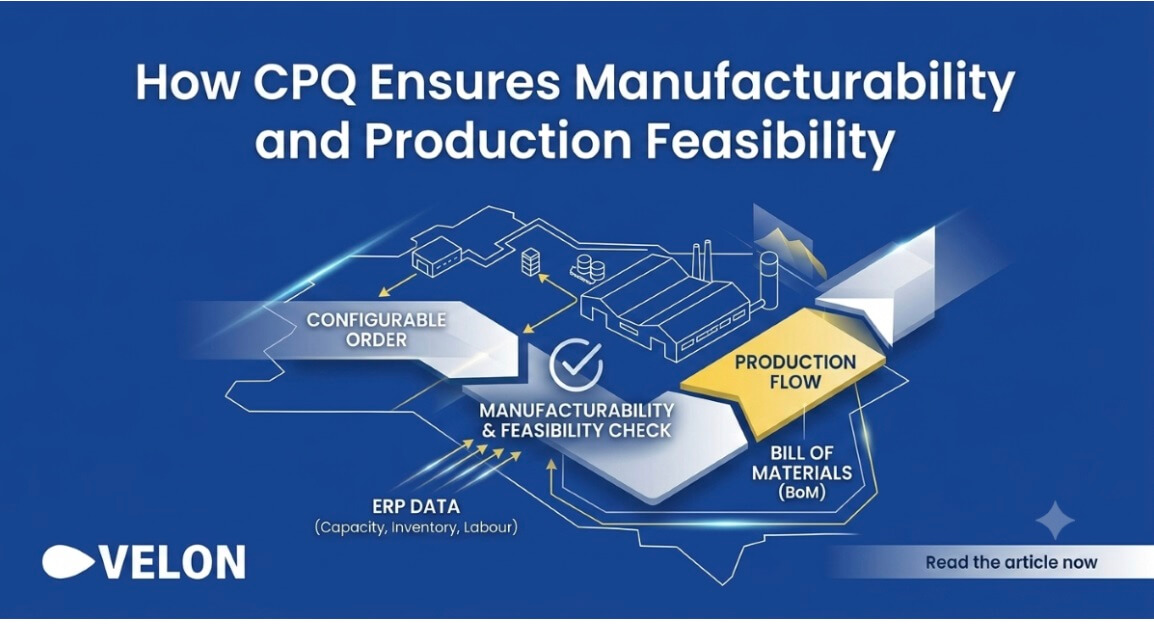
- Live capacity modelling at the quoting stage: Before a quote is finalised, the system evaluates the proposed configuration against actual plant capacity, current inventory levels, labour availability and production throughput data drawn from connected ERP systems.
- Constraint-based configuration rules: Only valid, producible product combinations are permitted. If a configuration would create a downstream bottleneck or require components outside current supply parameters, the system flags it or prevents it from proceeding.
- Dynamic Bill of Materials generation: Rather than creating the BoM after the deal is signed, CPQ generates it as part of the quote itself, giving production teams the full material picture before any commitment is made.
- Real-time cost calculation across materials, labour and overhead: Every configuration is costed against current data, not last quarter’s spreadsheet assumptions.
The result is that every quote that reaches a customer is not just commercially sound. It is operationally deliverable.
The Operational and Financial Case for Production-Aware Quoting
For Operations Managers, the value of CPQ moving manufacturability upstream is direct and measurable. Fewer orders arrive on the production floor as surprises. Material requirements are known earlier. Scheduling is predictable rather than reactive. The firefighting that consumes so much operational energy diminishes significantly when the root cause, which is commitments made without feasibility checks, is eliminated at source.
For Finance Leaders, the picture is equally compelling. Margin leakage in manufacturing businesses rarely announces itself dramatically. It seeps out through expedited freight, overtime costs, unplanned subcontracting and the quiet commercial concessions made to customers when deliveries slip. CPQ addresses margin risk not by restricting sales, but by ensuring that every deal the business commits to is one the business can actually fulfil at the margin it was priced to achieve.
For Production Managers, the transformation is perhaps the most tangible of all. When the Bill of Materials is generated at the point of quote rather than after contract signature, production planning begins from a position of clarity rather than catch-up. Lead times become realistic. Material procurement aligns with actual order pipelines. The chaotic scramble that so often characterises the handover from sales to production is replaced by a clean, structured workflow.
Why AI-Powered Pricing Intelligence Makes This Even More Powerful
There is a dimension to this that moves beyond process improvement alone.
As AI-driven pricing and revenue tools become more sophisticated and embedded into B2B quotation tools, they create a new and important risk for manufacturing businesses. Autonomous revenue execution, where AI recommends and optimises deals at speed, is only commercially beneficial when the operational systems behind it can answer four fundamental questions:
- Is this feasible to produce, given current constraints?
- What is the realistic lead time?
- What is the true cost, including materials, labour and overhead?
- What is the capacity and delivery risk?
Without a pricing-embedded CPQ platform capable of supplying those answers in real time, AI-powered revenue tools optimise deals that the operations team simply cannot deliver. The commercial intelligence outpaces the operational intelligence, and the business is left holding commitments it cannot honour.
This is where solutions like Velon®, which integrate pricing intelligence directly into the CPQ workflow rather than treating pricing and quoting as separate tools, demonstrate a meaningfully different capability. The pricing engine and the feasibility layer speak the same language, using the same data, at the same moment in the commercial process.
From Fragmented Planning to Feasible Quoting
The shift from traditional quoting to production-aware CPQ is not a marginal efficiency gain. It is a structural change in how a manufacturing business connects its commercial promises to its operational reality.
Done well, it delivers:
- Shorter sales cycles, because configuration and feasibility are resolved at the quoting stage rather than revisited afterwards
- Stronger margin protection, because cost and capacity are calculated in real time rather than estimated after the fact
- More predictable production planning, because the Bill of Materials exists before the order is confirmed
- A healthier relationship between sales, finance and operations, because all three are working from the same validated data
The question that once drained the colour from your sales floor need never arrive late again. With the right CPQ software in place, it is answered before anyone picks up the phone. The gap between knowing this and fixing it is smaller than you think. To find out how small that gap can be, start a conversation with us here.
Frequently Asked Questions on Manufacturability and Manufacturing Feasibility
Can CPQ software integrate with our existing ERP systems, or does it require us to replace our current infrastructure?
+
Quality CPQ platforms are designed to sit between your CRM and ERP rather than replace either. They pull live data from your existing systems, including inventory, labour capacity and production throughput, so the feasibility intelligence they provide is always current. Implementation typically involves integration work rather than a wholesale infrastructure change.
How does CPQ handle highly customised or bespoke product configurations that fall outside standard parameters?
+
Constraint-based configuration engines within CPQ software allow businesses to define the boundaries of what is producible, including exceptions and edge cases. Where a configuration genuinely falls outside current capability, the system flags it for engineering review rather than allowing it to proceed unchecked, ensuring that unusual orders receive appropriate scrutiny before commitment.
What is the realistic timeline for seeing measurable ROI after implementing CPQ software?
+
This varies with business complexity and the scale of integration required, but manufacturing businesses that replace spreadsheet-based quoting with CPQ consistently report faster quote cycle times and reduced post-sale rework within the first two quarters. Margin improvements often follow as pricing consistency and cost visibility improve across the full deal pipeline.
How does CPQ support businesses that sell through distributors or partner networks as well as direct?
+
Modern CPQ platforms extend feasibility and pricing governance beyond the internal sales team through partner portals. Distributors configure and quote using the same rules as internal teams, ensuring that capacity constraints and pricing corridors apply consistently across every channel, not just deals handled in-house.