
Forget the Chatbot: Why Pricing Strategy is AI CPQ Software’s Superpower
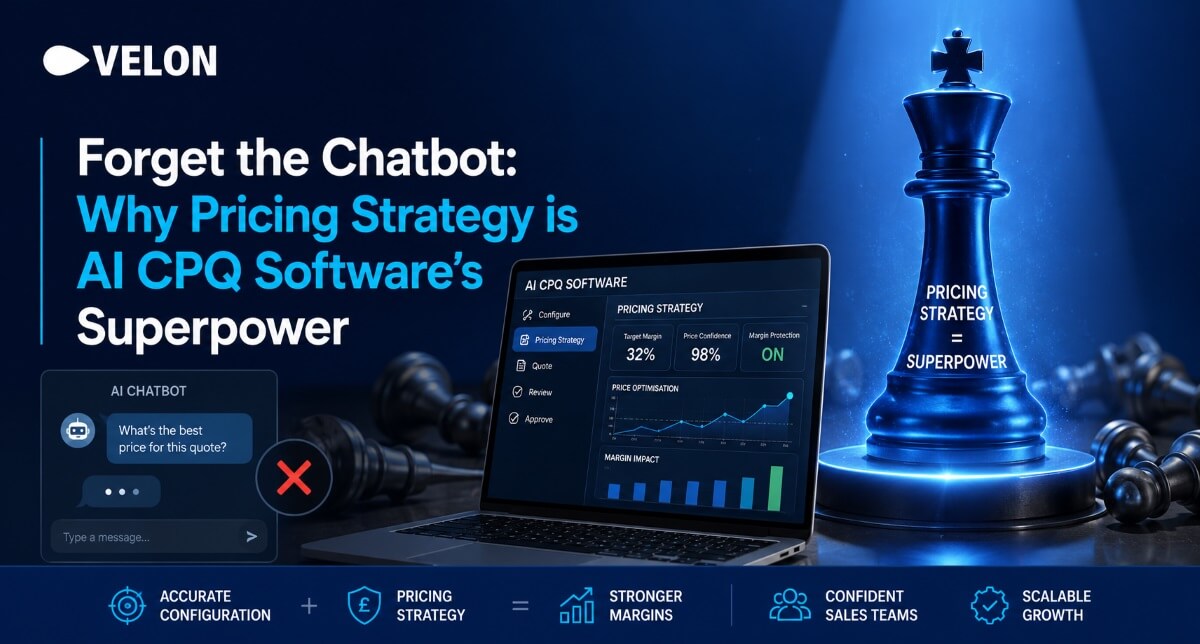
Every “AI for CPQ” launch this year seems to arrive wearing the same costume. A chatbot sits inside the quoting tool, a sales rep types a question, and a configured quote appears faster than it would have done manually. It can be impressive on a demo stage. It can also be a case of ‘style’ over ‘substance and may potentially be considerably less impressive once you ask the question that matters for a mid-sized B2B manufacturer watching its margins closely.
Building the quote was never the hardest part (although the never-ending liaison between engineering and sales and manually spreadsheeted price lists could really hinder getting it out the door and in the hands of the customer quickly). Making sure the quote made your business was always rightly the chief concern.
What has genuinely changed is what AI now layers on top of that foundation, and what that foundation now makes possible. RFQs and Bills of Materials get processed and checked automatically, turning what once took hours into a matter of minutes, while specifications are verified and pricing stays consistent on every single quote rather than drifting from one estimator to the next. Unusual configurations no longer get assumed or guessed at, they get flagged for a proper human review, which keeps the whole process fully transparent. Product, engineering, finance, sales and operations all draw on the same information at the same time, rather than five slightly different versions of the truth passed along by email.
That accuracy and consistency that AI CPQ Software like Velon® makes possible is precisely what allows a genuine pricing strategy to hold, quote after quote, without quietly leaking margin somewhere nobody is watching.
For mid-level B2B companies in particular, that combination is what finally makes margin erosion something you can eliminate rather than simply massage or manage, and it is what lets a business scale faster without scaling its risk alongside it.
No Time to Read the Full Article? Here’s 6 Key Things You Need to Know to Stress Test AI CPQ Software for Pricing
- ✅ Configuration speed alone is table stakes now, not a competitive advantage worth chasing on its own with an AI Agent
- ✅ Accurate, AI-verified configuration data is what allows pricing strategy to hold firm on every quote
- ✅ AI-based price guidance applies steady margin thresholds and pricing rules so quotes stay consistently profitable
- ✅ Margin erosion, the quiet loss most mid-level companies never fully see, can be genuinely eliminated rather than merely managed
- ✅ Sales teams gain the confidence to move quickly, knowing every price already sits within agreed boundaries
- ✅ For mid-sized B2B companies, configuration accuracy and pricing intelligence working together is what lets the business scale faster
Read on for the full breakdown.
The AI Chatbot Was Never Going to Be the Hard Part
There is a reason nearly every recent AI CPQ launch looks so similar. A conversational assistant that helps a rep move through quote configuration steps a little faster is a genuinely achievable engineering task. It may demo beautifully. It also solves a problem that, for most manufacturers, was never the one keeping finance leaders awake at night.
Configuring a product correctly matters enormously and getting it wrong can cause real revenue and margin erosion damage further down the line. But configuration accuracy alone answers the question of whether something can be built. On its own, it says nothing about whether it should be sold at that price, to that customer, on that day. That second question is where actual commercial risk lives, and a chatbot bolted onto a configuration engine was never designed to answer it alone.
What changes the equation entirely is when accurate configuration and pricing intelligence are built to work together rather than in isolation. Once every quote is built from verified specifications, checked BOMs and consistent product data, pricing strategy finally has something solid to stand on. Guesswork gets squeezed out of the process from both directions at once, and that is precisely where margin stops quietly disappearing.
Why Pricing Is the Real Test of AI CPQ
Here is the honest distinction worth holding onto. A CPQ system that manages configuration brings structure. An AI CPQ platform genuinely infused with pricing intelligence, built on that same accurate structure, brings strategy and grows profit, and the second only works because the first does its job properly first.
Pricing-embedded AI CPQ applies systematic guardrails to every single quote, developing floor, ceiling and target price recommendations aligned to a business’s actual profit goals rather than to whichever rule of thumb happens to be popular that quarter. It draws on historical transaction data, current cost inputs and competitive context to recommend a price that protects margin without pricing the business out of a deal it should genuinely win. None of that pricing accuracy is possible if the configuration feeding it is inconsistent, unchecked or built on data three revisions out of date.
That is the real test facing every AI CPQ launch this year. Not whether the chatbot can build a quote faster, but whether the system underneath it produces data clean enough and ensures manufacturability and production feasibility for a genuine pricing strategy to run on top of it, quote after quote, without a human having to double check the foundation every time.
What Pricing-Embedded AI CPQ Software Actually Looks Like
Strip away the marketing language, and pricing-embedded AI CPQ earns its place by solving specific, well understood commercial problems rather than promising to reinvent selling entirely.
- Consistent margin guardrails apply automatically to every quote, regardless of who built it, removing the dependency on individual pricing judgement that varies from one estimator to the next.
- Floor, ceiling and target guidance gives sales teams a defensible range to work within, rather than a single fixed price that either loses flexibility or invites unnecessary discounting.
- Approval workflows route automatically based on genuine commercial risk, so, a quote within agreed boundaries moves fast, while one that pushes against a margin threshold gets the scrutiny it needs.
- AI-assisted selling keeps pricing accurate across the ERP, the CRM and the CPQ platform itself, so a cost change upstream reflects correctly in every quote downstream, rather than being caught three weeks later in a reconciliation nobody enjoys.
- Commercial analytics turns every quote into a data point, sharpening future pricing recommendations as real outcomes, wins, losses and margin performance, feed back into the system over time.
Every one of those capabilities depends on the same thing: configuration data accurate enough to trust. That is the quiet dependency most AI CPQ launches skip past on their way to the chatbot demo.
Why Smart Pricing Strategy Matters More for Mid-Level B2B Companies
Large enterprises typically have dedicated pricing analysts, finance business partners and enough deal volume to smooth out the occasional pricing mistake. Mid-sized B2B manufacturers and distributors rarely have that luxury. Pricing decisions often sit with the same sales team responsible for closing the deal or maybe the product team incentives to grow volumes, which creates an obvious and entirely human tension between winning the business and protecting the margin.
Pricing-embedded AI CPQ resolves that tension without asking anyone to choose one priority over the other.
Sales teams gain the confidence to move quickly, because every price they offer already sits within boundaries the business has sanctioned in advance.
Finance leaders retain full oversight of discounting and approvals without becoming the bottleneck that slows every deal down. And because configuration and pricing are working from the same accurate foundation, margin erosion, the small, repeated losses that rarely show up until quarter end, finally becomes something a business can eliminate rather than simply try to manage after the fact.
This is precisely why holistic AI CPQ, configuration and pricing intelligence working together rather than one bolted onto the other, tends to matter disproportionately more for mid-level companies than for their larger competitors. It is not a convenience. It is very often the difference between growth that protects margin and growth that quietly gives it away, one slightly generous quote at a time. And it is what allows a mid-sized business to scale its quoting volume without scaling its exposure alongside it.
Configuration Plus Pricing: The Combination That Actually Changes the Business
None of this is an argument against configuration tools, or against the genuine value of drawing intelligence, RFQ automation and BOM validation covered in earlier pieces on this topic. Those capabilities remain genuinely useful, and they solve real operational friction.
The point is that their value multiplies considerably once pricing intelligence is built directly on top of them, rather than treated as a separate exercise altogether.
Configuration without pricing intelligence produces quotes faster. Configuration built to feed pricing intelligence produces quotes that are faster, more accurate and reliably profitable, all at once, because the accuracy of one is what makes the strategy of the other genuinely trustworthy. That combination is what turns AI CPQ from a productivity tool into a genuine margin and revenue lever, which is a considerably higher bar than most current launches are clearing.
This is exactly the philosophy behind pricing-infused CPQ platforms such as Velon®, where configuration accuracy and pricing intelligence sit alongside each other by design. The pricing engine continuously refines its recommendations using real transaction data drawn from properly validated quotes, and those recommendations flow directly back into the quoting process itself. Sales teams are not simply operating within rules. They are operating with evidence, on every single quote, built on a foundation solid enough to trust.
Frequently Asked Questions on Pricing-Embedded AI CPQ Software
What is pricing-embedded AI CPQ?
+
It is CPQ software where AI-driven pricing guidance, including floor, ceiling and target recommendations, is built directly on top of accurate, AI-verified configuration data, rather than existing as a separate pricing exercise layered on afterwards.
Why isn't faster configuration enough on its own?
+
Configuration speed answers whether a product can be built correctly. Real value comes when that accurate configuration data feeds a genuine pricing strategy, which is where margin protection and consistency happen.
Why does pricing-embedded AI CPQ matter more for mid-sized B2B companies specifically?
+
Mid-level companies rarely have dedicated pricing teams to catch inconsistent quotes, so pricing decisions often fall to the same salespeople responsible for winning the deal. Embedded pricing intelligence removes that tension without slowing sales down.
Can margin erosion genuinely be eliminated, not just reduced?
+
When configuration data is accurate and consistent, and pricing guardrails apply automatically to every quote, the small, repeated pricing inconsistencies that cause margin erosion have nowhere left to hide, which is what allows businesses to move from managing the problem to removing it. Strong ROI of typically builds over the first twelve months. Expect a 10x return on investment in the first 12 months, followed by a 20x return after that or check out our free ROI calculator to calculate your company’s unique potential benefits.
How quickly can a mid-sized manufacturer expect to see margin improvement?
+
Most businesses notice more consistent pricing and fewer underpriced quotes within the first few weeks, since these gains come from applying existing guardrails automatically rather than requiring a change in team behaviour.